Sociale cohesie in dorpen

Rurale Sociologie heeft onderzoek gedaan naar sociale cohesie in de Overijsselse dorpen Lierderholthuis en Wesepe. Het onderzoek is verricht op verzoek van het Katholiek Centrum voor Welzijnsbevordering Overijssel. De resultaten zijn afgelopen weken besproken met dorpsbewoners.Saamhorigheid en een rijk verenigingsleven, dat zijn de kenmerken die de ondervraagden noemden als hen gevraagd werd naar de identiteit van hun dorp. Het zijn de traditionele ideeën over het dorpsleven. Toch blijkt een mythe over de sociale verbondenheid niet houdbaar: of mensen oorspronkelijk bewoner zijn of import, dat maakt weinig uit voor sociale verbondenheid en deelname aan het verenigingsleven. Wel telt de duur van het verblijf in het dorp. Doordat we met z’n allen steeds mobieler zijn geworden, hebben steeds meer mensen uitgebreide sociale contacten buiten het dorp, familie, vrienden, kennissen, noem maar op. Maar dat blijkt geen invloed te hebben op de sociale cohesie: alle werk- en privécontacten elders gaan niet ten koste van de identiteit als dorpsbewoner. Veel mensen die elders een rijk sociaal leven hebben, zetten zich maar wat graag in voor hun dorp. Een opvallende bevinding van de onderzoekers is dat vrouwen zich vaak iets minder gewaardeerd voelen dan mannen. Daarnaast kunnen de vrouwen de sociale cohesie beter en uitgebreider benoemen. Een hypothese hierover zou nader getoetst kunnen worden: misschien staan vrouwen wat minder in de picture, is hun inzet meer verscholen. Ook bleek uit het onderzoek dat ouderen zich om verschillende redenen lijken terug te trekken uit het dorpsleven. Naar aanleiding van het onderzoek gaan verschillende organisaties zich in de toekomst specifieker richten op de rol van ouderen en de ondersteuning van vrouwenactiviteiten. Ook gaan dorpsbewoners na op welke manieren bijvoorbeeld vrouwen en ouderen beter bereikt kunnen worden via het (nog te verbouwen) dorpshuis. Na de zomer worden de eindresultaten gepresenteerd tijdens een conferentie. Voor meer info: Don Weenink, don.weenink@wur.nl.

Het onderzoek is verricht samen met de Wetenschapswinkel van Wageningen Universiteit en andere organisaties betrokken bij het Overijsselse opbouw- en vormingswerk zoals VariyaZijactief Overijssel, PKN.  Zie ook de scriptie van Irna Hofman over dit onderzoek.
Excursions Understanding Rural Development

As a part off the course Understanding Rural Development (RSO 31806) we went on a field trip to de Eemlandhoeve in Bunschoten and explored the inner-city of Utrecht. By this excursion we visited a number of interesting expressions of urban-rural relationships, from a rural and an urban perspective.

De Eemlandhoeve

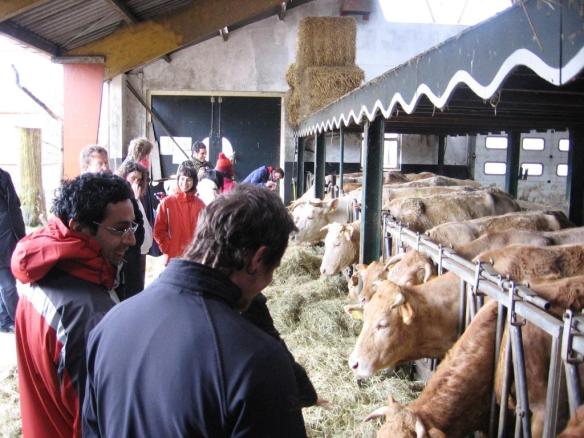
De Eemlandhoeve, owned by farmer, rural entrepreneur and philosopher Jan Huijgen, can be considered as an extreme example of a multifunctional farm enterprise. The group of Blonde d’Aquitaine’s form the centre of a rural enterprise which includes a large number of activities like a farm shop, care facilities, meeting and office facilities, an education garden and even a farmer’s cinema under construction.Blonde d'Aquitaines at the Eemlandhoeve

Next of being a multifunctional entrepreneur Jan Huijgen is a well known personality in Dutch rural development, active on a local, national, international (and maybe in the near future on a global) level. The farm residents a rural innovation centre and last October de Eemlandhoeve hosted the EEconference or Europese Eemlandconference, veelzijdig platteland.

On the excursion owner Jan Huijgen told us about his inspiration, motives and future plans with his farm. After his presentation we had an interesting discussion and were showed around the place.

Local food in the city of Utrecht

The second trip brought us to a rather different surrounding; the historical inner-city of Utrecht. On de Eemlandhoeve our focus was on the rural side of urban-rural relationships, in Utrecht we looked upon it from an urban perspective.

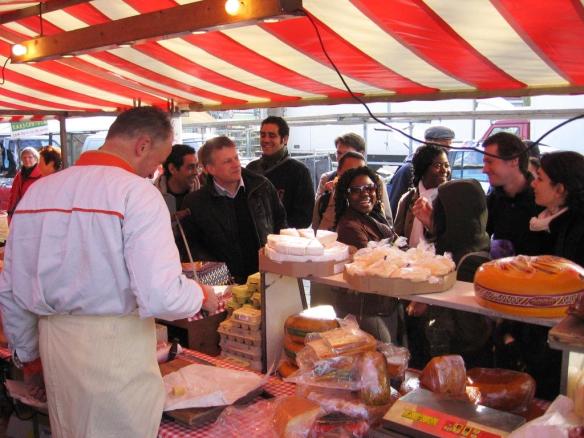
Cheese stall at the Vredenburg MarketTogether with our guide Frank Verhoeven (see his website)  we first went to the Wednesday Vredenburg Market. On this market we visited a cheese seller linked to the organization called Dutch Cheese Centre (website under construction). The stallholder told us about some typical Dutch cheeses and the trade in locally produced ones. After some tasting we set out for the traditional bakery Bakkerij Blom were owner Theo Blom showed us around and told about his bakery, traditional products and production.  

Our last stop was a visit to the five star hotel and restaurant Karel V for a number of short presentations. In the hotel our guide Frank Verhoeven started by telling us about his ‘Boerenbox’ initiative and his vision on a more locally based production and consumption. Secondly, one of the Karel V chefs explained us about the way they work with seasonal products originating solely from regional grounds and local suppliers. Lastly, Arie Bosma, one of the initiators of the campaign ‘Lekker Utregs’, told us about the initiative to reconnect the city of Utrecht with its surrounding countryside by establishing a so called Green Participation Society.

By the fieldtrips we got acquainted with several interesting expressions of urban-rural relationships, from a rural and an urban perspective. It was a nice and inspiring way of linking theory from class to reality by ‘tasting’ real life examples in ‘the field’.

Drivers of sustainable food networks

Today the Limburg Chamber of Commerce hosted the first day of the provincial tour of the Foundation Urgenda, a foundation aimed at innovation and sustainability. Members of Urgenda are spending 3 days in the province of Limburg to visit a range of iniatives about sustainable regional development. I was asked by the Limburg Chamber of Commerce to give a lecture about the role of food in sustainable regional development. In my lecture I first explained the unsustainability of the prevailing food regime as it has resulted in a wide variety of problems, such as the obesity epidemic, malnutrition among the elderly and poor, and environmental impact due to food waste and food transport. I then presented and discussed several examples of sustainable food networks (in different stages of development) that are (potentially) capable of addressing one or more of the problems just mentioned. Examples discussed were for Continue reading

Kick-off new EU-research project – DERREG

derreg_logo2Last week we had a kick-off meeting of the DERREG research project in Brussels. DERREG is the acronym for  ‘Developing Europe’s Rural Regions in the Era of Globalization’.  The project will last for three years and involves 9 partners from 8 EU-countries and 10 case-study-areas.  Aim is to study how, especially disadvantaged regions respond to key-challenges arising from globalization. Focus is on rural business, migration, sustainable development and capacity building.

The Rural Sociology Group, in my person, will coordinate a workpackage called ‘Capacity building, governance and knowlegde systems’. We will study how public policies and knowledge-infrastructure are connected to bottum up initiaves and thus facilitate regional learning. And, in the end, recommend stakeholders how this regional learning can be further improved.

Coming months we will start up research activities and soon a website will be launched with detailed information. And we will keep you posted at our blog.