Rural regional learning in the Westerkwartier (NL)

The Westerkwartier is a predominantly rural area in the province of Groningen (NL), situated between the cities of Leeuwarden and Groningen. The Westerkwartier is one of the case-study areas in the research project DERREG funded by the European Commission (see www.DERREG.eu for more info). Capacity building and governance of regional learning and innovation is one the four research task (see also previous posts on DERREG).

Last Monday, October 18, Rural Sociology Group facilitated a group discussion in the Westerkwartier. The discussion focussed on: a) how the support rural regional learning and innovation is actually arranged in the area and b) how beneficiaries evaluate the quality of the support.

DERREG Group discussion at the Hayema Heerd

17 representatives from collective (grassroot) development initiatives in the area, from local and regional government and from knowledge institutes participated in the discussion.
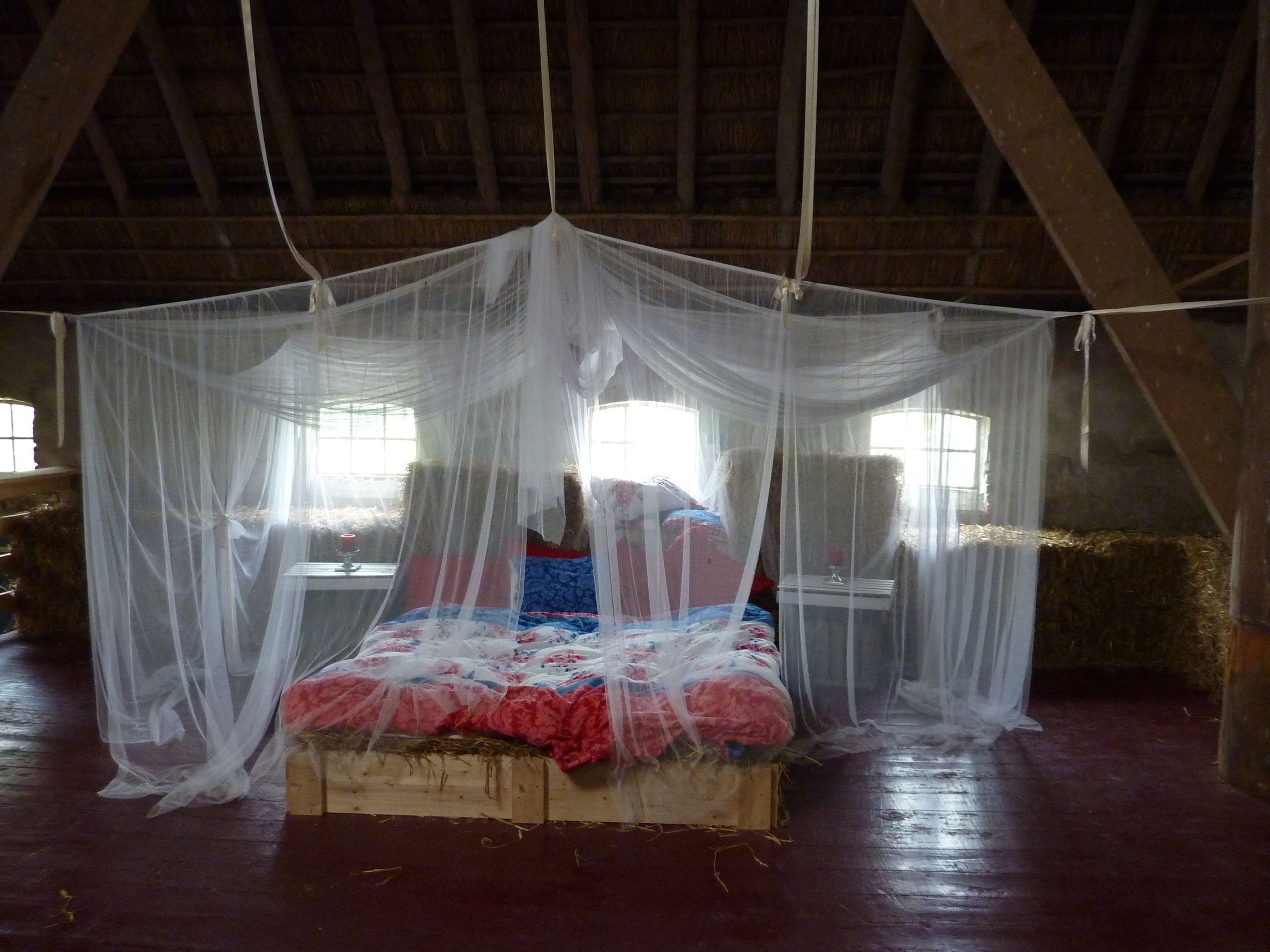
Sleeping in straw beds at Hayema Heerd

The workshop was organised at an inspiring location: the barn of the former farm Hayema Heerd in Oldehove (see www.hayemaheerd.nl), now offering citizens the special countryside experiences to sleep on straw beds. In addition Hayema Heerd also offers to learn more about real-life farming at nearby farms. this has been set up jointly with local farmers and is called In-Boeren, what refers to learning about being a farmer.
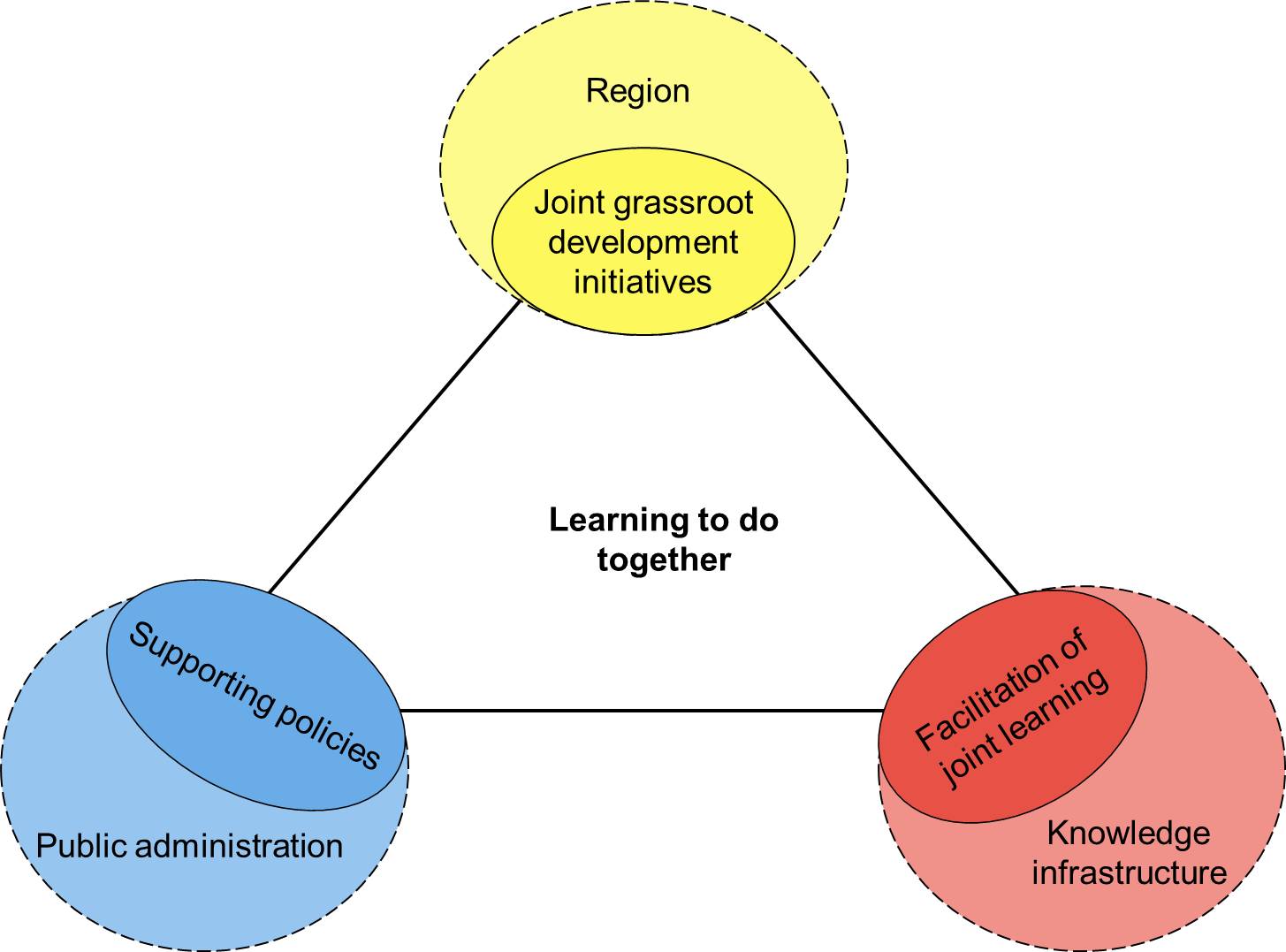
Mapping the governance of rural regional learning and innovation (Source: Wellbrock and Roep, 2010)

Other collective initiatives represented in the workshop were Wichterwest, a group of women entrepreneurs setting up their own business, and the regional Agricultural Nature Association. The collaboration and joint learning-by-doing in these networks is supported by several arrangements. These arrangements can be mapped as operational interfaces between grassroot development activities in the region, supporting public policies and learning and innovation supporting facilities in the framework of what we call a learning region (see the figure), reflecting thus a map of how the support of joint rural regional learning is actually arranged (see picture).
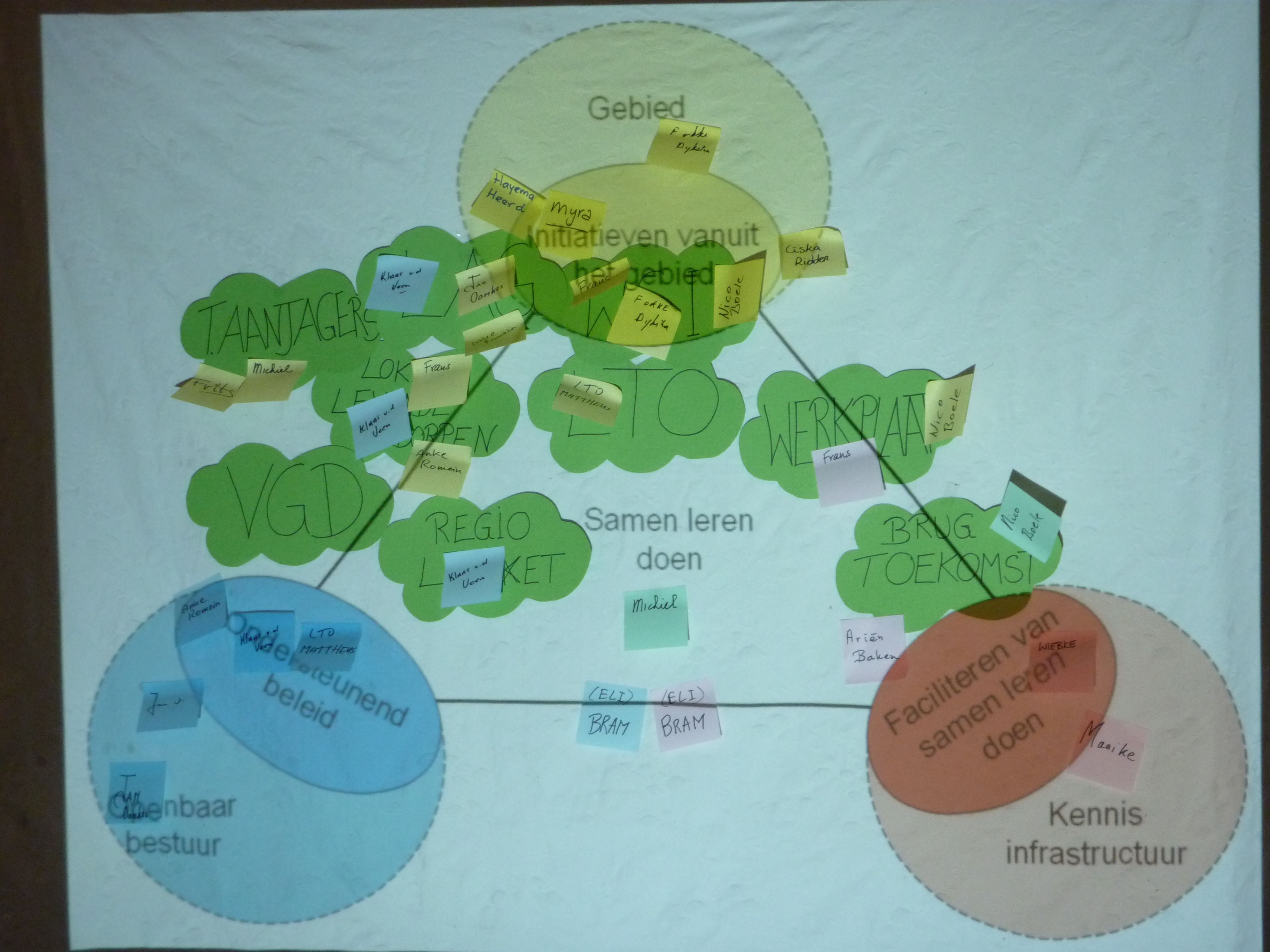
Mapping the arrangements and personal roles of the participants

Examples of arrangements operational in the Westerkwartier are:

  • The Local Action Group (Leader);
  • The Countryside House (Plattelandshuis) serving amongst others as a window for entrepreneurs and citizens with new ideas and development initiatives;
  • An Atelier, which is under construction building on previous experiences with the aim to get public funded education and research engaged on a structural base in the support of development activities in the region;
  • Three Touristic catalysts, supporting indivudual and collective initiatives of recreational entrepreneurs in the area.

The discussion made clear that these arrangements are important to channel the various types of support to individual and collective development activities: information, financial suport, expertise, feedback, maneuvring within (public) regulations, etc. Especially the Countryside House serves well as an entry to support as it lowers the threshold for initiators, a place were people from the area can meet and find themselves someone who coaches them and get them known in the unknown, complex world of numerous subsidies, regulations and networks. Continue reading →

Fez Noz and Black Cross… – Jan Schakel in Rennes – Part 5

Last week, I was asked to take part of a jury to assess  a thesis (‘memoire’), and it was a great experience. The classroom was filled up with many students (rather unusual), but that was due to the topic:  the performing arts in rural Brittany). The title of Alice Varagnat’s (the student) thesis was: “Le spectacle vivant dans le milieu rural en Ill-et-Vilaine” . Before I go into the ‘rural-urban’ aspect of her topic, it is good to mention that again I was too biased (or unaware) about this event. It was a real ‘defense’, even more then we are used to in Wageningen. There was a solid presentation, and after that, there was a real argument between the candidate and the committee (of 4 staff members, including me). Both took at least one hour. After that, the committee (likewise a real  PhD-thesis defense) went into ‘retraite’, and evaluated the thesis, presentation and defense. I was really pleased with the quantity and quality of the data, of her resources, findings, presentations, etc., but I had some serious comments on the structure of her report: there was no hypothesis, no methodology, no theoretical framework, no reflection, etc. But my comments didn’t make sense, because I was not participating a Master-thesis defense, but the ‘Memoires de fin d’études’, which  has more the character of an internship then from a scientific research project.  Again I had to find out that the degree of d’Ingénieur  is very different from a Masters degree. Alice’s thesis was not a scientific prove of competences, but a practical one: the report covers the ‘stage’, and shows that you’re able to organize your activities in a professional way. When I realized, that this was the context of her research (and findings), I was even more enthusiastic about it. So I proposed a high mark… just like the rest of the committee did. Finally her mark was a 17,5 (so almost belong to the best 5%), so really good!

The topic attracted many students. Rennes is a city with a lot of concerts and other cultural events. But also the rural area is famous because of an old British or even Celtic tradition: folk music, in bars and village halls, sometimes whole weekends or late in the evening. Festivals during the night, ‘feast at night’, so in Breton language called: ‘Fez Noz’ are very popular!  Alice’s study was on much more then jus this phenomenon of Fez Noz (she looked at cabaret, theater, dancing etc; see her report if you are interested), and the results of her empirical study were rather impressing: there is a vivid world of ‘spectacle vivant’ in the’ very’ rural Brittany (in areas far from the city). When I tried to compare these findings with my experiences in Holland, I couldn’t think about more or other things like the “Zwarte cross”(a multi performance and cultural motorcycle event), the “boeren bruiloften” (Farmers weddings) or “zuipketen” (no translation…). When I talked about this with the other members of the jury, they said they had the same idea before this project started. Part of the rural identity was the tradition of the ‘spectacle vivant’, and everybody thought it had disappeared, so the main goal of this project was to find out ‘why so’ and ‘what to do’ to restore this tradition (by means of infrastructural or economical or institutional arrangements), etc. But –to everybody’s surprise-, it turned out that there still is a rural identity in Brittany in terms of these cultural traditions. Maybe a topic for a thesis at the RSO-group in Wageningen?

Continue reading →

Second European Sustainable Food Planning Conference – a last reminder

As mentioned in one of my previous blogs the  Urban Performance Group of the University of Brighton (UK) will host the second European Sustainable Food Planning Conference on 29 and 30 October 2010 under auspices of the Association of European Schools of Planning (AESOP). Although the deadlines for submission of abstracts and selection of papers and posters have passed, there are still a few places available to attend the conference. It promises to become an interesting conference due to the diversity of disciplinary and interdisciplinary contributions and the geographical range of cases and experiences that are going to be presented. And, furthermore, it also seems to be a vary timely conference; the attention for urban agriculture, food and health, food and urban design and food governance is rapidly increasing, not only in the academic realm but also in political and societal debates.

For more information about the conference you can download the conference brochure or have a look at the conference website.

PUREFOOD research and training network

The Rural Sociology Group has been granted the coordination of a Marie Curie Initial Training Network  entitled ‘Urban, peri-urban and regional food dynamics: toward an integrated and territorial approach to food (PUREFOOD)’ funded by the European Commission’s Seventh Framework PEOPLE program. The PUREFOOD research and training programme aims to reduce the enormous knowledge and skills deficit that is negatively affecting the capacity to design and deliver appropriate political and developmental solutions in the crucial supra-disciplinary fields of food security, public food procurement, public health and sustainable urban and regional development. Hence, the objective of PUREFOOD is to train a pool of 12 early-stage researchers (ESRs) in the socio-economic and socio-spatial dynamics of the (peri-)urban and regional foodscape. The research and training program will therefore provide knowledge and innovation for the Commission’s aim to deal with economic, social and environmental policies in “mutually reinforcing ways” which reflects the core of the Lisbon and Gothenburg agenda’s call for integrated solutions towards economic prosperity, social cohesion and environmental sustainability. The PUREFOOD network is centred around food as an integrated and territorial mode of governance and studies the emergence of the (peri-)urban foodscape as an alternative (as opposed to a globalised) geography of food, including the ways in which, and the extent to which, sustainability aspects generally considered to be intrinsic to the alternative food geography are incorporated by the more conventional food companies.

The PUREFOOD Initial Training Network consists of 7  university partners who will each host one or more ESRs:

  1. Wageningen University – Rural Sociology Group (The Netherlands)
  2. Cardiff University – School of City and Regional Planning (United Kingdom)
  3. Pisa University – Department of Agronomy and Agro-ecosystem Management (Italy)
  4. Latvia University – Faculty of Social Sciences (Latvia)
  5. City University London – Centre for Food Policy (United Kingdom)
  6. Federal University of Rio Grande do Sul – Postgraduate Program in Rural Development (Brazil)
  7. Makerere University School of Public Health – Department of Community Health and Behavioural Sciences (Uganda)

In addition to these universities as full consortium partners, the PUREFOOD network consists of 8 associated partners, a combination of private firms, public authorities and civil society organisations:

  1. Peri-Urban Regions Platform Europe (PURPLE)
  2. Sustainable Agriculture Initiative (SAI) Platform
  3. Sodexo UK
  4. Willem&Drees
  5. Slow Food Study Center
  6. Stroom Den Haag
  7. Sustain – the alliance for better food and farming
  8. Tukums municipality

The associated partners will contribute to the PUREFOOD training program by contributing to courses, participating in Communities of Practice and by hosting ESRs for a secondment. The active involvement of these associated partners is also of great importance for safeguarding the practical applicability of scientific research in the commercial, public as well as civic realm and for the dissemination of results.

The seven universities have opened (or soon will open) vacancies for 12 early-stage research positions. The launch of the vacancies has been announced on this weblog. As of now the PUREFOOD vacancy brochure with information about ESR projects, eligibility criteria, contact persons for additional information and addresses for submitting applications is available. For potential prospective ESRs an information pack has been compiled with information about the PUREFOOD research and training programme, the individual ESR projects, the timeline of the project and short descriptions of the full and associated consortium partners.

Superhoogbouw en Stadstuinbouw

Woensdag 29 september was ik één van de sprekers op een bijeenkomst georganiseerd in het kader van Onderzoek ERASMUSPOORT® project over stedelijke verdichting. Onderzoek ERASMUSPOORT® is tot op heden een virtuele casus, die juist daardoor de gelegenheid biedt om allerlei nieuwe ideeën en concepten te genereren over de vraag hoe op een duurzame manier om te gaan met de stedelijke verdichtingsopgave in Nederland en tegelijkertijd de kwaliteit van de stedelijke leefomgeving substantieel te verbeteren.  Daarmee wordt dan nadrukkelijk ook of vooral de kwaliteit van de publieke ruimte bedoeld.

Als onderzoek naar een virtuele casus leent Onderzoek ERASMUSPOORT® zich voor vernieuwende vragen over maar vooral voor creatieve en onconventionele oplossingen voor duurzame superhoogbouw in Nederland – uitgevoerd middels een drietal afstudeerscripties aan de TU Eindhoven, die woensdag jl. ook werden gepresenteerd. Maar het noopt ook tot nadenken over de gevolgen van verdichting voor energiehuishouding, verkeer en vervoer, sociale cohesie, et cetera. Op woensdag 29 september stond het vraagstuk van stedelijke voedselvoorziening centraal: biedt superhoogbouw nieuwe kansen om wonen en voedselproductie ruimtelijk te combineren. En zo ja, om welke vormen van voedselproductie gaat het dan, wat zijn de voor en nadelen hiervan en hoe kan die combinatie worden gerealiseerd.

In mijn verhaal ben ik ingegaan op de sociale, economische, ecologische en gezondheidsproblemen die samenhangen met het heersende geglobaliseerde en geïndustrialiseerde voedselsysteem: obesitas, ondervoeding, achteruitgang biodiversiteit, grote sociale verschillen m.b.t. toegang tot voldoende vers voedsel, waterverbruik bij voedselproductie, strijd om land, achteruitgang bodemkwaliteit, et cetera. Voedsel als thema structureel inbedden in stedelijk ontwikkelingsbeleid, zoals met veel succes in Toronto via de Toronto Food Policy Council, is mijns inziens de enige manier om allerlei grootstedelijke problemen aan te pakken, simpelweg omdat veel van deze problemen direct of indirect met het dominante voedselsysteem samenhangen. Eén van de manieren om voedsel als thema structureel in te bedden in stedelijk ontwikkelingsbeleid is het creëren van ruimte voor stadsland- en tuinbouw, waarbij ook nadrukkelijk gebruik wordt gemaakt van de mogelijkheden die de stedelijke infrastructuur biedt. Dus naast voedselproductie in de grond (in groenstroken, voor- en achtertuinen, parken, et cetera) ook voedselproductie op daken (hetgeen goed aansluit bij Rotterdam’s groene daken programma), op balkons en in gebouwen.

Dit laatste – voedselproductie in gebouwen – was de boodschap van de spreker na mij: Gertjan Meeuws van Plantlab. Plantlab staat, naar eigen zeggen, voor een revolutie in kweken omdat

“producten in meerdere lagen worden geteeld met gebruik van LED-verlichting in volledig geconditioneerde ruimten zonder daglicht. Deze meerlagen kwekerijen staan straks dicht bij de consumenten en bieden vele voordelen zoals een hoger productieniveau met een exact voorspelbaar oogstmoment en een stuurbaar product qua uiterlijk, smaak en voedingswaarde”  (http://www.plantlab.nl/4.0/index.php/revolution-in-growing/?lang=nl).

Ik vond het een fascinerende presentatie van Gertjan Meeuws; het lijkt een bijzonder innovatieve benadering die, net als mijn ideeën over stedelijk voedselbeleid, voortkomt uit de constatering dat het huidige mondiale voedselsysteem niet duurzaam is. Een technologische oplossing bedenken om honger, watertekorten en bodemdegradatie tegen te gaan vormt het voornaamste uitgangspunt voor Plantlab’s benadering. Vooral de bewering dat productieniveaus t.o.v. de huidige productieniveaus in kassen kunnen worden verveelvoudigd met slechts 10% van het huidige waterverbruik, significante vermindering van energieverbruik en zonder gebruik te maken van chemische bestrijdingsmiddelen klinkt ronduit fantastisch. En het lijkt erop dat Plantlab een systeem heeft ontwikkeld dat zich leent voor redelijk kleinschalige tot zeer grootschalige toepassing, alhoewel met name dat laatste sterk werd benadrukt. Dat deed me teveel denken aan het agro-productiepark concept dat niet alleen qua bedrijfsmodel niet goed is doordacht, maar ook niet in staat is om burgers actief bij voedselproductie te betrekken en om voedsel in de stedelijke context als een vehikel voor andere publieke doeleinden in te zetten (zoals eductie, sociale cohesie, werkgelegenheid, stedelijke vergroening, et cetera). Dat kwam ook in de discussie naar voren na onze presentaties. Maar volgens mij hoeft het één het ander niet uit te sluiten en is het juist een uitdaging om te zien hoe Plantlab’s benadering een plaats kan krijgen in een integraal voedselbeleid voor steden die worstelen met een verdichtingsopgave. En ik ga binnenkort in op Gertjan’s uitnodiging om een kijkje te nemen bij Plantlab. Het lijk me erg leuk en leerzaam om dat te doen in de vorm van een excursie met een internationale groep MSc studenten.