
Earlier I wrote a post on the PhD-thesis ‘Selective breeding in organic dairy production’ by Wytze Nauta. The complete PhD-thesis can be downloaded at the site of the Louis Bolk Institute
Category Archives: Research
Folder Onderzoek Dynamiek en Robuustheid Multifunctionele Landbouw
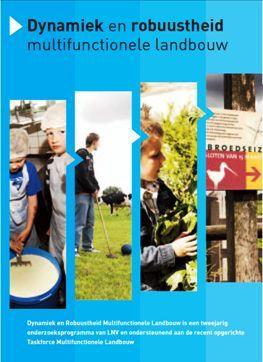 Onlangs hebben we een mooie informatiefolder gemaakt voor ons onderzoek ‘Dynamiek en Robuustheid van Multifunctionele Landbouw’. In deze folder is, naast een beknopt overzicht van de onderzoeksfasen, ook informatie te vinden over o.a. de achtergronden, doelstellingen, resultaten en partners van het project.
De folder is hier te downloaden.
Overige informatie is te vinden op ons ‘Multifunctionele Landbouw Weblog’. Op deze plek houden we u op de hoogte over de recentste ontwikkelingen en resultaten van het project.
Job opening – Assistant/Associate Professor in Food Sociology
Job description
As assistant/associate professor you will teach and coordinate Bachelor and Master courses for the Bachelor and Master programme International Development Studies (specialization Sociology of Development) and for the Master programme Food Technology (specialization Gastronomy), and supervise Bachelor and Master thesis research for these programmes. You will undertake independent research and coordinate international research projects, specifically focusing on food production and provision in metropolitan regions and its importance for sustainable regional development as well as its significance for issues of public health, rural and regional employment, environmental quality and urban-rural relationships. If you qualify for an associate professorship you are expected to coordinate the Rural Sociology Group’s research theme “Dynamics and sustainability of regional food networks”. Other aspects of the job include project acquisition, training and supervision of PhD students and participation in various research and/or education committees. Continue reading
Rural development driven by unfolding rural webs
Today the main outcomes of the EU-funded project ETUDE were presented by our colleagues Jan Douwe van der Ploeg (scientific coordinator of ETUDE), Rudolf van Broekhuizen (project-coordinator) and Henk Oostindie (senior researcher). Main finding is that neither policy, nor markets or grass root rural development activities are by itself decisive for successful rural development, but the web of different and increasingly interlinked networks. Or as Jan Douwe van der Ploeg states:
Successful rural development is rooted in a myriad of encounters, transactions, interactions and networks that link people, resources, activities and markets. (Source: E-magazine by British Publisher, pp. 64-65).
Van der Ploeg & Marsden (in ‘Some Final Reflections’, the concluding chapter in the book ‘Unfolding webs’ , p 227) refer to these rural web as emerging counter-structures:
because rural development processes (that are grounded upon and resulting from this web) are essentially transitional: they represent a major shift that takes many years to occur and which proceeds through changing conditions of invisibility and confusion. Visibility, coherence and comprehension only occur during, and as an effect of, this transition. We also refer to the rural web as a counter-structure because it increasingly helps to deal with complexity (especially Chapter 8 of this Volume), creating simultaneously new patterns of coherence. All this relates to the contested nature of rural development: what might be highly meaningful in terms of the rural web, might be insignificant or even ludicrous at the level of the dominant structure. What we are beginning to conceptually explain here, therefore, are the particular dynamic qualities (both new coherences and contestations) of web formation. These are, indeed, built out of the seeming contradiction between creating counter-structures to prevailing conditions, at the same time as re-creating new coherences out of these very deviations and ruptures.
The project has come to a closure. The findings and recommendations will soon be published in a second book. Earlier publications, such as the chapters of the first book ‘Unfolding webs’, edited by Jan Douwe van der Ploeg & Terry Marsden and published by Royal Van Gorcum, and deliverables (e.g. case study reports) can be downloaded at the ETUDE-website.
For more information on the outcomes you can contact one of the colleagues.
Kringlooplandbouw – CLM-rapport
Op de site ‘Duurzaam boer blijven‘ meldt Frank Verhoeven, zelf trekker van kringloopdenken (zie eerdere blog), het verschijnen van het CLM-rapport over kringlooplandbouw ‘Van top down naar bodem up‘ :
In dit rapport wordt, aan de hand van interviews en bronnenonderzoek, een omschrijving gegeven van kringlooplandbouw in de melkveehouderij. Daarbij wordt uitgegaan van een bedrijfsvoering waarin optimaal gebruik wordt gemaakt van op het bedrijf beschikbare en geproduceerde hulpbronnen en voorraden. Onderzoek naar en praktijkervaringen met op kringlopen gebaseerde melkveehouderij geven aan dat meer aandacht voor kringloopdenken maatschappelijk gewenst is. Daarbij wordt vooral gedacht aan certificering van kringloopmelkveehouderij, meer aandacht voor kringlopen in het agrarisch onderwijs en een uitvoerig communicatietraject richting gangbare melkveehouderij.

