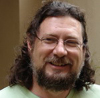
 Prof. Fabio dal Soglio from the Federal University of Rio Grande de Sul (UFRGS) is currently our guest. He is one of the professors working in the Post-Graduate Programme on Rural Development (PGDR) and he has a particular interest in agro-ecology.
The UFRGS and the PGDR-group in particular wants to extend collaboration with the Rural Sociology Group, as initiated by prof. van der Ploeg, by the exchange of staff, exchange of MSc and PhD-students and by joint research.
As part of an assignment for the MSc-course Sociology in Development, a group of MSc-students grasped the occasion and interviewed prof. Fabio dal Soglio on the Landless Workers Movement (MST) in Brazil and their struggle for land and land reforms.
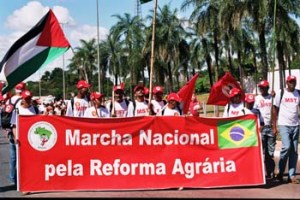 Quoted from the MST-website (English edition):
The MST is the largest social movement in Latin America with an estimated 1.5 million landless members organized in 23 out 27 states. The MST carries out long-overdue land reform in a country mired by unjust land distribution. In Brazil, 1.6% of the landowners control roughly half (46.8%) of the land on which crops could be grown. Just 3% of the population owns two-thirds of all arable lands.
Since 1985, the MST has peacefully occupied unused land where they have established cooperative farms, constructed houses, schools for children and adults and clinics, promoted indigenous cultures and a healthy and sustainable environment and gender equality. The MST has won land titles for more than 350,000 families in 2,000 settlements as a result of MST actions, and 180,000 encamped families currently await government recognition. Land occupations are rooted in the Brazilian Constitution, which says land that remains unproductive should be used for a larger social function.
The MST’s success lies in its ability to organize and educate. Members have not only managed to secure land, therefore food security for their families, but also continue to develop a sustainable socio-economic model that offers a concrete alternative to today’s globalization that puts profits before people and humanity.

 From 16 to 27 of Februari I am staying at the The Danish Institute of Rural Research and Development (IFUL) as a visiting researcher. IFUL is located in Esbjerg, at the western coast of Jutland. IFUL is an institute within the social sciences of the Southern Denmark University aimed at the development of sustainable rural areas specially focusing on business development and the population’s life condition. Whereas our group has its roots in agriculture and has broadened to rural and regional studies, this institute always had a territorial focus on rural development (working papers).
 By Sergio Schneider – Since the 1990’s discussions on rural development in Brazil are no longer associated with policies to combat poverty. From these times onwards discussions on rural development have been related to themes like environmental sustainability, land reform, policies to support small family farming and more recently, the issue of food security. The discussion on rural development in Brazil has gained strong momentum …
