Internship: Governing food sharing in Utrecht

We are looking for a research intern to conduct scientific research on food sharing and governance in the Municipality of Utrecht as part of the EU-funded project CULTIVATE. Knowledge of Dutch and experience with qualitative research methods and analysis are essential.

CULTIVATE uses a multi-actor approach to build sustainability and resilience in urban and peri-urban areas through a ground-breaking online social innovation support platform – The Food Sharing Compass. Built with and for five key stakeholder groups – food sharing initiatives, policy makers, food supply actors, researchers and citizens – the platform will make it possible to navigate diverse food sharing landscapes and cultures, in order to understand, develop, replicate, expand and strengthen sustainable food sharing in Europe. In essence, CULTIVATE will establish the EU as the global frontrunner in the development of resilient and inclusive food sharing economies, identifying drivers and implementation gaps and challenging existing theories and practices which currently constrain sustainable food sharing.

Internship description: The intern will be participating in research which aims to better understand the evolution of, and help transform, existing policies, regulatory regimes, governance structures and habits to strengthen local food sharing economies, promote sustainable food sharing and prevent and reduce food waste.

The intern will part of the Rural Sociology Group of Wageningen University but the work will be based mainly in Utrecht from September 2023 to January 2024 (4 months, full time).

For questions about the position, please contact Dr Lucie Sovova lucie.sovova@wur.nl

Generally, the intern will support the WUR Research team and other members of the CULTIVATE to collect, organize and analyse information and data to help achieve the scientific objectives of the project, develop effective task management and collaboratively work, publish and disseminate project findings.

We seek highly motivated candidates to:

  • work in an international, innovative and multistakeholder project,
  • develop qualitative research skills while working with different types of stakeholders,
  • communicate and amplify scientific, policy and innovation knowledge around food sharing in Utrecht.

Key responsibilities:

  • Follow research protocols to analyse the urban food sharing governance landscape in the city of Utrecht with special focus on food waste, social and solidarity economies, and urban agriculture with support from the research team.
  • Work closely with university researchers and the Municipality of Utrecht to identify leverage points and pathways for transformative change, using scenario and backcasting tools.
  • Support the organisation of project meetings.

Expertise/Competence/Skills:

  • Excellent Dutch and English language skills are a requirement
  • Capable of working independently and meeting deadlines
  • Proven capacity to synthetize and communicate complex ideas
  • Experience with qualitative research methods, especially interviewing is an asset
  • Experience with data collection and policy analysis is an asset
  • Experience with food sharing initiatives is an asset
  • Experience working in diverse teams is an asset

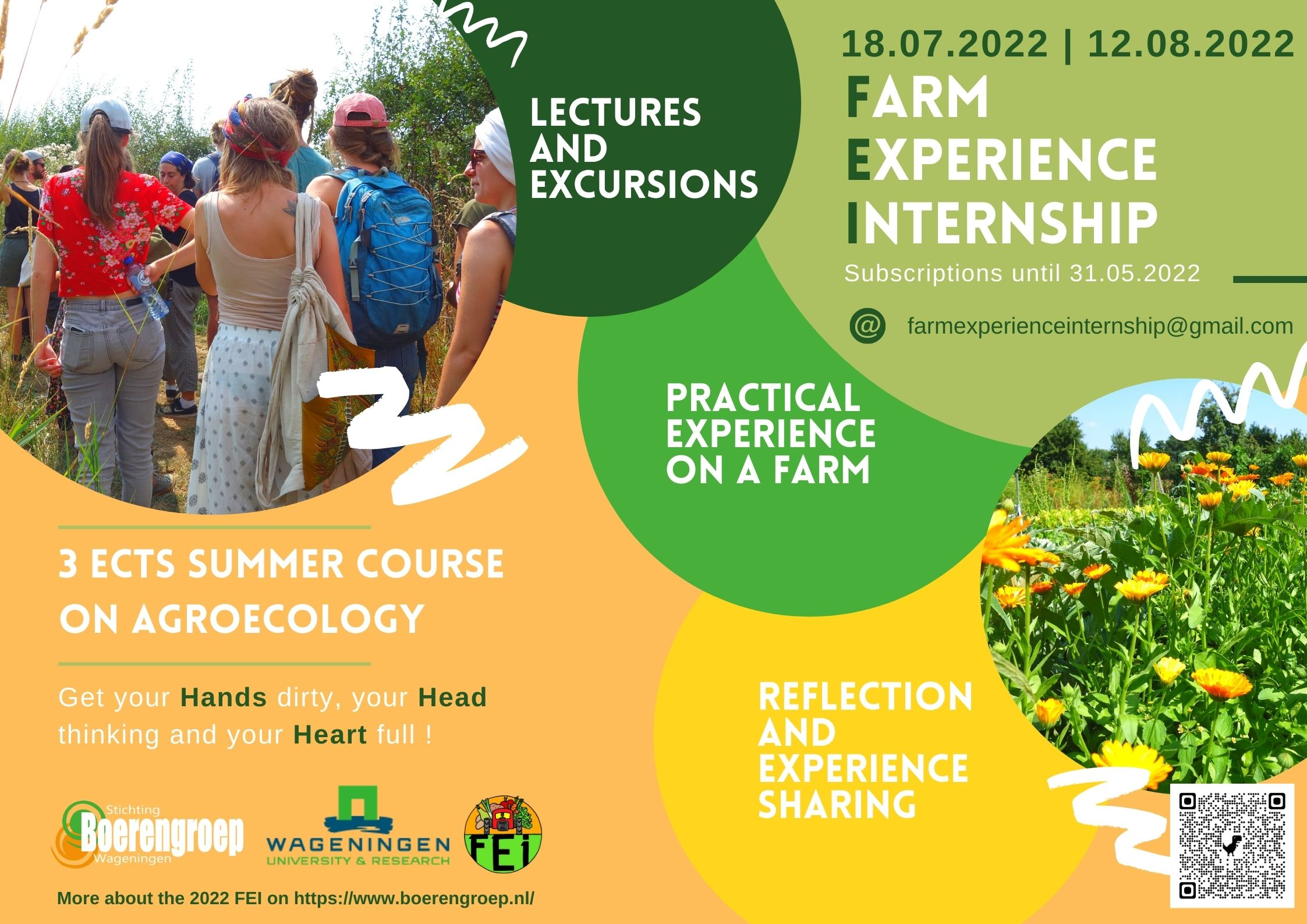
Vacancies @Boerengroep: coordinator and intern Farm Experience Internship 2023

Coordinator:
Stichting Boerengroep (Peasant Foundation) is looking for a new coordinator starting April 1, 2023. The coordinator is a spider in the web of students, farmers, interest groups and educational institutions. The coordinator initiate activities, supports initiatives of others, and maintains the Boerengroep network. More information at https://www.boerengroep.nl/vacancy-coordinator/

Intern:
Boerengroep has also a vacancy for an intern, from the end of March until the end of August 2023, to organize the coming 2023 Farm Experience Internship (FEI). The FEI is a four-week summer course on agroecology, see https://www.boerengroep.nl/what-is-the-fei/. As an intern you will help organizing, promoting and shaping the course content and contact farmers and students. More information at https://www.boerengroep.nl/internship-vacancy-coordinate-the-farm-experience-internship/

SPS Thesis Market March 20, 2023.

Have you started thinking about your MSc thesis, but are you not sure what topic to choose? Or do you have a lot of ideas, but are you not sure what chair group to join?

Come and meet the SPS chair groups at our annual thesis market!

Learn more about our research domains, meet potential supervisors, and get inspired!

Especially interesting for students from: MFT, MID, MTO, MOA, MDR, MCH (and everyone who is interested).

When? Monday February 20th – 16:00-18:00h.

Where? Leeuwenborch, 3rd floor.

Questions? Email us: thesis.sdc@wur.nl / thesis.rso@wur.nl / thesiscoordination.hso@wur.nl

Support to the Short Food Supply Chains in Ukraine: MSc Research Practice

This research practical is a project under the supervision of Dr Jessica Duncan, Rural Sociology Group, Wageningen University. It has been set up  students who want to prepare for a career in science but who have a passion for applied research.

Because the practical is research based, the student will need to write a research proposal, carry out a research project and finish with a research practice report.

  • Starting immediately
  • 4-6 months
  • 24-39 ECTS (to be determined with student and study advisor)
  • Flexible in terms of location
  • Only available to students who have permission from their study advisor. The research practical replaces the internship.

The candidate must have:

  • Strong research and communication skills required (english and additional languages are considered an asset)
  • Understanding of short food supply chains
  • Interest working with interdisciplinary teams
  • Ambition to publish research results as part of a team of co-authors

Description:

We are looking for a MSc student to research the possibility of short food supply chains in Ukraine in the current crisis and post-crisis contexts. The project will be supervised by Dr Jessica Duncan who is facilitating a collboration the the topic.

The intern will support the project by desiging and conducting research related to the following 4 steps. It is expected that the results will be published in a book on urban agriculture and occupied territories.

Step 1: Analyse the needs and opportunities for supporting the food supply chains

A rapid assessment of the current situation in Ukraine regarding food chains with support from experts and local networks.

Step 2: Identify and analyse the participating Municipalities

The situation in Ukraine varies and is changing on daily basis, thus rather than working on general level it would be best to identify Municipalities that have interest and capacity to work on short food supply chains. With experts, the intern will coordinate with at least 5 municipalities. The network of contacts in Ukraine will support identification of municipalities. 

Step 3: Map the stakeholders

An analysis of the needs in the selected Municipalities, as well as their potential would be performed. Issues such as population and demographic trends, land availability, labour availability, current food sources, provision and demand, as well as logistics, including storage, supply and distribution should be included in the analysis. Land availability, skills and labour are factors which influence the possibility of various approaches, ranging from large-scale production to small-scale involvement (e.g. garden plots).

Mapping of the stakeholders would be done with the support of local authorities, CSOs and local contacts. Mapping would include not only food producers, food processing companies, retailers, cooperatives and authorities responsible for food quality control, but also small-scale businesses, CSOs, organisations dealing with IDPs and informal groups (e.g. local women initiatives). An important aspect is the potential to organise therapeutic activities for the traumatised as part of short food supply chains.

Step 4: Prepare evidence-based guidelines for supporting short food supply chains

Based on the analysis, guidelines will be prepared for organising and supporting food supply chains. In order to be used by a variety of actors, from municipal authorities to CSOs, the guidelines would include a range of issues and activities, such as organisation of local food markets and food distribution, integration of relocated businesses and people, agricultural advisory service and advice on food processing, as well as provision of therapeutic support and recreation. Preparation of the guidelines would require close collaboration of the international experts and the network of contacts in Ukraine and would nee to be useful in a range of contexts (urban / rural, cash-for-work programmes / contribution in kind), and include a range of practices (e.g. seeds sharing and distribution, food sharing, community cooking).

Learning outcomes

After successful completion of your MSc research practice, you are expected to be able to:

  1. Evaluate career interests and ambitions in relation to the research project and reflect on professional ambitions and capabilities.
  2. Develop a research plan, including: a description of the research topic in relation to the wider scientific context; an identification of the knowledge gap; formulation of research questions and/or a hypothesis, aims and objectives; an explanation of how you intend to conduct the research (e.g. in terms of a design for the project, data-collection and -analysis methods, research tools).
  3. Collect, select and process data, using the design for the project, methods and tools described in the research plan.
  4. Analyse and synthesise the data in order to answer the research questions and/or test the hypothesis.
  5. Formulate answers to the research questions that are supported by the research outcomes; pay attention to potential limitations;  critically discuss the outcomes in relation to the wider scientific and societal context.
  6. Report on the research, both in writing and in oral presentation.
  7. Work in compliance with academic codes of conduct and with proper management of time and resources.
  8. Make use of input and feedback for executing the research project and provide feedback to others.
  9. Define personal learning goals, which could include domain-specific skills, and reflect on development therein.

For more information please contact Jessica Duncan: jessica.duncan@wur.nl

Thesis vacancy: A new global movement

Thesis research (BSc/MSc)

A new global movement is in the making. It’s a movement known by many different names, such as democratic confederalism, communalism and municipalism. Defined as “a nascent global social movement” aiming to democratically transform the political and the economy (Thompson, 2021), it is build street by street, village by village, city by city. Protagonists refer to communalism or municipalism as a way to “take back the city” after decades of neoliberal privatization, make livable villages, experiment with new forms of co-production and co-op ecosystem and “put local institutions at the service of the common good” (Barcelona En Cumó 2019). The development of more sustainable food systems are seen as part of this emerging global movement (Sonkin & Treakle 2017), which has strong footholds in cities and villages in Catalonia (including Barcelona), Spain (i.e. Madrid), Argentina (i.e. Rosario), the United States (i.e. Jackson and Los Angeles), Mexico (Chiapas), Brazil (i.e. Bello Horizonte), Lebanon (Beirut Madinatti), and South-West-Kurdistan (Rojava) and many other regions across the world.

I am looking for students, who are interesting to do research into this new global movement and study one particular experience or “case” and the alternative forms of governance and production developed from within these experiences or “cases”.

Interested? Contact joost.jongerden@wur.nl