
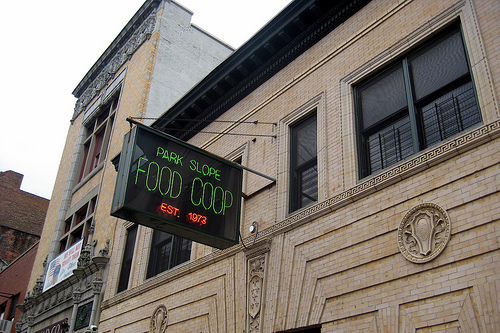
While being in Brooklyn, NY, I visited the Park Slope Food Coop, established in 1973. I only visited, because in order to buy something, you have to be a member. I could actually only enter the Coop in the first place, because Mikey, with whom I explored Brooklyn, is a member. In the upstairs office we had to identify ourselves after which I received a visitor card. Downstairs, I had to give the card to one of the two persons guarding the entrance. It was quite an intense experience, but the coop had more strict policies like this, needed to prevent that people take advantage. With only a 21% mark up across the board, good and mostly local and organic food is relatively cheap here. This is possible because the food coop is a not for profit organization in which 75% of the work is done by members themselves. So almost all persons I saw working are members; upstairs taking our identification, downstairs guarding the entrance, the cashiers, the people who walk you to the car and take the shopping cart back, all were members. Mikey works a three hour shift every four weeks in the basement, unpacking incoming supply and sending it up to the shopping floor. With over 14.000 members, this coop is an astonishing example of intense level of social coordination which pays off to all its members.
Urban agriculture in Red Hook, Brooklyn NY
 I took opportunity to visit New York City while on my way to my friend Jessica in Ithaca. Fortunately, I had the opportunity to ‘go local’ because Mikey, a friend of her agreed to show me around. We went on bikes exploring Brooklyn, a great experience. I soon learned that you only have to remember one thing; you are on your own, there are no rules in urban jungle traffic.
We visited an urban farm in Southern Brooklyn, in the Red Hook neighborhood, a predominantly black and low income community. The Added Value farm is experiencing its third growing season. The farm is located on a run down playground, still visible as a grey spot on Google earth, but now a green oasis, with a small hoop house nursery and a composting section.
 The playground is still there but most of it is covered, underneath 18 inches of rich compost soil. All vegetables you can imagine are growing here, except carrots which go too deep. The produce is sold at the weekly farmers market at the spot and serves a twenty member CSA. The farm now neighbors a gigantic new and heavily opposed IKEA outlet. The outlet symbolizes the start of gentrification of the neighborhood, of which we saw an example at the waterfront, where abandoned industry buildings have been converted into lofty apartments. As more white people move in, rents and living costs increase, which forces the current inhabitants to move to other, cheaper parts of the city.
The controversy around the outlet is one of the factors influencing the struggle of the farm to reach out to its immediate neighborhood community Donna explained. She is one of the farm workers and kindly showed us around. Showing and explaining the farm to whoever passes by is an important aspect of the openness of the place; the gate is always open while work is going on. Without a programmatic structure such as the youth education program, it has been hard to reach the neighborhood. For many the farm is still a bridge too far in the daily struggle to make a living while on a totally different diet due to the lack of affordable fresh produce and lost cooking skills.
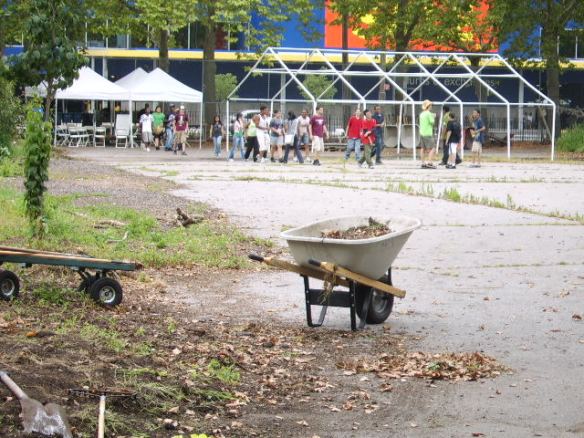 Donna is one of 4 farm interns. We met the manager briefly on his way to a meeting. There are also 4 youth workers employed on the farm. One of them was working with a new group of teenagers from the Bronx, who were introducing themselves to each other at the start of their Summer Youth Intensives. Weeding, harvesting, learning about vegetables and composting. But it all starts at a very basic level. Because more than anything else, the farm program is trying to teach these kids a different set of values. Learning the benefit of working as a team. Learning that it is not about the show, wearing appropriate working clothes. Turning compost; doing the dirty jobs. Respect for each other and for every living creature. The value of sharing. The taste of fresh basil.
The skeptics (see blog Han) or the question alone really, about whether or not urban agriculture can actually provide enough produce to feed an entire city is the narrow economist argument of linear industrial thinking. The remnant of a past modernist era which by default end up in cost efficiency, scale enlargement and mass production solutions. At the cost of soil fertility and hard working people, Marx already taught us in the 19th century. Urban agriculture is about so much more than “only” providing “a bit” of fresh and healthy food.
Voedsel lijmt versnipperd beleid
De komende maanden gaat Simone Planting (5e jaars studente Internationale Ontwikkelingsstudies) in het kader van haar doctoraalscriptie bij Rurale Sociologie onderzoek doen naar de mogelijkheden voor een integraal voedselbeleid in de Provincie Noord-Brabant. Eerder liep Simone stage bij Stichting Vrienden van het Platteland (nu: Nederland bloeit). Hierover schreef ze ook deze bijdrage aan deze weblog.
Simone voert haar doctoraal onderzoek uit in opdracht van de Brabantse Milieufederatie (BMF) en in samenwerking met de Provincie Noord-Brabant. Naar aanleiding van de aanvang van haar onderzoek liet de BMF gisteren een persbericht uitgaan:
Voedsel biedt een interessante ingang voor beleidsintegratie. Niet alleen raakt onze moderne voedselvoorziening aan verschillende beleidsterreinen, waaronder landbouw, transport en infrastructuur, natuur, milieu en gezondheid. Maatschappelijke problemen met voedsel gaan vaak ook verder dan een enkel beleidsterrein. Overgewicht is bijvoorbeeld gerelateerd aan gezondheid, maar raakt bovendien aan educatie en de beschikbaarheid en samenstelling van ons voedsel. De huidige sectorale insteek van overheidsinstanties biedt weliswaar altijd duidelijkheid over waar en bij wie de verantwoordelijkheid ligt, maar dreigt als geheel toch vaak onsamenhangend te blijven en suboptimaal. Voor duurzame ontwikkeling is echter juist een integrale aanpak geboden bij de grote maatschappelijke uitdagingen van deze tijd. Voedsel kan daarbij een verbindende rol spelen. Ondanks de complexiteit van het moderne voedselsysteem en het gebrek aan betrokkenheid van velen daarbij is er immers een grote gemene deler die ons allemaal verbindt: iedereen eet, liefst elke dag weer opnieuw.
Door een literatuuronderzoek te doen en door het voeren van interviews met diverse partijen hoopt Simone een voorstel te ontwikkelen waarmee een stad als Tilburg aan de slag kan om een voedselbeleid op te zetten dat bijdraagt aan duurzame ontwikkeling. Het onderzoek wordt in december afgesloten met een publieke presentatie in Tilburg.
Als belangrijk voorbeeld maakt Simone gebruik van het in de VS en Canada beproefde concept ‘Food Policy Council’ (FPC). Binnen Europa zet Londen de toon sinds enkele jaren met een eigen voedselstrategie. Het is een aanpak die ook bij enkele Nederlandse steden voorzichtig navolging vindt. Een FPC is een breed maatschappelijk netwerk of platform waarin verschillende prominente personen plaatsnemen die belang hebben bij een goed ontwikkeld regionaal voedselsysteem. Dit zijn bijvoorbeeld mensen uit de gezondheidsector, landbouw, natuur- en milieuorganisaties, bestuurders, ambtenaren, voedselverwerkende bedrijven, transportsector, horeca en consumenten. Het samenbrengen van verschillende meningen en ideeën over voedsel in een transparante omgeving leidt tot duurzame en maatschappelijk gedragen oplossingen voor een breed scala van vraagstukken die gerelateerd zijn aan onze stedelijke voedselvoorziening. Een FPC kan daarmee als brug fungeren tussen verschillende partijen en maatschappelijke initiatieven en de overwegend sectoraal ingestelde overheid. Een succesvol voorbeeld is de in 1991 opgerichte Toronto Food Policy Council in Canada.
De Brabantse Milieufederatie wil op het terrein van dit soort innovatieve benaderingen een initiator zijn en een stimulerende rol vervullen. Voor de Provincie Noord-Brabant geldt dat dit onderzoek aansluit bij een veranderende kijk op maatschappelijke sturing en beleidvorming. Tijdens dit onderzoek wordt Simone begeleidt vanuit de leerstoelgroep Rurale Sociologie van Wageningen Universiteit, de BMF en de Provincie Noord-Brabant.
Over de uitkomsten en eventueel interessante tussenresultaten zal Simone en/of haar begeleider Petra Derkzen de komende maanden via deze weblog verslag doen.
To eliminate our networking desert
How to share experiences with people working in establishing local food systems in other places? What is going on where? In Iowa, the Leopold Center for Sustainable Agriculture, serves as a linking pin around building local food systems. Today I joined a meeting of the Regional Food Systems Working Group. This group is a Community of Practice of around a hundred people who meet four times a year to network, learn and share with other Iowans from all over the state, but today, there were also quite a few visitors from other states. Because it seems there is a lot going on in Iowa, compared to some other (Midwestern) states.
The Leopold center is a research and education center of ISU established under the Groundwater Protection Act of 1987 committed to systemic change in agriculture. Currently, there are three programs around the themes of marketing food systems, ecology and policy. Next to the center’s outreach through workshops, network meetings, seminars, and the like, it provides grants to researchers and educators of all Iowa universities and to private and nonprofit agencies throughout the state. These project grants, 33 this year, worth over 700.000 dollar in total, are a very important catalyst for furthering sustainable agriculture. Projects range from research on nitrogen management to improve water quality, developing alternative swine production systems, targeting perennial conservation practices, analysis of the value chain of local produce to targeting on-farm energy needs through renewable energy.
One of the fields on the Small Potatoes Farm
Today the center presented their ongoing work in local food. For example they are putting together a resource guide which will give an overview of all organizations and programs working in local food. We also reviewed a draft on local food procurement information about regulations around raw agricultural products. There are still a lot of myths and fears around the use of local raw agricultural products in commercial institutions, but there are no laws prohibiting direct sale from a producer to an institution.
The Community of Practice brings together various regional food initiatives. Those initiatives gave short presentations and updates on their activities before the more interactive sessions started. For example the Hometown Harvest initiative in Southeast Iowa started a feasibility study to come to a farmer owned food coop and announced a new website and logo. The Northern Iowa Food and Farming partnership shared their experience on how to set up local food distribution among various producers. And the Southwest Iowa Food and Farming Initiative is building a database mapping all local producers and potentially interested consumers as part of the first step in building a food system. The initiative in Marshall town, COMIDA also presented their ongoing work, for example their seminar with Ken Meter (see blog.)
These quarterly meetings are very important for the people working in the regional food initiatives. “I come here and hear about what others do which gives me new ideas” one of the participants said. “Sharing here is a big source of information” and, “things are changing fast now”. There is more acceptance nowadays, that whereas some continu to target the world, others actually want to feed their neighbor.
Selective breeding in organic dairy production II – PhD-thesis completed
Earlier I wrote a post on the PhD-thesis ‘Selective breeding in organic dairy production’ by Wytze Nauta. The complete PhD-thesis can be downloaded at the site of the Louis Bolk Institute


