II Festival de Expresiones Urbanas y Rurales: Diálogo por la Diversidad y Buen Vivir, Bucaramanga, Colombia

Last weekend (18-20 of November 2011), I was able to participate in the II Festival for urban-rural dialogue in the barrio La Joya in Bucaramanga, Colombia. The festival was visited by peasants (such as fishers, women groups, and farmers), indigenous groups as well as knowledge brokers from all over Colombia, Costa Rica, Venezuela and Cuba. In addition, urban citizens from Bucaramanga, and La Joya in particularly, participated in the event. This mix of participants created a valuable learning environment for everyone (including me), and resulted in new ideas and organisations amongst the participants. In a way, this festival reminded me of the rural cafés I visited in the Westerkwartier, the Netherlands.

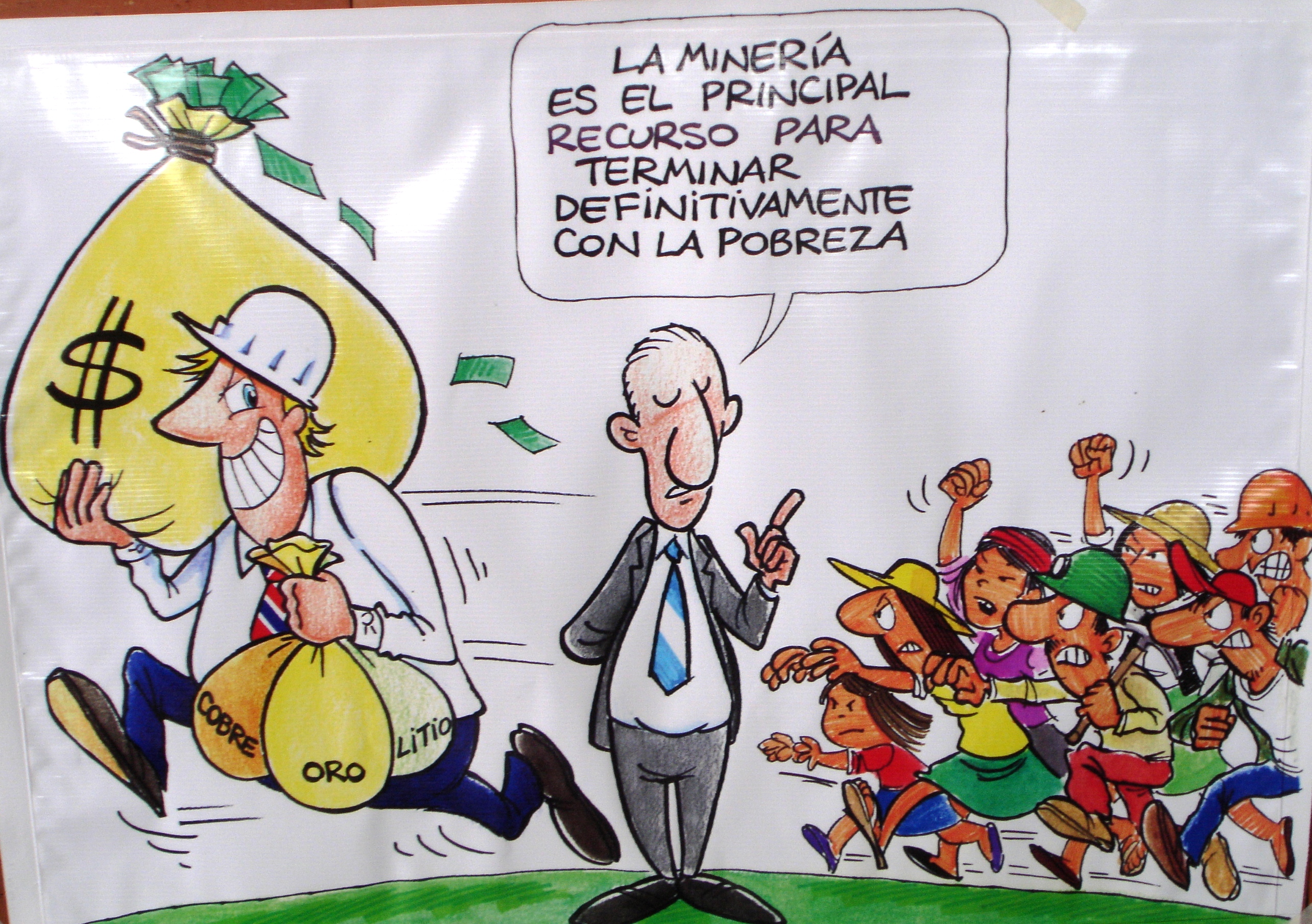
The overall theme of the event was the environmental conflicts in rural Colombia resulting on the one hand from the numerous (and often multinational) economic exploitation activities (e.g. gold mining, hydroelectric power activities and monoculture) and on the other hand from conservation activities.

Poster presented at festival

Continue reading

PUREFOOD research and training network

The Rural Sociology Group has been granted the coordination of a Marie Curie Initial Training Network  entitled ‘Urban, peri-urban and regional food dynamics: toward an integrated and territorial approach to food (PUREFOOD)’ funded by the European Commission’s Seventh Framework PEOPLE program. The PUREFOOD research and training programme aims to reduce the enormous knowledge and skills deficit that is negatively affecting the capacity to design and deliver appropriate political and developmental solutions in the crucial supra-disciplinary fields of food security, public food procurement, public health and sustainable urban and regional development. Hence, the objective of PUREFOOD is to train a pool of 12 early-stage researchers (ESRs) in the socio-economic and socio-spatial dynamics of the (peri-)urban and regional foodscape. The research and training program will therefore provide knowledge and innovation for the Commission’s aim to deal with economic, social and environmental policies in “mutually reinforcing ways” which reflects the core of the Lisbon and Gothenburg agenda’s call for integrated solutions towards economic prosperity, social cohesion and environmental sustainability. The PUREFOOD network is centred around food as an integrated and territorial mode of governance and studies the emergence of the (peri-)urban foodscape as an alternative (as opposed to a globalised) geography of food, including the ways in which, and the extent to which, sustainability aspects generally considered to be intrinsic to the alternative food geography are incorporated by the more conventional food companies.

The PUREFOOD Initial Training Network consists of 7  university partners who will each host one or more ESRs:

  1. Wageningen University Rural Sociology Group (The Netherlands)
  2. Cardiff University School of City and Regional Planning (United Kingdom)
  3. Pisa University Department of Agronomy and Agro-ecosystem Management (Italy)
  4. Latvia University Faculty of Social Sciences (Latvia)
  5. City University London Centre for Food Policy (United Kingdom)
  6. Federal University of Rio Grande do Sul Postgraduate Program in Rural Development (Brazil)
  7. Makerere University School of Public Health Department of Community Health and Behavioural Sciences (Uganda)

In addition to these universities as full consortium partners, the PUREFOOD network consists of 8 associated partners, a combination of private firms, public authorities and civil society organisations:

  1. Peri-Urban Regions Platform Europe (PURPLE)
  2. Sustainable Agriculture Initiative (SAI) Platform
  3. Sodexo UK
  4. Willem&Drees
  5. Slow Food Study Center
  6. Stroom Den Haag
  7. Sustain – the alliance for better food and farming
  8. Tukums municipality

The associated partners will contribute to the PUREFOOD training program by contributing to courses, participating in Communities of Practice and by hosting ESRs for a secondment. The active involvement of these associated partners is also of great importance for safeguarding the practical applicability of scientific research in the commercial, public as well as civic realm and for the dissemination of results.

The seven universities have opened (or soon will open) vacancies for 12 early-stage research positions. The launch of the vacancies has been announced on this weblog. As of now the PUREFOOD vacancy brochure with information about ESR projects, eligibility criteria, contact persons for additional information and addresses for submitting applications is available. For potential prospective ESRs an information pack has been compiled with information about the PUREFOOD research and training programme, the individual ESR projects, the timeline of the project and short descriptions of the full and associated consortium partners.

How art and rural life meet

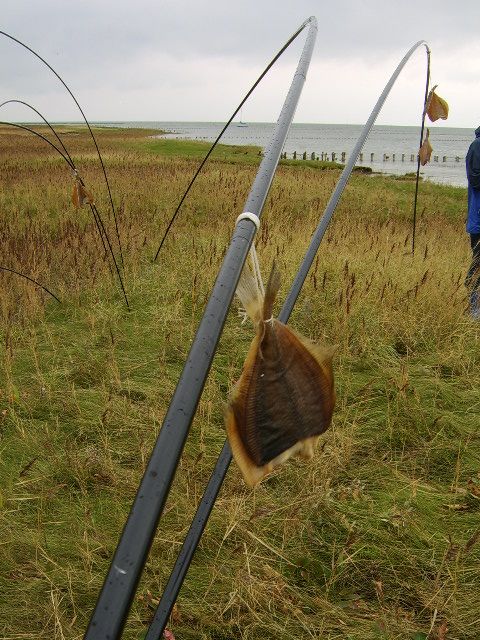
Drying fish in Sarah's work

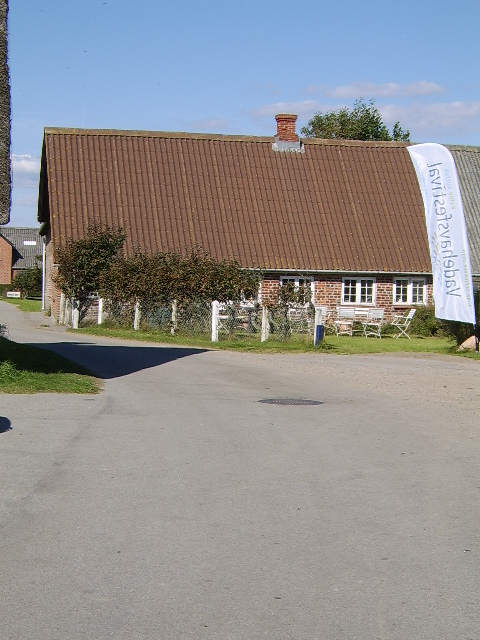
At best sceptical were most of the islanders of Mandø about the Any Questions? art project on their island. Not many were fond of modern art. Their highlight of the year is the Mandøfest which brings back many related to Mandø in july for a celebration of tradition and island culture in big family gatherings. The Vadehavsfestival is different and the ‘elite’ art is distant this culture. However, the aim of the festival was to instill inhabitants of the wadden region with new wonder about their own environment.

How to prevent that the project on Mandø would completely bypass the community because of separated mental worlds? Inspired by theories on action research – in particular appreciative inquiry – and on social interaction (see Collins 2004. still the best explanation) we formulated a social process to embed ourselves in the place. In three steps (oct/june/sept) we worked at building a positive chain of interaction with the islanders which accumulated – also to my surprise – in openness to and interaction with the artists and the art works.
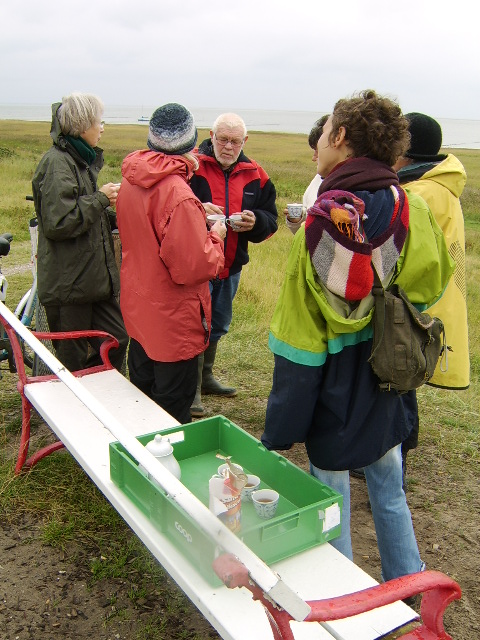
Tea and cookies

The shopkeeper commented how moved she was by the threedimensional house drawing on top of the dune and that it was this moment rather than big audiences which was – maybe-  important too. An unannounced barn concert attracted islanders who normally do not go anywhere we were told. People passed by our café with a bottle of wine or wiskey or came to have ‘tea and cookies’ in and near the house of Sarah and holding up her window. Our bonfire in the withdrawing sea at the landart site of Liesbeth attracted ‘a record of people’ according to the man who fanatically helped building it with lots of diesel (however many stayed at the dunes because the way through the grass was too dark unfortunately).
Peter With's Café

We became part of this community for a week, using the closed café, sleeping in people’s summerhouses, struggling with internet as they do, enjoying the wadden nature and the endless horizon. The embedding of the project and the dialogue in which it resulted inspired us too, as can be read on the waddenart weblog. Thanks, people of Mandø for opening up to us.
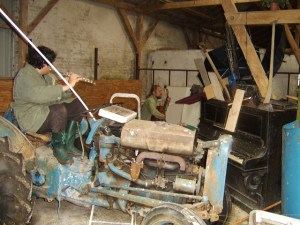
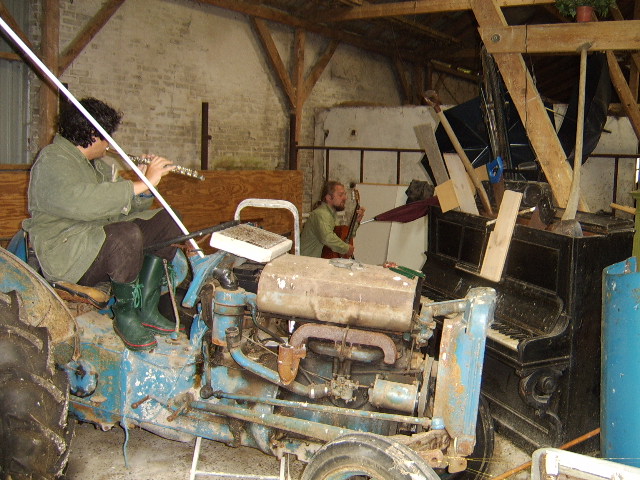
concert with barn materials

Modern art in a rural setting. The art week on Mando, DK

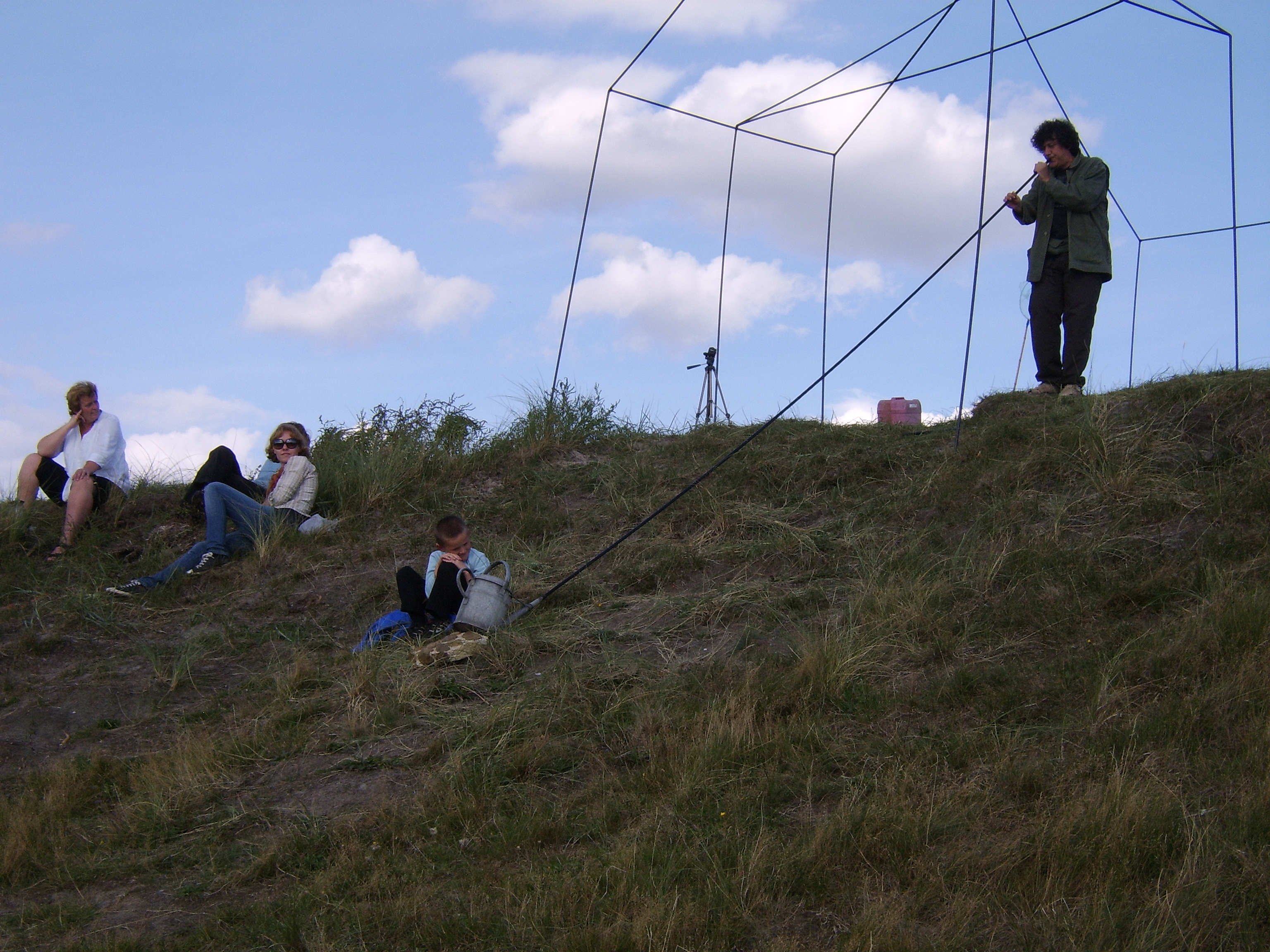
Dario makes music with tent poles of Sarah inside her threedimensional drawing

The sunny weather, a great mix of people, the lovely atmospheric cafe and the beautiful wadden nature have contributed to a kick start of the Any Questions art project on the Danish wadden island Mando. We officially started yesterday with a reception with the inhabitants and for the week to follow there will be daily performances, concerts and ongoing art works made by the individual artists as well as in collaboration with each other. Two writers will observe and reflect on how modern art is meeting people on this island, see previous blog

You can follow us at www.waddenart.wordpress.com

The waddenart group blog will be daily updated by the organisers, the artists and the writers with stories and pictures about the art works, the island and the people.

Art and social interaction on Mando; Call for Researchers

The Wadden Sea coast of Denmark from Tønder to Blaavand is a beautiful natural and rural area with three wadden islands Romø, Mandø and Fanø. For the third time, the biannual Wadden Sea Festival from 4 to 12 september draws attention to this area with various forms of Contemporary Art at many different places. One of the art projects is organised by Foundation Waddenart on the island Mandø. This is a special island, very small and only accessible at low tide through a gravel road at the sea bottom.

The project Any Questions on Mandø is an interdisciplinary project, an experiment to integrate art and research in one project and at the same time embed the project in a local place. Foundation WaddenArt started in collaboration with SDU to explore the question of quality of life for the inhabitants at Mandø in October 2009. The findings fed into the Call for Artists to attract Contemporary Art in Installation art, Performance art and Landart. Five different artist(groups) have been selected to work daily to create works of art during the festival in september. 

There is also space for three researchers to be involved in the project in september. We ask researchers to reflect from a research background in the social sciences or art & humanities to what they observe during the festival. We ask you to observe and write a short story based on personal experience and empirical observation which can be performed during the closing event on Mandø. Are you interested questions such as; How does contemporary art relate to the cultural and social life of the community on Mando? How do the people on Mando relate to a festival that is not theirs? How is Mando expressed? What symbols the links between past, present and future? What are defining factors in change and stability? Then please look at this link for the full Call text and the way to submit your interest to Foundation Waddenart.