
As a part off the course Understanding Rural Development (RSO 31806) we went on a field trip to de Eemlandhoeve in Bunschoten and explored the inner-city of Utrecht. By this excursion we visited a number of interesting expressions of urban-rural relationships, from a rural and an urban perspective.
De Eemlandhoeve
De Eemlandhoeve, owned by farmer, rural entrepreneur and philosopher Jan Huijgen, can be considered as an extreme example of a multifunctional farm enterprise. The group of Blonde d’Aquitaine’s form the centre of a rural enterprise which includes a large number of activities like a farm shop, care facilities, meeting and office facilities, an education garden and even a farmer’s cinema under construction.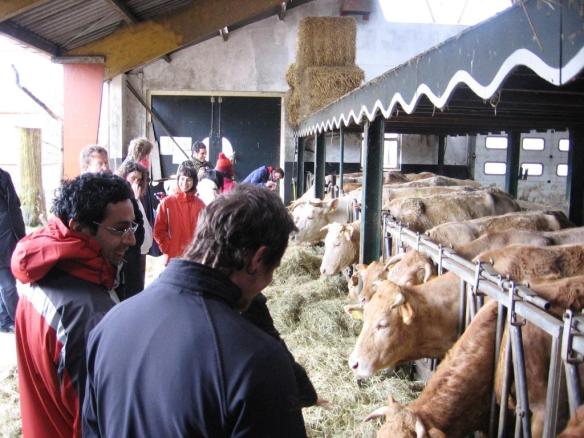
Next of being a multifunctional entrepreneur Jan Huijgen is a well known personality in Dutch rural development, active on a local, national, international (and maybe in the near future on a global) level. The farm residents a rural innovation centre and last October de Eemlandhoeve hosted the EEconference or Europese Eemlandconference, veelzijdig platteland.
On the excursion owner Jan Huijgen told us about his inspiration, motives and future plans with his farm. After his presentation we had an interesting discussion and were showed around the place.
Local food in the city of Utrecht
The second trip brought us to a rather different surrounding; the historical inner-city of Utrecht. On de Eemlandhoeve our focus was on the rural side of urban-rural relationships, in Utrecht we looked upon it from an urban perspective.
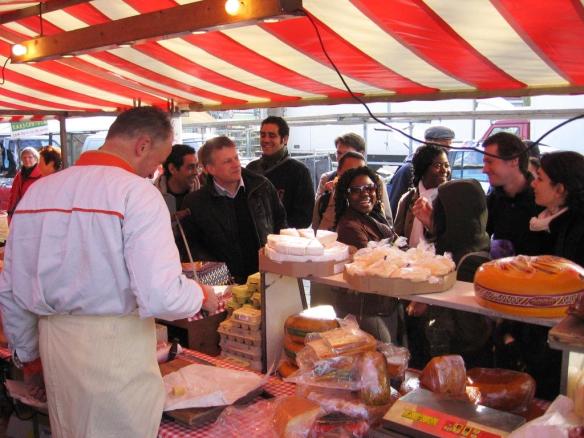 Together with our guide Frank Verhoeven (see his website) we first went to the Wednesday Vredenburg Market. On this market we visited a cheese seller linked to the organization called Dutch Cheese Centre (website under construction). The stallholder told us about some typical Dutch cheeses and the trade in locally produced ones. After some tasting we set out for the traditional bakery Bakkerij Blom were owner Theo Blom showed us around and told about his bakery, traditional products and production.
Our last stop was a visit to the five star hotel and restaurant Karel V for a number of short presentations. In the hotel our guide Frank Verhoeven started by telling us about his ‘Boerenbox’ initiative and his vision on a more locally based production and consumption. Secondly, one of the Karel V chefs explained us about the way they work with seasonal products originating solely from regional grounds and local suppliers. Lastly, Arie Bosma, one of the initiators of the campaign ‘Lekker Utregs’, told us about the initiative to reconnect the city of Utrecht with its surrounding countryside by establishing a so called Green Participation Society.
By the fieldtrips we got acquainted with several interesting expressions of urban-rural relationships, from a rural and an urban perspective. It was a nice and inspiring way of linking theory from class to reality by ‘tasting’ real life examples in ‘the field’.
 Rural Sociology Wageningen University