IFSA 2012 workshop ‘The meaning of semi-subsistence farming in different cultural contexts’

Together with Imre Kovach and Catherine Darrot,  I will be hosting a workshop at the IFSA symposium in Aarhus, Denmark from the 1st of July until the 4th of July 2012.

The workshop is aimed at exploring the multiple meanings of semi-subsistent food production strategies in different cultural context. Two questions are at the centre of attention: 1) How has the meaning of semi-subsistent food production changed over time for producers, society and institutions? and 2) What recommendations can be derived from the research for policy makers of multi-state institutions (e.g. EU?). We invite researchers from diverse countries to present their empirical research in order to stimulate a fruitful discussion and knowledge exchange.

The deadline for submitting abstracts is the 31st of December 2011.  More information and a link to submitting your abstract can be found here. I hope to see you there!

Working group at 24th ESRS congress in Chania, Greece 22-25 August 2011: Call for papers

Imre Kovách ( Institute for Political Science of the Hungarian Academy of Sciences, Budapest), Petra Derkzen and I are organising a working group on “the governance of semi-subsistent food and farming strategies in the countryside and city- a compartive perspective” at the 24th ESRS congress in Chania (Greece) from 22-25 of August 2011. We would like to invite all interested researchers to submit their papers dealing with empirical or theoretical reflections on the driving forces, structure and mechanisms of semisubsistence food and farming strategies in the countryside and-or cities, both within developed and developing countries. Abstracts may be submitted  to Imre Kovach (ikovach@mtapti.hu) AND chania2011@agr.unipi.it until the 30th of April 2011.  For a more detailed description of the workshop please read further…

Courtesy of European Forum on Nature Conservation and Pastoralism

Continue reading

Eetvervreemding

‘We weten niet meer wat er in al die pakjes en zakjes zit maar voeden graag onze verbeelding met een geidealiseerd beeld van hoe ons voedsel groeit en geproduceerd wordt’, lees ik in één van de essays in Kost, nieuwe gezichten op eten. Daarvan vond ik recent een mooi voorbeeld. Want als een stier het lef heeft dwars door dat beeld te lopen ontstaat grote consternatie. De wildebras wist half november te ontspannen uit een slachthuis in Arnhem en stoof woest door de stad totdat hij verdoofd en gevangen werd.

Ot en Sien

Binnen no time had de stier een actiegroep die hem wilde redden. 41 landelijke en regionale krantebrichten later is de stier inderdaad geadopteerd door een ‘boerderij voor ontsnapte dieren’. Nog een paar kranteartikelen verder is hij toch afgemaakt. Hij bleek nog meer driftbuien te hebben en was als opstandige puber niet handhaafbaar.

Mary Douglas beschrijft in Purity and Danger mooi wat hier gebeurt met haar concept ‘anomaly’. Een abnormaliteit is een item dat niet binnen een gegeven serie of set past. Het is ‘matter out of place’. In ons verstedelijkte brein is de categorie ‘landbouwhuisdier’ aan het verdwijnen. We houden daarmee nog twee categorieen over, (huis)dier en vlees, nu volstrekt van elkaar gescheiden.

Zo gauw een normaliter anoniem landbouwhuisdier zichzelf zichtbaar maakt ontstaat een abnormale situatie. Als (huis)dier moet hij gered worden, de lapjes van zijn anonieme broertjes mogen op ons bord verschijnen als vlees.

Second European Sustainable Food Planning Conference – a last reminder

As mentioned in one of my previous blogs the  Urban Performance Group of the University of Brighton (UK) will host the second European Sustainable Food Planning Conference on 29 and 30 October 2010 under auspices of the Association of European Schools of Planning (AESOP). Although the deadlines for submission of abstracts and selection of papers and posters have passed, there are still a few places available to attend the conference. It promises to become an interesting conference due to the diversity of disciplinary and interdisciplinary contributions and the geographical range of cases and experiences that are going to be presented. And, furthermore, it also seems to be a vary timely conference; the attention for urban agriculture, food and health, food and urban design and food governance is rapidly increasing, not only in the academic realm but also in political and societal debates.

For more information about the conference you can download the conference brochure or have a look at the conference website.

Eat your landscape Part 1; tea

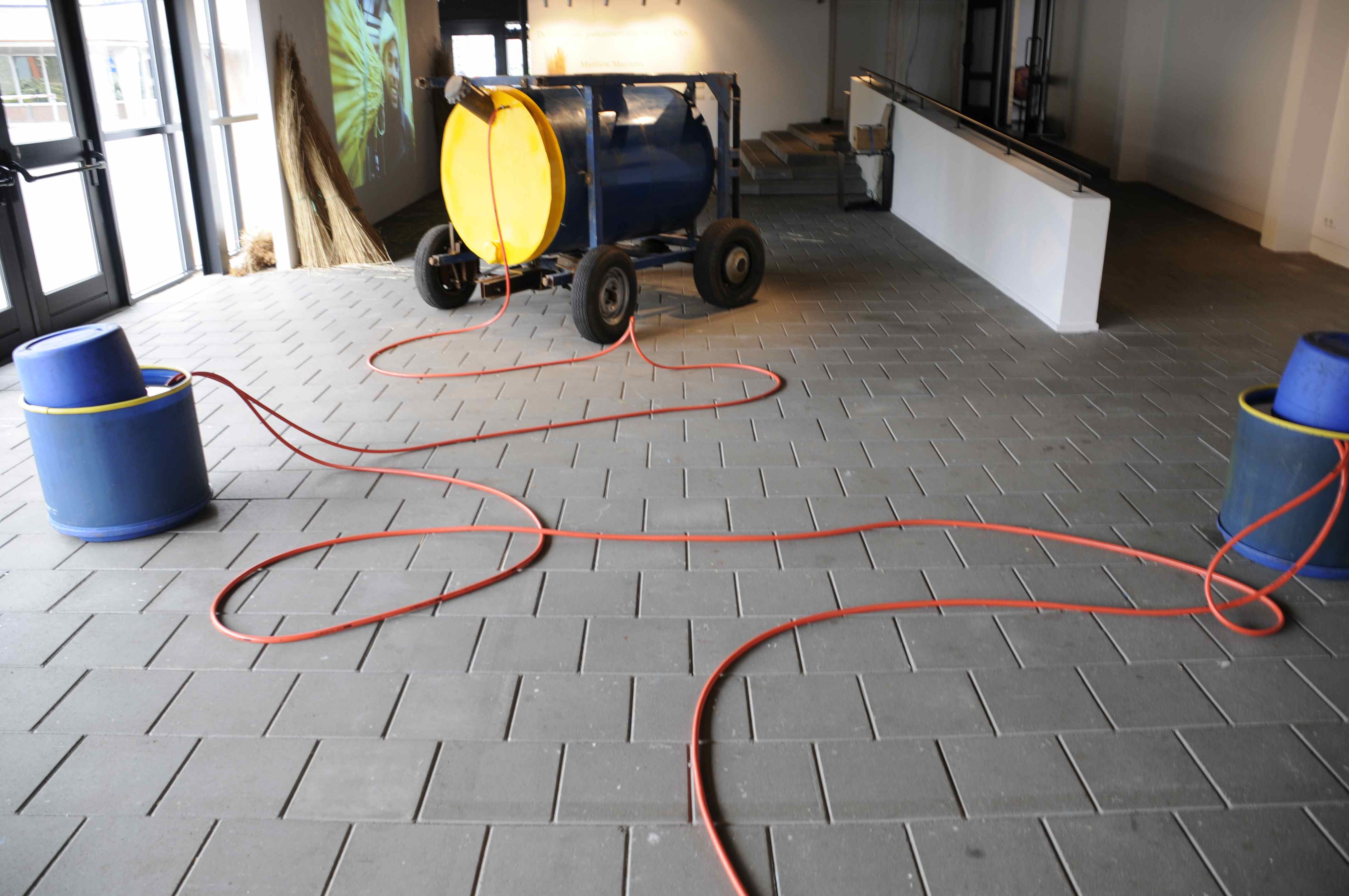
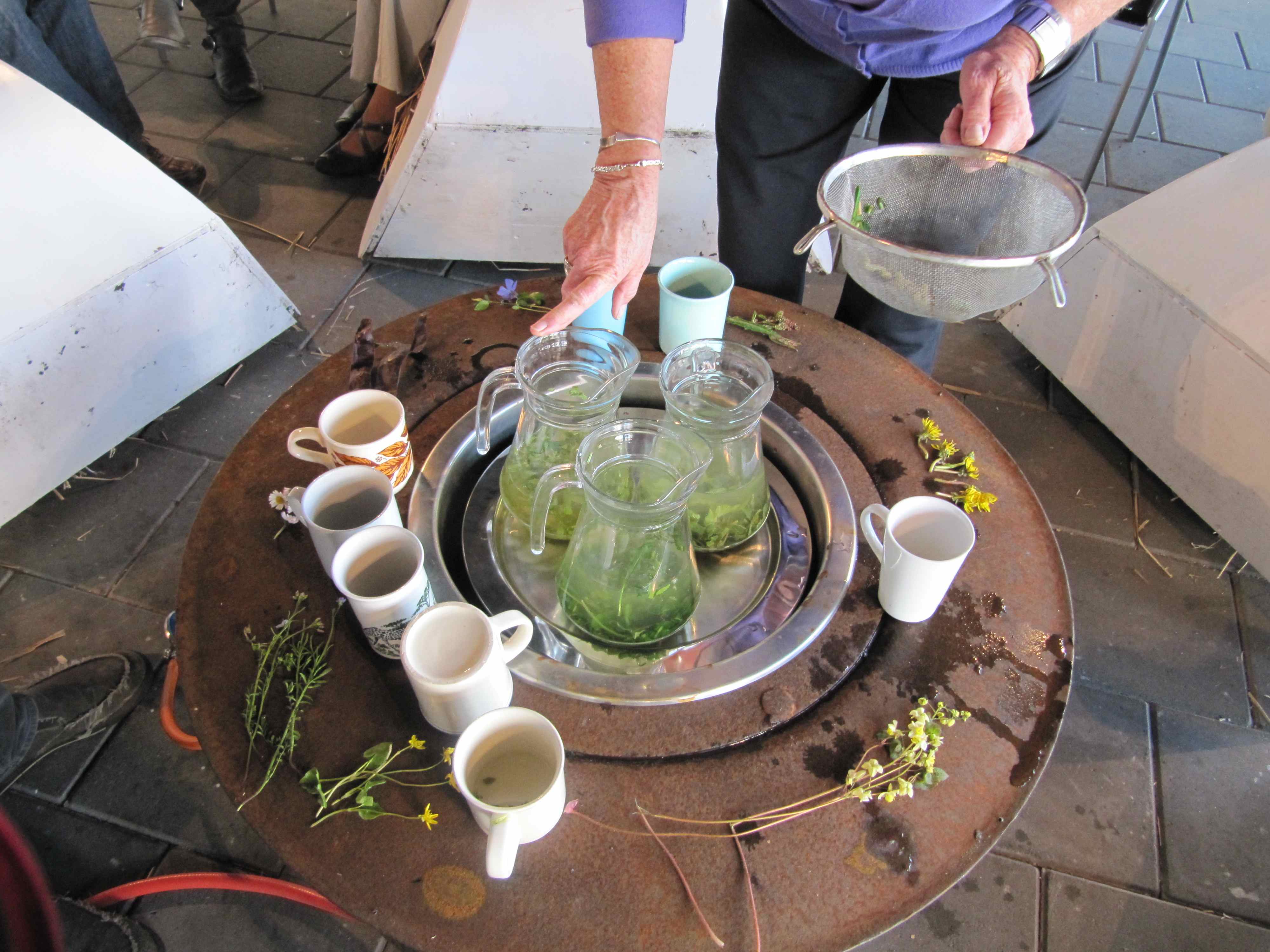
Two weeks ago I was present at a tea session in the tea house installation of artist Matthew Mazzotta whom I visited earlier in Smalle Ee. His installation is now exhibited in De Galerij in the city of Drachten, Friesland until the 20th of May. The methane production unit was ready to produce the gas to boil the water. However, the tea itself still had to be gathered. And the urban environment of Drachten was going to provide our tea according to Matthew. His project about local knowledge and social interaction challenged us, visitors of the gallery, to go into town together and search for edible plants.

Since the introduction of the plant Camillia Sinsensus from ‘the far east’ around the 17th Century, we say that we are going to ‘make a tea’ even if this means that we actually make an infusion of local herbs or weeds, such as camomile or nettles. We still refer to that as ‘a herbal tea’ such is ‘drinking tea’ integrated in our culture. And not only in our culture. Think of the British afternoon tea, Japanese tea ceremonies or tea from a Russian “samovar”. Also, the Inuit in northern Canada and several indigenous peoples in Kenya adopted (black) tea into their culture after its introduction. How important tea is for social gatherings you can read here.
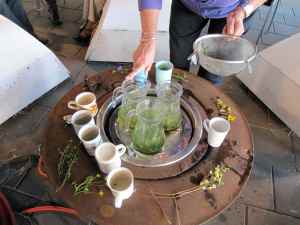
We went into Drachten with books to determine that we would not collect toxic plants. Downtown Drachten turned out to be full of edible plants, once you know where to look and what to look for. We quickly developed a preference for unattended places.. And while searching interesting discussions emerged. How to weight the pollution aspect of heavy metal from car gas on road plants against the use of pesticides, herbicides and antibiotics in our ‘clean’ supermarket food? What about soil quality in between two pavement tiles? Why did we worry about the soil in which sorrel, dandelion or ivy could be found and not about the fake ‘soil’ in which tomatoes and lettuce is grown?

I preferred the infusion of ivy, rich and spicy although the subtle taste of elder was also special.