Local food at the Rhederoord estate – gastronomic highlight

By Renee Ciulla  – Msc-student attending the course Origin Food: a market for identity

On April 8th, the Origin Food course (see earlier post) was treated to a gastronomic excursion to the Rhederoord estate near the town of Arnhem in De Steeg. Located on 12 ha, the estate provides a magnificent view over the foothills of the IJssel valley and Veluwe forests. The Rhederoord  is mainly known for it’s restaurant which offers a fine dining experience, sourcing most of their products from the surrounding countryside or within the Netherlands. However, the estate also caters events, hosts weddings and can accommodate over 250 guests in their 22 rooms. Possibilities also exist to book business and private meetings.

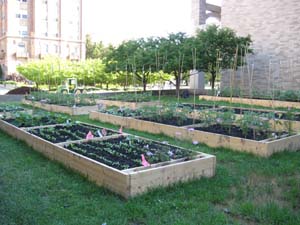
Despite the snowy morning, grey clouds and traffic delays in Arnhem, our group was in high spirits when we saw what greeted us in the foyer of the Rhederoord: a cheerful group of staff awaited to take us to a tastefully decorated coat room followed by a delicious estate-made apple tart on a delicate butter crust. As we mingled with our steaming cups of coffee, the sounds of clinking forks and laughter drifted up the wood-paneled walls and out the large paned windows to the manicured gardens and rolling fields. After our mid-morning feast we sat for an entertaining and inspiring history of the Rhederoord. The goals are to support local farmers and producers in every culinary aspect of their restaurant which they believe is reflected in the flavors and visual appeal. Additionally, the estate tries to educate other chefs and visitors about how to grow their own vegetables and herbs. A garden near the entrance of the restaurant displays various herbs, strawberries and vegetables enabling chefs to see first-hand what these foods look like in their growing state. Sheep and cows are also owned by the estate for their own supply of local meat.
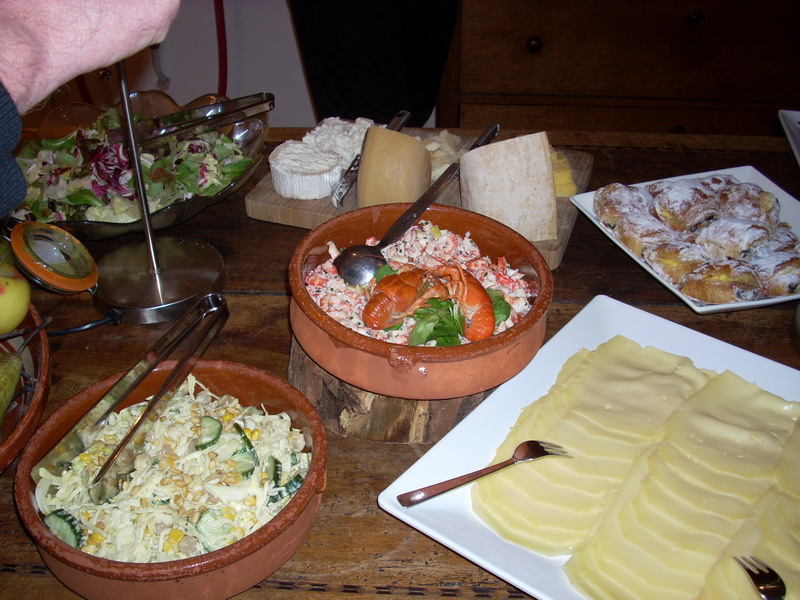
Buffet of local food at the Rhederoord estate

After our outdoor tour we couldn’t have been more surprised when we saw the buffet that welcomed us downstairs. Glowing in the atmospheric, perfectly positioned lights was an assortment of local gastronomic gems: pates, organic sheep, goat and cow cheeses, savory thinly-sliced ham, loaves of freshly baked breads with Dutch wheat, and mounds of warm rolls. Local greens and cabbage made some delicious salads. Meats included blood sausage, sea bass and river lobsters. The food was bursting with flavor and succulent textures- the entire room fell silent during our first ten minutes of eating as everyone floated in their personal eating heaven. A wine tasting of foud Dutch wines followed with ample joking about the quality of Netherlands wine. As for me, I was too distracted with the dessert still sitting on the buffet table: beautiful croissant-type cream puffs filled with fresh-egg custard and pieces of dark chocolate; every bite melted in my mouth.

The entire experience to Rhederoord was reminiscent of a family Christmas dinner. We all left feeling extremely grateful for the learning experience and culinary delights. Thanks to Dirk for organizing a spectacular and delicious trip!
Second European Sustainable Food Planning Conference

As a follow-up of the first European Sustainable Food Planning Conference, which took place on 9 and 10 October 2009 in Almere (The Netherlands), the Urban Performance Group of the University of Brighton (UK) will host the second European Sustainable Food Planning Conference on 29 and 30 October 2010. Like the first one, this second conference will be held under auspices of the Association of European Schools of Planning (AESOP).

Context and aim

Planning for sustainable food production and consumption is an increasingly important issue for planners, policymakers, designers, farmers, suppliers, activists, business and scientists alike. In the wider contexts of global climate change, a world population of 9 billion and growing, competing food production systems and diet-related public health concerns, are there new paradigms for urban and rural planning capable of supporting sustainable and equitable food systems? Continue reading

Growth of local food economy in USA – Ken Meter

Sustainability impact is one of the five themes of the course ‘Origin Food: a Market for Identity’ (see my earlier post for more info). Surfing on internet, looking for some empirical material on the importance of local food for local economies, we came across the work of Ken Meter, president of the Crossroads Resource Center

Crossroads Resource Center, a non-profit organization, works with communities and their allies to foster democracy and local self-determination. We specialize in devising new tools communities can use to create a more sustainable future.

Ken Meter is one of the most experienced food system analysts in the United States. His work integrates market analysis, business development, systems thinking, and social concerns. As president of Crossroads Resource Center in  Minnesota, Meter holds 39 years experience in inner-city and rural community capacity building.

As documented ath the site, Ken Meter has promoted 45 local food networks in 20 US-states and one in Canada. He has thus built a record on building local food communities and its impact on local economy. In an interview published in three part on You Tube, he shares his vision and experiences on ‘ Building a local food economy’: see part I, part II, part III. At the CRC website also an example presentation of Ken Meter on the ‘Growth in local food economies‘ in the USA. An eye-opener to all of us knowing that the USA is the worlds largets food exporting country, but actually has to import food to feed their own residents as Ken Meter says.  Anyway, local food seem to be booming in the USA, the internet is loaded with initiatives, as was already documented in the posts of our collegue Petra Derkzen at this blogsite.

Sustainable Food Systems Education and Engagement in Detroit

Recently, in the process of writing an international research proposal, I had an email exchange with Dr. Kami Pothukuchi, Associate Professor in Urban Planning at the College of Liberal Arts and Sciences of Wayne State University. Dr. Pothukuchi is, together with Prof. Jerry Kaufman, one of the founders of food planning in the USA. She was the first to write about food as a stranger to the planning field in 2000 and is one of the authors of “Community and Regional Food Planning: A Policy Guide of the American Planning Association“. This policy guide was a major source of inspiration for organizing the first European Sustainable Food Conference under auspices of the AESOP.

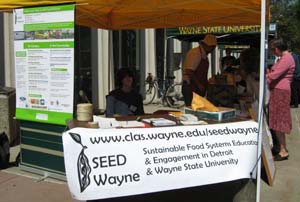
In our email exchange Dr. Pothukuchi informed me that she has recently become director of SEED Wayne. SEED is the acronym for Sustainable food systems Education and Engagement in Detroit. 

SEED Wayne is dedicated to building sustainable food systems on the campus of Wayne State University and in Detroit communities. SEED Wayne works in partnership with community-based organizations promoting food security, urban agriculture, farm-to-institution, and food and fitness planning and policy development. SEED Wayne embraces core university functions in teaching, research, engagement and operations. 

I think SEED Wayne is a perfect example of the role a university can and should play in enhancing sustainable food systems as well as in creating a learning-by-doing environment for students in which close collaboration with local communities is an intrinsic part of university teaching and research. For those interested in SEED Wayne download the brochure or simply browse SEED Wayne’s website.

Good food nation: reversing obesity via local food systems

Recently the Massachusetts Institute of Technology (MIT) and Columbia University published the results of a study on reversing America’s obesity epidemic by reorganising the system of food production, processing and distribution. According to the researchers obesity is widespread due to the national-scale system of food production and distribution, which surrounds children — especially lower-income children — with high-calorie products. Up to 90% of American food is processed, which contains ingredients, often acting as preservatives, that can make food fattening. The MIT and Columbia researchers propose a solution:

 America should increase its regional food consumption. Each metropolitan area, the researchers say, should obtain most of its nutrition from its own “foodshed,” a term akin to “watershed” meaning the area that naturally supplies its kitchens. Moreover, in a novel suggestion, the MIT and Columbia team says these local efforts should form a larger “Integrated Regional Foodshed” system, intended to lower the price and caloric content of food by lowering distances food must travel, from the farm to the dinner table.

For more information, you can read the complete press release by MIT or go the online project results.