Sign in now for the course A global Sense of Place!

vechtdal 1

A Global Sense of Place (RSO-55306) is an optional interdisciplinary course on sustainable place-based development for students from various master programmes (e.g. MDR, MES, MID, MLP, MUE, MOA, MFN). The course builds on the BSc course RSO-56806 Sociology and Anthropology of Place-shaping providing an introduction to place-based approaches in development. Knowledge of this introductory course is an advantage, but is not assumed.

The course aims to make students acquainted with an interdisciplinary and place-based approach to development. A relational place-based approach is seen as key to the understanding of interrelated rural and urban transformation processes and ergo sustainable development.

By means of this course students will achieve profound understanding in key-concepts and methods on place-based sustainable development. Work from key thinkers in sustainable place-making will be critically discussed and examined on the basis of various cases. Guest speakers are invited to reflect on place-based approaches to sustainable development and illustrate these through case studies. Ultimately students will acquire a place-based perspective on development.

Different interdisciplinary themes will be addressed such as:
• a relational approach of place and space;
• key thinkers on place and space and politics of place;
• community development
• cultural approaches of place-based development
• ‘the human dimension’, encompassing collaboration and leadership
• ‘defence’ of places and conflicts

If you are interested or want to register for this course, please send a mail before October 4th to lummina.horlings@wur.nl
Interested in Food and Place?

Are you interested in the sociological aspects of food provisioning and place-based development and want to know more about topics like place-based food systems, food citizenship, civic food networks, sustainable place-shaping, diverse economies, place branding and social movements? Then it may be a relevant for you to attend the MSc course ‘Sociology of Food Provisioning and Place-based Development’ that starts on Monday 17 March 2014. Lectures and workshops are held on Monday, Wednesday and Friday mornings for a period of 6 weeks. Included in the program is also a gastronomic excursion to rural estate Rhederoord, to experience the practice of place-making and enjoy the taste of place-based food products. Although registration for the course has formally closed you can still register for the course by sending an email to the course coordinator  (han.wiskerke@wur.nl). For more information about the content of the course, the program and the literature, have a look at the Course Guide.

Course announcement: Sociology of Food Provisioning and Place-based Development

The course ‘Sociology of Food Provisioning and Place-based Development’ starts on Monday 17 March 2014. This course is primarily designed for the Rural Sociology track in the specialisation ‘Sociology of Development’ of the Master International Development Studies. It is, however, open for all students interested in the sociology of food and place, provided they have a basic sociological understanding (at BSc-3 level) of transformation processes in food provisioning, rural and regional development and urban-rural linkages. For more information about the course have a look at the course description in the online study handbook or at the Leaflet Sociology of Food Provisioning and Place-based Development.

Well-working operational interfaces – PhD-thesis Wiebke Wellbrock

December 4 Wiebke Wellbrock succesfully defended her thesis (can be viewed at wurtv.wur.nl):

Well-working operational interfaces: A key to more collaborative modes of governance

This thesis comprises five chapters that are independent scientific publications. In the first chapter, I show how the ‘learning region concept’ and ‘triple helix thesis’ can be reframed to address support for collaboration in rural areas. In the second chapter, I reflect on the experiences of using the conceptual lens as a research tool for studying the operational features of arrangements supporting joint learning and innovation in the case study area of Westerkwartier, the Netherlands. In the third and fourth chapters, I deal with the question of how to best arrange support for collaboration by comparing the operational features of arrangements across the German and European case study areas. This thesis concludes with a discussion of the lessons learnt concerning: 1) wellworking operational features of arrangements supporting collaborative modes of governance, 2) the development and refinement of the conceptual lens, based on experiences of using it as a heuristic research tool, and 3) the potential of the refined framework to effectuate more collaborative modes of governance.

Continue reading

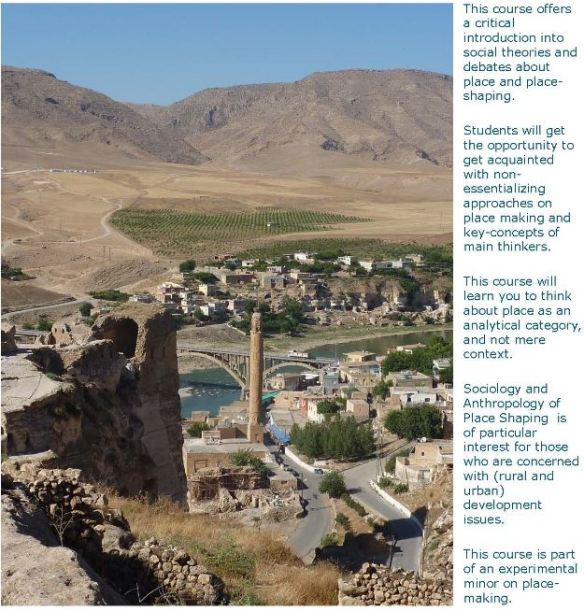
Introduction into Sociology and Anthropology of Place Shaping – optional course and free choice minor

Poster RSO-56806Starting Monday 17 Februray 2014,  in the 4th educational period of Wageningen University, the optional course RSO-56806 Introduction into Sociology and Anthropology of Place Shaping will be offered again in collaboratyion with Cultural Geography Group and Land Use Planning Group. For more information on the course contact the course coordinator Joost Jongerden: joost.jongerden@wur.nl

The course can be the first of four succeeding courses in period 5 and 6 up to a total of 24 ects as part of the free choice minor ‘Place and space in planning and development‘ open to BSc-students from WU and other high education institutes, such as the Van Hall Larenstein University of Applied Sciences.

The course offered as part of the minor are:

  • Period 4: RSO-56806 Sociology and Anthropology of Place-Shaping, whole days
  • Periode 5: RDS-30306 Sociological Theories of Rural Transformations, morning or GEO-23306 Cultural and istorical Geography, afternoon
  • Period 6: LUP-33306 Methods for strategic planning, whole days in week 34-39 and LUP-32306 Studio strategic planning, whole days in weeks 40-43

For more information contact minor coordinator Dirk Roep: dirk.roep@wur.nl