Rural regional learning in the Comarca de Verín, Galicia, Spain

Within the European research project DERREG, we are investigating how public policy can best be arranged to stimulate capacity building within development initiatives operating at grassroots level in rural areas across the European Union.

To find out how public policy interventions can best be arranged, we and our research partners have spoken to various stakeholders in different rural regions across the European Union to find out how they intend to support and facilitate learning and innovation and- most importantly- how the support and facilitation agreed upon is actually provided to the grassroots development initiatives. To find out what is working well and what isn’t working well yet, we have spoken to a number of grassroots development initiators in the participating DERREG case study areas and ask them to evaluate the current support and facilitation received.

To be able to compare the results obtained in the different case study areas, I have travelled to Alytus County, Lithuania in October and Oberlausitz, Germany in December of 2010. In January of this year, I was able to visit our colleague Lola Dominguez Garcia of  Universidade de Vigo in the Comarca de Verín in the South-West of Galicia, Spain. In this blog, we intend to share our experiences. Continue reading

Rural regional learning in ‘Upper Lusatia’ (Oberlausitz), Germany

Following my visit to Alytus County, Lithuania in October, I travelled to Leipzig, Germany to visit our DERREG project partners Michael Kriszan, Robert Nadler and Joachim Burdack (Leibniz Institute for Regional Geography) in their case study area ’Upper Lusatia’. In this blog, Michael, Robert, Joachim and I would like to share some of our experiences.

We first discovered that the case study regions Westerkwartier and Upper Lusatia are very different in their geographical and demographical characteristics. The LEADER region Westerkwartier in Groningen province comprises four municipalities on an area of 374km² and has a population density of 173.4 inhabitants/km² (as of 2007). In 2006, its GDP per capita was estimated at 55,400 Euro and the area has recently witnessed a population increase due to its popularity amongst young families who work in the city of Groningen and value the countryside as their residential area. The Southern part of the Westerkwartier is thus characterized by a high population density and a number of conflicting interests regarding the use of the countryside while the North of the Westerkwartier is primarily used for agriculture.

Upper Lusatia consists of the two Saxon districts Landkreis Görlitz and Landkreis Bautzen that have only been established in 2008 in the process of a reform of the administration units in Saxony. The case study region has an area of about 4,500 km² and has a population density of 135 inhabitants/km². It comprises 122 municipalities- of which 30 are urban centers- and had a GDP per capita of 18,329 Euro (district Görlitz) respectively 19,396 (district Bautzen) in the year 2007 . The region is divided into ten rural development areas, six ILE regions and four LEADER regions. In contrast to the Westerkwartier, the population of Upper Lusatia is shrinking rapidly. Young inhabitants are leaving the area due to a lack of employment opportunities, leaving the elder people behind. Rural development in this region is therefore not only affected by an aging population but also by a shrinking human capital available for development purposes. Through the reform of administrative units altogether four previously distinct districts (Landkreise) and two cities (kreisfreie Städte) have been incorporated into the two “new” districts of Görlitz and Bautzen. The previous Landkreise, however, are very distinct in their physical appearance. The former district Niederschlesien-Oberlausitz for example is characterized by a low population density and shaped through past and present coal mining activities while the hilly district Löbau-Zittau is recognized as a touristic area and winter sport resort. Due to the lack of a common history and the physical distinctiveness, there is no regional identity of the population within both districts.

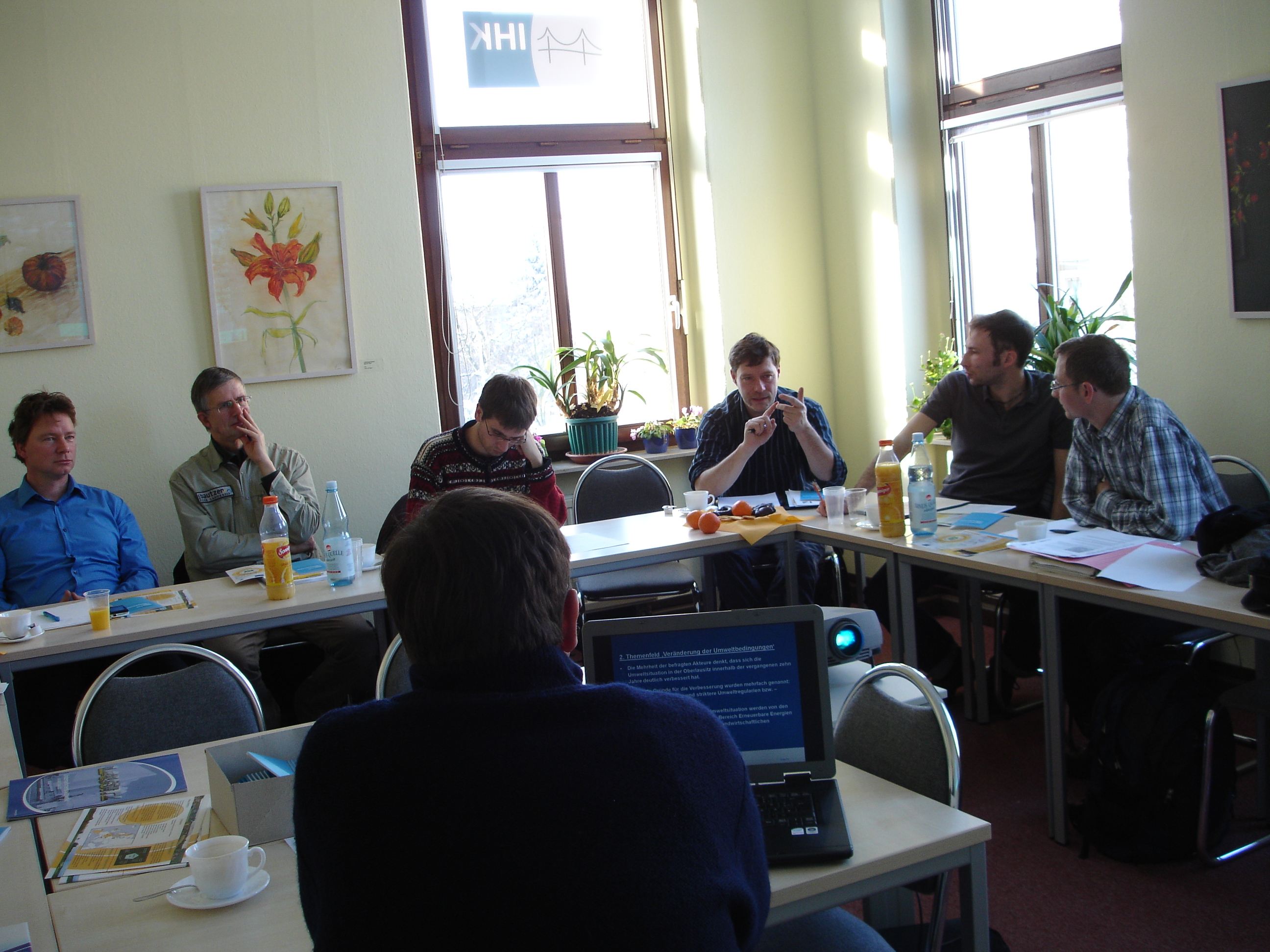
To evaluate the support and facilitation available for learning and innovation within local grassroots development initiatives in Upper Lusatia, Robert, Michael and Joachim organized a workshop for regional stakeholders.

Workshop in Upper Lusatia, Germany

Continue reading

FAQs for PUREFOOD vacancies

We have received a high number of inquiries with regard to our 12 PUREFOOD vacancies. It is good to see there is so much interest in these topics!
Most reactions were inquiries about similar issues. Therefore, we have prepared a list of FAQs for the PUREFOOD vacancies. Please have a look at this list of FAQs before sending us an e-mail!

PUREFOOD – 12 vacancies for ESRs are open

As mentioned in an earlier post on this weblog, the Rural Sociology Group has been granted the the coordination of a Marie Curie Initial Training Network  entitled ‘Urban, peri-urban and regional food dynamics: toward an integrated and territorial approach to food (PUREFOOD)’ funded by the European Commission’s Seventh Framework PEOPLE program. The objective of PUREFOOD is to train a pool of 12 early-stage researchers (ESRs) in the socio-economic and socio-spatial dynamics of the (peri-)urban and regional foodscape. The PUREFOOD network is centred around food as an integrated and territorial mode of governance and studies the emergence of the (peri-)urban foodscape as an alternative (as opposed to a globalised) geography of food, including the ways in which, and the extent to which, sustainability aspects generally considered to be intrinsic to the alternative food geography are incorporated by the more conventional food companies.

As of now all 12 PUREFOOD research vacancies have been published (or soon will be) by the host universities. For information about the ESR vacancies and application guidelines, you can download the PUREFOOD vacancies leaflet. For more information about the objectives, training and research approach and training program of PUREFOOD you can download the PUREFOOD information pack for prospective ESRs. The deadline for application is 3 January 2011.

Eligibility criteria

The enhancement of transnational mobility to improve career perspectives of early stage researchers is the main goal of the Marie Curie Initial Training funding. To achieve this objective the following eligibility criteria for prospective ESRs have been formulated:

  • You are eligible as an ESR if you are, at the time of recruitment (i) in possession of a university degree, and (ii) have a maximum of four years of full-time research experience, including any period of research training. This is measured from the date when you obtained the degree which formally entitles you to embark on a doctorate, either in the country in which the degree was obtained or in the country in which the research training is provided. Please not that ESRs cannot be PhD holders.
  • You are eligible to the position if, at the time of the selection by the host university, you did not reside or carry out your main activity (work, studies, etc) in the country of the host university for more than 12 months in the 3 years immediately prior to your recruitment.

If you have any questions about a vacancy please contact the contact person mentioned in the vacancy announcement. For general question about PUREFOOD please contact me (han.wiskerke@wur.nl).

Rural regional learning in Alytus County, Lithuania

Last week (October 21-22, 2010), I was given the opportunity to visit our DERREG project partner Emilija Kairyte (Institute NeVork) in her case study area of Alytus County in the South of Lithuania. In this blog, Emilija and I would like to share our experiences.

Like the Dutch DERREG case study region Westerkwartier in the province of Groningen, Alytus County comprises four rural municipalities. In terms of demography and economy, both areas are very different from each other. For example, the Westerkwartier has a population density of 173.4 inhabitants/ km², whereas the population density of Alytus County is estimated as 32.6 inhabitants/ km². While the Westerkwartier has witnessed an increase in citizens over the last years, amongst them a large number of young families, rural development in Alytus County is strongly affected by an increasing out-migration and an aging population. Living standards differ considerably. In the Westerkwartier, the GDP per capita was estimated as 55.400 Euro in 2006 while the GDP in Alytus County was estimated as 19.100 Litai in 2007 (equals 5.531,74 Euro, October 2010). Also in geographical terms the two regions are very different. The Westerkwartier is characterized by open grasslands in the North and small fields with framing hedgerows in the South. Alytus County is renowned for its vast forests and lakes.

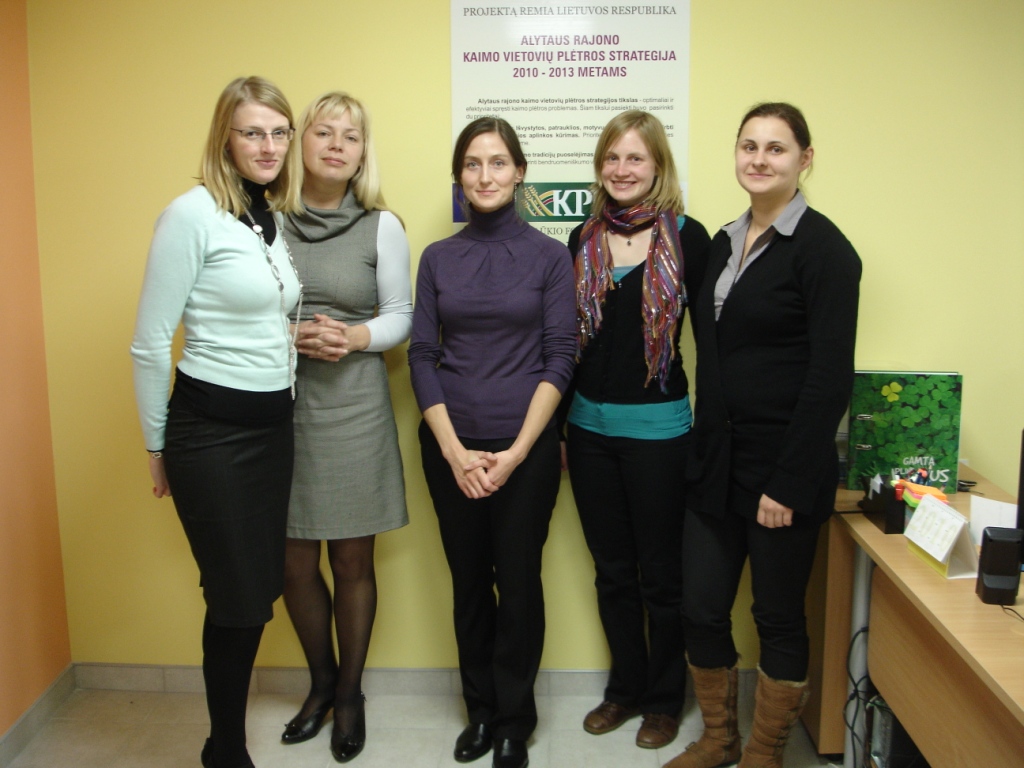
During my visit to Alytus County, I accompanied Emilija to two workshops, one for the LAG and other public administration authorities on the 21st of October and one for rural initators and actors on the 22nd of October, which she organized in order to evaluate existing arrangements for support and facilitation of joint learning-by-doing activities within rural development initiatives. At these workshops, I presented supportive arrangements and benefiting rural development initiatives that we found during our investigations in the Westerkwartier and which we evaluated together with local stakeholders at a workshop organized by the Rural Sociology Group in the Westerkwartier on the 18th of October.

Meeting with rural development initiative supporters in Alytus District LAG office, Alytus

To my surprise, both regional learning supporters (including the LAG) and rural initiators did not see striking differences between the existing arrangements and support given to rural development initiatives in Alytus County and the Westerkwartier. Emilija and I however learned that there are some basic differences in the foundation and operation of the Countryside House (Plattelandshuis) in Westerkwartier and Seniūnija (NUTS5) in Alytus County. Continue reading