Excursions Understanding Rural Development

As a part off the course Understanding Rural Development (RSO 31806) we went on a field trip to de Eemlandhoeve in Bunschoten and explored the inner-city of Utrecht. By this excursion we visited a number of interesting expressions of urban-rural relationships, from a rural and an urban perspective.

De Eemlandhoeve

De Eemlandhoeve, owned by farmer, rural entrepreneur and philosopher Jan Huijgen, can be considered as an extreme example of a multifunctional farm enterprise. The group of Blonde d’Aquitaine’s form the centre of a rural enterprise which includes a large number of activities like a farm shop, care facilities, meeting and office facilities, an education garden and even a farmer’s cinema under construction.Blonde d'Aquitaines at the Eemlandhoeve
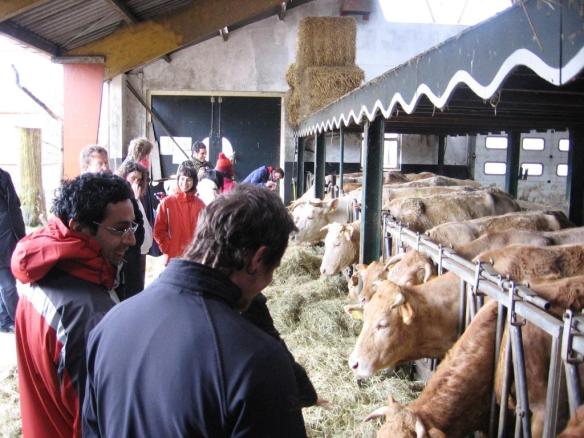
Next of being a multifunctional entrepreneur Jan Huijgen is a well known personality in Dutch rural development, active on a local, national, international (and maybe in the near future on a global) level. The farm residents a rural innovation centre and last October de Eemlandhoeve hosted the EEconference or Europese Eemlandconference, veelzijdig platteland.

On the excursion owner Jan Huijgen told us about his inspiration, motives and future plans with his farm. After his presentation we had an interesting discussion and were showed around the place.

Local food in the city of Utrecht

The second trip brought us to a rather different surrounding; the historical inner-city of Utrecht. On de Eemlandhoeve our focus was on the rural side of urban-rural relationships, in Utrecht we looked upon it from an urban perspective.
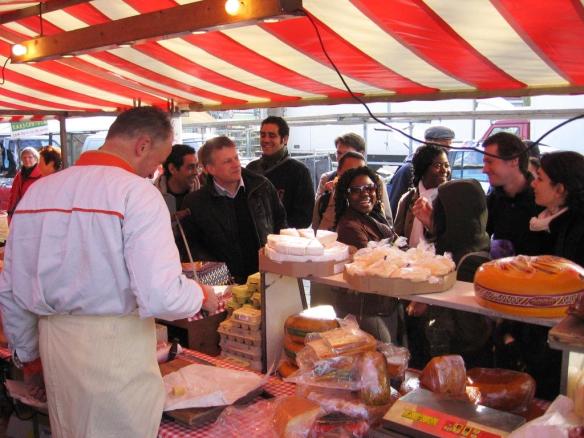
Cheese stall at the Vredenburg MarketTogether with our guide Frank Verhoeven (see his website)  we first went to the Wednesday Vredenburg Market. On this market we visited a cheese seller linked to the organization called Dutch Cheese Centre (website under construction). The stallholder told us about some typical Dutch cheeses and the trade in locally produced ones. After some tasting we set out for the traditional bakery Bakkerij Blom were owner Theo Blom showed us around and told about his bakery, traditional products and production.  

Our last stop was a visit to the five star hotel and restaurant Karel V for a number of short presentations. In the hotel our guide Frank Verhoeven started by telling us about his ‘Boerenbox’ initiative and his vision on a more locally based production and consumption. Secondly, one of the Karel V chefs explained us about the way they work with seasonal products originating solely from regional grounds and local suppliers. Lastly, Arie Bosma, one of the initiators of the campaign ‘Lekker Utregs’, told us about the initiative to reconnect the city of Utrecht with its surrounding countryside by establishing a so called Green Participation Society.

By the fieldtrips we got acquainted with several interesting expressions of urban-rural relationships, from a rural and an urban perspective. It was a nice and inspiring way of linking theory from class to reality by ‘tasting’ real life examples in ‘the field’.

Manual for Cross Cultural Learning

Since 2005 I particpate in the ENDLT network with people from the area Westerkwartier in Groningen. Together we form a Dutch team and we have been visiting other teams in Ireland, Wales, Sweden and Finland trying to learn in-depth from other rural development practices in other cultures. Along the way we developed a manual for cross cultural learning which was discussed and tested this year January (see blogs 26-1 and 29-1). Our Swedish partners have taken up initiative to write the manual which is available now for all who want to set up cross cultural exchanges.

Our network, based on LEADER funding, differs in three ways from usual transnational LEADER visits:

  1. Teams involve different types of expertises, from local activists, to scientists, to local government officers and governors
  2. Visits are multi-team visits in which learning not only takes place in confrontation with the visiting area but also in the confrontation with other cultural perspectives from other visiting teams
  3. Multiple visits within the same network over the years

All three factors serve to make knowledge exchange and learning more effective. It pays off to invest in longer term relationships because for in-depth learning people need time, trust and enabling/safe interaction. We indicated this as one of our success factors in the factsheets that we produced for the ruract network. This network describes itself as:

1) A cooperation network gathering European Regions politically involved for promoting rural innovation at operational and regional level. 2) A resource centre providing methodological tools and an updated database with regional good practices for rural areas and analyzed in terms of transferability. 3) A field of experimentation for European Regions allowing them to exchange and find solutions face to global challenges of rural territories.

This French initiative links up good practices in rural development all over Europe. Our experience in the ENDLT network will be available on this website early summer.

Places worth caring about

This week I have discussed, in my MSc course Understanding Rural Development, the modernization of Europe’s agriculture and rural areas in the post World War II era. By showing pictures, tables and figures I have tried to demonstrate how drastically the rural landscape, the agrarian structure and the food supply chain have changed in a period of several decades. Multifunctional countrysides were transformed into places for specialized and high-tech forms of food and fibre production, the number of farms decreased by some 80% in 50 years time, the average farm size increased enormously, agricultural employment decreased drastically, an ever increasing part of the agricultural products are processed by the food processing industry and the supermarket has become the dominant outlet for most food products. There are, of course, differences between regions and countries, but this is the prevailing development trend in EU member states that have been subject to the EU’s original Common Agricultural Policy. The agricultural modernization project has been very successful in terms of creating food self sufficiency in Europe at low prices for consumers, but this has also come at a cost. By the 1990s the negative side-effects of modernization became widely acknowledged. When talking about negative side-effects topics as environmental pollution, degradation of biodiversity, declining farmers’ incomes, animal welfare concerns and consumers’ distrust in the modern food system are usually brought to the fore.

Inspired by a humorous and thought-proviking presentation of James Howard Kunstler at the TED 2004 conference (“The tragedy of suburbia” ) as the analogy between suburbian development and agricultural modernization is astonishing, another side-effect came to mind: the loss of a sense of place and a sense of belonging due to the (feeling of) expropriation of local self control (e.g. due to centralized spatial planning) and due to the eradication of many specific and distinctive regional assets (cultural history, landscape, traditional products and processing techniques, etc…). Rural regions that were subject to the agricultural modernization project have de facto become non-places and are thus easily interchangeable. And as a result many rural regions have become, quoting Kunstler, places not worth caring about … and places not worth caring about are places not worth protecting or defending.

Looking at rural development from this point of view sheds an interesting light on its dynamics. Continue reading

Regional differentiation

On 2 March my MSc course “Understanding Rural Development: Theories, Practices and Methodologies” started (also see the course outline). This course is specifically designed for the specialization Sociology of Rural Development of the Master in International Development Studies, but is open to students from other Master programmes as well. At this moment 14 students (from Columbia, Germany, Ghana, Italy, the Netherlands, New Zealand, Spain and South Africa) are participating. Each week we focus on one particular theme that I consider to be highly relevant to better understand rural and regional development dynamics.

This week’s theme was “Regional differentiation”, which refers to the fact that rural regions are moving along distinct and different development trajectories. During the last decades a vast body of scientific literature about regional differentiation has been developed, although a substantial part of this literature is characterised by an urban bias towards regional development. Terry Marsden and Jonathan Murdoch are among the few scholars that have explicitly included the rural in theories of regional differentiation. With their conceptualisation of regional differentiation as the outcome of different constellations of political, economic and social networks they have been able to significantly contribute to contemporary theories about regional development that also take the rural into account.

Although it is important that students are introduced to these concepts, I want to avoid that theoretical insights remain abstract notions. That’s why students are also introduced to empirical realities (through field trips, presentation of case studies from research projects and (short) movies). This week we looked at five movie clips about regional development in Southwest Minnesota. Together these five clips very well showed some of the key factors impacting on changes in regional political, economic and social networks: migration, utilization of endogenous resources, learning and innovation (learning region), technologies, and visionary leadership. More in general the case of Southwest Minnesota shows that regional development is a specific combination of endogenous and exogenous development, or,  a specific local response to global developments.

Intensive Course Programme – agriculture, territorial identity and competitiveness in rural Poland

Since 2002, Rural Sociology Group is partner in a European Intensive Course Programme. MSc-students from universities across Europe can attend an intensive course programme of two weeks to study in depth rural issues in one of the particiapating countries. Earlier IP’s were organized in Ghent, Pisa, Cordoba, Faro, Malibor and, last year, in Kaunas, Lithuania.IP Kaunas 2008, lecture

As MSc-student I participated in the IP course in Lithuania last year and I have very good memories of the course which fully lived up to its name ‘intensive program’. The days were filled with lectures, excursions and activities aimed at providing us with a thorough inside into diverse problems (regarding society, environment and economy) encountered in rural Lithuania as well as teaching us methodological means to investigate these. On top of that, the course did not fail to allow for time to engage in social activities, providing the opportunity to get to know fellow course participants from various European countries. To support this unique opportunity to get acquainted with rural development in the EU, I will join this years’ IP as a tutor! Perhaps we will meet. 

Agriculture, territorial identity and rural competitiveness
This year the IP is organized by the University of Life Sciences in Lublin, Poland, from April 19 till May 2. The IP is open for 52 students from the 13 partner universities. This year topic is the place of agriculture in territorial identity and competitiveness of rural areas and its contribution to rural development. Students that plan to do a minor or major in Rural Sociology and with an interest in the topic can apply and contact Jan Schakel: Jan.Schakel@wur.nl . A course programme and newsletter are available.