
The island of Vinön

Part of the study the ENDLT network did (see blog 26 -1) was to visit a project on outdoor education on the island of Vinön.

The island is the largest island in lake Hjalmaren, approximately 200 km from Stockholm. The island has 100 permanent inhabitants and population decreased over the past twenty years. Many commute to mainland jobs, others have small-scale enterprises, often a combination of fishing, farming, gardening and tourism. The European LEADER funding for rural development has been used to develop a framework for the development of Vinön. Continue reading

New Project – Dynamics and Robustness of Multifunctional Agriculture

On the first of February the Rural Sociology Group, in collaboration with the Education and Competence Studies Group, will start with a large research programme entitled ‘Dynamics and Robustness of Multifunctional Agriculture’. This project is financed by the Dutch Ministry of Agriculture, Nature and Food Quality and supported by the Task Force Multifunctional Agriculture. The programme aims to deepen our understanding of the critical factors that exert an influence on the dynamics of multifunctional agriculture. Factors that could play a role are for instance the Continue reading

Rural development in Brazil

fabio_kesslerProf. Fabio dal Soglio from the Federal University of Rio Grande de Sul (UFRGS) is currently our guest. He is one of the professors working in the Post-Graduate Programme on Rural Development (PGDR) and he has a particular interest in agro-ecology.

The  UFRGS and the PGDR-group in particular wants to extend collaboration with the Rural Sociology Group, as initiated by prof. van der Ploeg, by the exchange of staff, exchange of MSc and PhD-students and by joint research.

As part of an assignment for the MSc-course Sociology in Development, a group of MSc-students grasped the occasion and interviewed prof. Fabio dal Soglio on the Landless Workers Movement (MST) in Brazil and their struggle for land and land reforms.
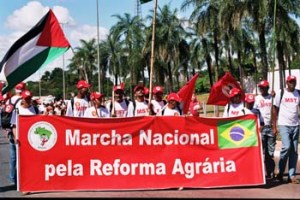
mst-21Quoted from the MST-website (English edition):

 The MST is the largest social movement in Latin America with an estimated 1.5 million landless members organized in 23 out 27 states. The MST carries out long-overdue land reform in a country mired by unjust land distribution. In Brazil, 1.6% of the landowners control roughly half (46.8%) of the land on which crops could be grown. Just 3% of the population owns two-thirds of all arable lands.

Since 1985, the MST has peacefully occupied unused land where they have established cooperative farms, constructed houses, schools for children and adults and clinics, promoted indigenous cultures and a healthy and sustainable environment and gender equality. The MST has won land titles for more than 350,000 families in 2,000 settlements as a result of MST actions, and 180,000 encamped families currently await government recognition. Land occupations are rooted in the Brazilian Constitution, which says land that remains unproductive should be used for a larger social function.

 The MST’s success lies in its ability to organize and educate. Members have not only managed to secure land, therefore food security for their families, but also continue to develop a sustainable socio-economic model that offers a concrete alternative to today’s globalization that puts profits before people and humanity.

Drivers of sustainable food networks

Today the Limburg Chamber of Commerce hosted the first day of the provincial tour of the Foundation Urgenda, a foundation aimed at innovation and sustainability. Members of Urgenda are spending 3 days in the province of Limburg to visit a range of iniatives about sustainable regional development. I was asked by the Limburg Chamber of Commerce to give a lecture about the role of food in sustainable regional development. In my lecture I first explained the unsustainability of the prevailing food regime as it has resulted in a wide variety of problems, such as the obesity epidemic, malnutrition among the elderly and poor, and environmental impact due to food waste and food transport. I then presented and discussed several examples of sustainable food networks (in different stages of development) that are (potentially) capable of addressing one or more of the problems just mentioned. Examples discussed were for Continue reading

Cross cultural learning in rural development

Last week, from wednesday 21 to friday 23 of January, I stayed in Basenberga, mid Sweden for a workshop on cross cultural learning in rural development. The workshop was organised by the Swedish team of an informal LEADER-based network which exists since 2005 and which calls itself ‘European Network for Local Development Teams (ENLDT). The ENDLT is a knowledge building and shared learning network involving mixed teams of local practitioners, local politicians/civil servants and academics from the countries Ireland, Sweden, Finland, the Netherlands and with some earlier participation from Germany, Hungary and Great Britain. By visiting each other, by the mixed nature of our teams and by developing a method for cross cultural learning, we jointly deepened our understanding of local development in different European settings which benefited our own practice. This time in Sweden a small proportion of the network came together to test and discuss the Manual of our method, written by the Swedish team. The Manual will be published in March and will be available on the web.