Know your farmer, know your food

Recently I joined a Dutch internet Sustainable Food group. Today the convenor of this group informed the members about a new initiative of the USDA (United States Department of Agriculture): “Know your farmer, know your food”. The aim of this USDA initiative is to help more Americans understand where their food comes from and how they can support local food economies in their communities. The initiative was announced by USDA secretary Tom Vilsack in a YouTube video:

“An American people that is more engaged with their food supply will create new income opportunities for American agriculture. Reconnecting consumers and institutions with local producers will stimulate economies in rural communities, improve access to healthy, nutritious food for our families, and decrease the amount of resources to transport our food.”

While the White House kitchen garden and Obama’s idea to have a weekly farmers’ market at the White House (see my blog posted on 4 September) could have been perceived as ‘window dressing’, this USDA initiative surely gives the impression that the Obama administration is seriously attempting to fundamentally change US agrofood and rural development policy. Will, in this case, Obama’s campaign slogan – “Yes, we can” – become true?

Victory Gardens revisited – the Obama Foodscape

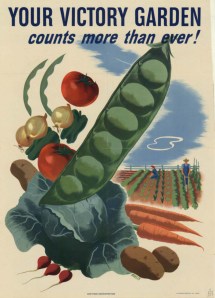
US World War II era poster promoting Victory Gardens (source: http://www.art.unt.edu/ntieva/pages/about/newsletters/vol_15/no_1/WarPosterImages.htm)

US World War II era poster promoting Victory Gardens

Victory Gardens, also known as ‘war gardens’ or ‘food gardens for defense’ were fruit, vegetable and herb gardens planted in backyards and on rooftops in the USA, the UK, Canada and Australia during World War II. They were considered to be an important means to reduce the costs for vegetables needed by the US War Department to feed the troops and to safeguard food security. One of the advocates of the Victory Garden was Eleanor Roosevelt, US first lady from 1933 to 1945, who also planted a Victory Garden at the White House. The Victory Gardens were a great success: the 20 million Victory Gardens in the US produced up to 40% of all vegetables that were consumed in the US.

After World War II the number of Victory Gardens rapidly decreased as most citizens believed that food shortages would be over soon. However, in recent years there is a campaign to re-establish Victory Gardens. Not to reduce the price of vegetables needed to feed US troops, but primarily from the perspective of food sovereignty; as a means to escape the growing dependence of consumers on the food stuffs provided by the food processing industries and retailers. At the same time gardening is also considered to be an important instrument in greening cities, in growing sustainable communities and in educating children about food and healthy eating (see e.g. our recent blogs about urban agriculture and nourishing the city).

For such a movement to become a success it is always helpful to have a leading figure as an icon. It seems that the USA’s new first family, in particular first lady Michelle Obama, is taking on this role. For the first time since the Roosevelt days, the White House once again as a garden. This beautiful short movie gives a good impression of the White House kitchen garden and the rationale behind it. 

However, there is more to food and the Obama’s than the White House kitchen garden only. Recently President Obama  announced that he wants to set up a White House farmers market to support local farmers and as an example of creating new connections between cities and its surrounding countryside. Interested to be informed about  the Obama Foodscape, have a look at the  Obama Foodorama weblog.

Urban Agriculture / Stadslandbouw

Growing food in urban gardens and allotments has a long history. In the Netherlands, allotment gardens are a marginal but natural part of the city’s infrastructure. Other European countries have their own history in urban gardening too, such as many Eastern European countries. Also in the US, urban gardening is a long standing practice.

However, in the Netherlands as well as in the US, urban gardening is moving from the fringe into the heart of a debate about health and sustainability. The manifestations look similar. For example, the Alemany Farm in San Francisco which started on a vacant lot (see story) or the Red Hook urban farm (see earlier blog). Also in Rotterdam, Proefpark de Punt started on a vacant lot and also this initiative met skeptics of urban planners and city leaders until it had proven itself.

Reading the articles and websites of initiatives related to Urban Agriculture in the US and its counterpart ‘Stadslandbouw’ in the Netherlands, there seems a striking difference too. In the US, the food production aspect of the gardening is taken far more serious as an option for providing people a significant portion of their daily food. Growing food in urban gardens is about access to fresh food. Not in the last place for those who do not have easy and affordable access.

In the Netherlands, this notion is not absent of course. But the language around the initiatives starts from a broader notion of the need for ‘green space’ for the health of the urban citizen. A green environment, education about nature and food, recreation possibilities in accessible green spaces, the improvement of mental health and social cohesion by means of gardening. These notions can also be found in the initial objective for setting up Proefpark de Punt:

‘Landleven in de Stad’, een natuurlijke speel- en recreatiemogelijkheid voor de buurt te creëren.

A trend watcher on the website of Proefpark de Punt talked about ‘squatting green space’ which is what many initiatives in the US and the Netherlands essentially do. However, the local context differs considerably which means that the connections to health and sustainability are interpreted quite differently. A call for comparative studies I guess.

Proefpark de Punt

Proefpark de Punt

Home

I came home to the Netherlands last week. That is, physically, I feel in between places mentally, somewhere in the ocean of experiences. My time in the US has been an intense experience.

Confucius said: tell me and I forget, show me and I remember, involve me and I understand. Thanks to the great hospitality of Cornelia and Jan Flora and to their ability to include I was involved in so many activities and meetings. And it was great fun to try to understand.

I came to appreciate the friendliness of the Midwest, the many spontaneous conversations in shops or on the street. And the many little things which caught my surprise. The use of ice cubes, the four way stop, the vegetable kale, the garage sale, the barbeque restaurant, shotguns, raccoons or badgers, bike paths ending in corn fields. To list just a few things.

Did I see mainstream US life? Probably not. Friends that I made usually turned out to be bikers, non-tv owners and local fresh vegetable eaters…Thanks my friends for crossing my path.

I terms of agriculture, it will be nice to contrast and compare that what I saw with what´s going on in Europe. I am sure there will be a lot of inspiration at the European rural sociology meeting in Vaasa, Finland, which is about to start.

Corn, soybean and hogs; the way we do things here

Iowa agriculture is dominated by corn, soybean, hog and ethanol production. A common feature among this list is that all of these are commodities; bulk products ready for further industrial processing. In a way, Iowa agriculture represents a single ‘farming style’ (Van der Ploeg et al), a choice for:
– a high level of specialization
– high input/high output (a throughput system)
– a high level of mechanization and reliance on technology

So, when the only thing you see growing is corn, you come to believe that Iowa is only suitable for corn, and, maybe, to a lesser extent for soybean. I came across such a conviction many times. For example, at the windmill visitors centre in Pella, I was explained how the wheat which is milled every six weeks comes from North Dakota. “Because in Iowa, you can only grow corn” the lady explained.

The omnipresence of corn, soybean and hog production has a social-coercive character.

“The habit obtains, when established, a more or less self-evident, normative character. Things do not only happen like this, they should happen like this” (Hofstee 1985 in Van der Ploeg 2003: 237).

Highly productive and efficient corn and hog production have become part of people’s identification with what good modern agriculture is all about. Something to be proud of and a status quo to be defended. This identification is not simply about knowledge and power but about beliefs and thus emotion of what is felt morally right.

In the Farm Bureau paper The Spokesman (H29/09) an author felt compelled to defend farming in Iowa, because environmentalists “impose” further unspecified “climate change rules” on farmers which lead oddly enough to environmental damage according to him. How? The logic of reasoning is startling. Basically, other countries would fill the market gap by the increased cost/decreased production is the argument. But – with empathy – the author continues that “in many of those areas, land is fragile and is prone to severe environmental degradation if it is intensively farmed.” Especially because “farming practices in the developing world are not as environmentally advanced as those in the United States.” He concludes therefore that “improving corn and soybean production right here in Iowa” is the best thing to do since Iowa is “the most efficient and most environmentally-friendly place on Earth” for it. Go figure.

Changing the agricultural landscape in Iowa is in essence a cultural change, a change in values and beliefs. The impact of the sheer presence only, of people making alternative choices, of alternative farming styles and practices such as those represented in forms of organic and local food production, cannot be underestimated. Their practice is a ‘nuisance’ because it confronts and therefore uncovers the taken for granted. Of course as the example illustrates, new awareness can be denied, but a return to unawareness is impossible.
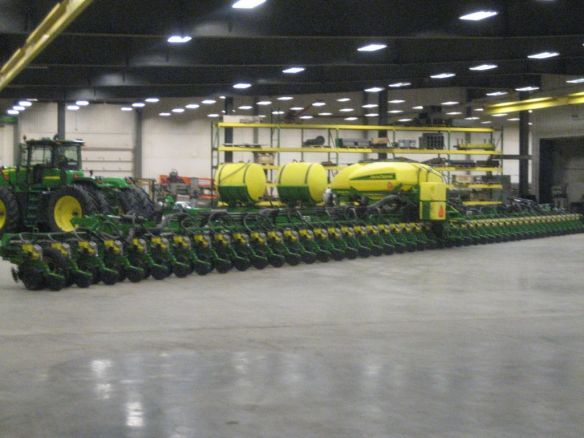
The Technology Treadmill. John Deere's new 48-row planter. From: combineforums.proboards.com

The Technology Treadmill. John Deere's new 48-row planter. From: combineforums.proboards.com