Romashki or a Life Less Ordinary, part 1

Thomas Macintyre is a MSc student enrolled in the Master International Development Studies. For his MSc thesis research he spent 3 months in an ecovillage in the Ukraine, to study everyday village life. Thomas’ post is the first of a series in which he shares his experiences of the “life less ordinary” he has lived for 3 months.

Imagine if you can a little village surrounded by forests beside a little lake. Squirrels play in trees amongst the woodpeckers, frogs play hide and seek with the cranes in the lake, and when the sun has set, the wild pigs come out to sniff and dig around the fields and gardens in the village, curious as ever as to see what is new.  Continue reading

Looking at organic+ activities and their perception by consumers in the rural web

Before I start writing about organic+ activities and consumers I would like to introduce myself.

My name is Corinna Feldmann and I study Organic Agriculture in my second year. I just finished my master thesis: ‘What does the consumer take up? – A case study on communication in the rural web around the dairy in Andeer’.

Everything started in late spring of 2009, when I decided that I would like to do my research on consumers and their opinion on producer’s activities which go beyond the minimum standards of organic regulations. So, I found my way to the Rural Sociology Group and met Bettina Bock. Doing some investigations on the internet I came across the first report of the EU Core Organic Project on Consumer Farmer Partnerships which deals with the identification of communication arguments used by small-scale farmers and producers who engage in organic+ activities. Thereupon I got into contact with the research institute for biological farming (FiBL) in Switzerland who is one of the partners in this EU project. In May I wrote my research proposal with the help of Heidrun Moschitz and Flurina Schneider from FiBL and Bettina Bock. The core of my research was to find out what aspects of the communication arguments consumers perceive as important. Continue reading

Afbouwers, liefhebbers en ondernemers – deel II

Het afstudeeronderzoek van Bart Bremmer naar kleine grondgebruikers in de gemeente Borne is hier al eerder belicht.  Hier vat Bart kort de belangrijkste uitkomsten van zijn onderzoek samen (klik hier voor de complete thesis).


Door Bart Bremmer

In Nederland zijn er ongeveer 20.000 agrarische bedrijven met een omvang tussen de 3 en 16 nge (Nederlandse grootte-eenheid): hele kleine bedrijven die vaak het predicaat ‘hobbyboeren’ krijgen en neergezet worden als een oninteressante restcategorie.

Door diepte-interviews heb ik in mijn onderzoek de activiteiten en drijfveren van 21 kleine grondgebruikers in de gemeente Borne in kaart gebracht. Op basis van betekenisvolle verschillen in drijfveren en achtergronden heb ik drie portretten opgesteld.

Liefhebbers noemen vrijetijdsbesteding als belangrijkste drijfveer voor de activiteiten die zij hebben – in de meeste gevallen het houden van koeien of schapen op één tot enkele hectares grond. Eén van de liefhebbers zegt hierover:

…ik vind het gewoon leuk; een ander verzamelt postzegels.

 Er zit echter veel meer achter: vrijetijdsbesteding is voor geen van de liefhebbers de enige drijfveer. Liefhebbers gebruiken vaak grond die al jarenlang in de familie is en die daardoor een bepaalde emotionele waarde heeft: zij willen dit familie-erfgoed behouden. Een andere belangrijke drijfveer voor de activiteiten is dat er met het grondgebruik invloed uitgeoefend kan worden op de directe omgeving. Liefhebbers hechten veel waarde aan rust, ruimte en een mooi uitzicht en dragen daar zelf ook met plezier aan bij.

Ook afbouwers noemen vrijetijdsbesteding vaak als eerste drijfveer. Zij hebben hun (reguliere) agrarische bedrijf afgebouwd tot een ‘hobbybedrijf’ en stoppen daar nu veel van hun tijd in:

De belangrijkste drijfveer? Dan heb je wat te doen: ik moet er niet aan denken dat ik de hele dag in de keuken moet zitten.

Het hebben en gebruiken van grond heeft voor afbouwers echter wel een andere betekenis. Zo is in hun ogen de vrijetijdsbesteding pas geslaagd – wordt er leuk ‘gehobbyboerd’ – wanneer er ook echt iets geproduceerd wordt. De activiteiten van de afbouwers zijn dan ook vaak iets omvangrijker en arbeidsintensiever. Ook voor de afbouwers geldt dat ze invloed willen (blijven) uitoefenen op hun leefomgeving.

Bij de ondernemers is het vergaren van inkomsten uit bedrijfsmatige activiteiten een belangrijke drijfveer. Het is een onderdeel van een inkomenstrategie. De activiteiten betreffen vaak een vorm van verbrede landbouw.  Maar het gaat niet alleen om inkomen vergaren, ondernemers hechten veel waarde aan het uitoefenen van (agrarisch) ondernemerschap:

Een beetje boer zijn is ook wel mooi: met dieren omgaan…

 Opvallend is dat ook bij de ondernemers het in stand houden van familie-erfgoed en het beïnvloeden van de leefomgeving vaak als belangrijke drijfveren worden genoemd. Economische en sociaal-emotionele drijfveren zijn eigenlijk niet te scheiden:

Wij wonen hier, wij werken hier en wij leven hier.

Door te kijken naar de drijfveren wordt duidelijk hoe belangrijk de activiteiten en de grond voor de kleine grondgebruikers zijn. Ook blijkt hoe verschillend de betekenisgeving, en daarmee de rol van de verschillende kleine grondgebruikers, eigenlijk is. Uit de verhalen van de respondenten blijkt namelijk dat het grondgebruik niet alleen voor de kleine grondgebruikers zelf belangrijk is, maar ook voor het gebied en de samenleving. Doordat zij vanuit andere drijfveren werken dan de reguliere agrariërs, zorgen kleine grondgebruikers voor verscheidenheid: afwisseling in het landschap en productie van unieke goederen en diensten.

Door de nadruk te leggen op wat ze niet zijn – namelijk productieve reguliere agrariërs – kunnen de kleine grondgebruikers inderdaad getypeerd worden als een restcategorie. Maar wanneer er vanuit een breder perspectief naar hen gekeken wordt, blijkt dat hun activiteiten en grondgebruik betekenisvol zijn voor henzelf en voor anderen.

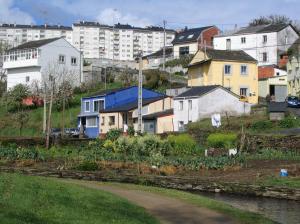
Land abandonment in Galicia

By Marlies Meijer (MSc-student)

Land Abandonment in Galicia

Land abandonment in Galicia

As I wrote earlier, I am balancing between the multiple realities of Galicia. Now, several weeks later I’m still balancing. Off course everything is different than the assumptions and hypotheses I had in the Netherlands. The rural situation here is complex and has many faces. For the moment I am trying to untangle the different storylines I encounter here. Hopefully one or two are nice enough to work out and to connect to a more theoretical storyline. It is a delicate job, which can only be completed in Spanish (I never realised that almost closed scientific communities existed because of language barriers) and with as less generalisation as possible, as ‘everything is different is Galicia’. It also implies that I have to let go of my Dutch reality and leave behind the loose ends I developed back home.

Land abandonment  – One of the storylines I encountered is land abandonment. Almost 25 % of the Galician countryside is abandoned, with far-reaching effects. In the Netherlands we would call an abandoned parcel new nature or verrommeld (messy). Here it implies higher chances for forest fires and agricultural devaluation. Rural Galicia exists of many small farms, with small parcels and above all many land owners. Most landowners simply own land, they do not live there, nor do they use the land for (agricultural) production. Because of low costs it is possible to own land, and leave it more or less abandoned. Most owners do not want to sell their land, they prefer to keep it as a capital resource for economically bad times, or in case its value increases because of urban expansion or afforestation. Some owners are simply not aware of the fact that they own land. Because of a malfunctioning administrative system and a lack of a clear spatial policy these situations can occur everywhere and to everyone, only no one knows exactly where.

On the other hand most farmers or peasants are not able to buy extra land. Their resources are limited. In the past decades the most substantial farmers already invested in milk quota, machinery and other devices in order to catch up with the rest of Europe.

The result is a situation where spatial and rural developments are fixated. Measures are developed to loosen the situation; for instance a land bank to facilitate renting land to other users, in order to mobilise the land market. But also these measures encounter problems.

On the one hand, Galicia struggles with policies from the past and large measures (top down) that are needed to change and improve the rural situation. Modernisation, like elsewhere in Europe, did not take place in Galicia. Notwithstanding the problems it brought to other countries, it is a phase needed in this country to improve the quality of life on the countryside. On the other hand, we do live in an era where bottom-up approaches and local participation are preferred, also in Galicia this is an hot item. How these two extremes are intertwined seems to me an interesting starting point for further research in Galicia.

Balancing between multiple realites

By Marlies Meijer, MSc-student combining Land Use Planning and Rural Sociology

“Only when we travel, and meet strangers, do we recognise other ways of being human” (Patsy Healey in Collaborative Planning, after Latour).

city - countryside transition in galicia

city - countryside transition in galicia

So here I am, travelling (or balancing) between land use planning and rural sociology, my Dutch planning knowledge and the Galician rural reality, between reading in Gallego, speaking in Castellano, writing in English and chatting in Dutch, between the Spanish working hours and my Dutch empty stomach.

As many students I wanted to stay abroad for a long period of time during my MSc. For students in rural sociology this is probably a logical highlight of their studies; students in land use planning leave their country less frequently. I wanted to go anyway. Since my interest in rural dynamics and policy making processes, contact with the RSO group was established quickly, together with the possibility to go to Galicia, Northern Spain.

Back in the Netherlands, I was aware of the Dutch context of my education so far. Most examples provided are Dutch, or could be placed in the planning Dutch context. I wanted to broaden my scope, go somewhere where policy making is less evident and face the effect of a different cultural context, but also to experience a real rural area. Now I find it hard to let the familiar Dutch context go and to explain what I exactly do study in the Netherlands (something like geography, people making plans and rural development) and what my research is about (even more vague). Multi-faceted policy, focussed on the spatial environment, does not exist here, as it exists in the Netherlands. So I keep on balancing, and exploring and let myself be surprised every day by the Galician way of doing.

Marlies also has a personal blog (in Dutch):  http://marliesengalicia.blogspot.com/