
October 11 2016, Anne Verschoor successfully defended her MSc-thesis ‘An impact assessment of potentially radical niche developments in the Dutch dairy sector‘. She thus completed the Specialization Gastronomy of the Master Food Technology of Wageningen University. Applying a Social Science perspective in her thesis research was extra challenging but she managed very well to do so. Below an abstract of the thesis. Continue reading
Category Archives: Agriculture
A light shining on Cluj – Nyeleni Europe Forum for Food Sovereignty
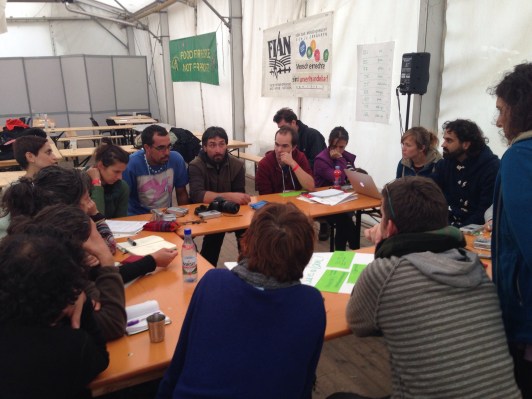
Participants discuss strategies to advance food sovereignty in Europe
Last week the second Nyeleni Europe forum for Food Sovereignty was held in Cluj-Napoca, Romania. The Forum brought together different delegations from European countries and beyond representing producers, consumers, NGOs and researchers involved in the Food Sovereignty movement. The Forum set out create new initiatives and ties among people in opposition to the dominant food paradigm. Continue reading
Resistance in action in the Mayan region: “NO to GMO’s”

Mayan women in a concert of the Ma OGM campaign. Source maria Boa
August 18 María del Refugio Boa Alvarado successfully defended her MSc-thesis ‘Resistance in Action; Mobilization of Mayan beekeepers against GM soy: The case of the ‘Colectivo MA OGM‘ for the Master International Master in Rural Development. Below a post by Maria.
Are you interested on social movements? On Indigenous rights? On collectives and their practices? For years, many social scientists have been fascinated by the study of social movements and collective action. In my case, I am fascinated by the research of complex associations that frame and articulate their claims or grievances. Particularly, the processes of social transformation that have their grassroots within indigenous communities. Continue reading
Assessing the Sustainability of Local and Global Food Chains – GLAMUR Special Issue

The EU-funded research project GLAMUR has been completed earlier this year. More info on the project, its sustainability performance-based approach and the findings can be accessed at the website. Next to all reports a synopsis of the project, its approach, the main findings and recommendations has been published, a leaflet with the main messages and finally a Special Issue of Sustainability: Sustainability Performance of Conventional and Alternative Food Chains was recently published containing eight open access articles following an editorial by Gianluca Brunori and Francesca Galli.
The Symbiotic Food System of Dar es Salaam – new publication
Just published in a Special Issue of Agriculture: ‘The Symbiotic Food System: An ‘Alternative’ Agri-Food System Already Working at Scale‘

Woman Maize Traders in Dar es Salaam, source Marc Wegerif
In this new article Marc Wegerif and Paul Hebinck show how small-scale and interdependent actors produce food and get it to urban eaters at a city feeding scale without large vertically- or horizontally-integrated corporate structures. The research from Dar es Salaam, a city of over 4.5 million people, reveals a ‘symbiotic food system‘ that is an existing alternative to the globally dominant agri-business model. Importantly, it can and does deliver at scale and in a way that better responds to the needs of people in poverty; both food eaters and food producers. Neither is the symbiotic food system static, it is growing in response to the needs of the city, but it does not grow through the popular notion of ‘scaling-up’, rather it grows through a much more equitable process of replication. The article gives particular attention to the functioning of market places and how new actors enter into the food system. These reveal that more important to the system than competition are various forms of collaboration based around symbiosis as a core ordering principle. Moreover, the paper shows that the symbiotic food system connects in many, often unexpected, ways the urban and rural spaces in Tanzania. There is much to learn from such a system which develops without significant support from the state or other agencies.
Also published in this Special Issue: Theorizing Agri-Food Economies by Jan Douwe van der Ploeg, discussing how agri-food economies evolve over time. A central thesis of the paper is that different theoretical representations not only reflect the differences in agro-economies and their developmental tendencies, but are also important drivers that actively shape the trajectories that they describe.
 Rural Sociology Wageningen University