Inclusion and exclusion of the rural… – Jan Schakel in Rennes – Part 4

As I wrote before, there are many relations between the urban and the rural. I just mentioned some of them: the markets, the food,  the regional identity, the life histories of families and …. biking trails… Although many people (in Rennes) don’t recognize this aspect, they do agree when I explain it to them. Maybe it’s too familiar to them –it might be in their backbone. But maybe also, because many Rennes’ peoples are getting very global: they just travel by car, TGV, Thalys or plane. Not any more by bike. Anyway, every day –after work- I’ll take my Batavus, and start roaming around. But when sunsets starts, I go to the écluse de St Martin’ (“shiplock”),  just nearby the Agrocampus. It is exactly on the edge of the city and the countryside. I go there, just to experience a beautiful phenomenon. I am not the only one that goes to that place. When it’s getting dawn, I see ten, hundred, thousand and ten thousands, maybe even millions of birds (starlings) coming back from the countryside. I don’t know where they have been all day, but every night the gather together on the electricity pylons and its wires; they come from everywhere, with thousands and thousands. Like me, but I’m there just to watch them. It almost takes an hour when they’re “all there”..(although I do not count them).  And then, suddenly (who said to leave; which bird took the initiative; and why?) they disappear, and they all go into the city. I’ve been told that they always go to the same places, and that hundreds of  trees are fully loaded with birds, really: fully loaded, and you can listen all night to their talks and stories…you can’t even sleep. But the next morning: they all have left. Where have they gone? Fascinating. But even more astonishing is the fact that this daily rural-urban migration became part of an urban ‘exclusion’ policy. The birds are not welcome anymore in the city, at least: not everywhere. For example, in the luxurious  Avenue de Jean Janvier (just opposite the central railway station)all trees are covered with nets(see picture), so the birds can’t have their sleep there anymore. I noticed these nets one morning on my daily trip to the station to buy my “de Volkskrant”. Rennes is changing … Anyway; the peoples who I asked about these nets, they just shook their head; they didn’t understand it either. Why exclude the birds…?

Some years ago, Rudolf van Broekhuizen and I did some research on “breeding and culture” as part of the EU funded project called “Sustainable Farm Animal Breeding and Reproduction” (SEFABAR). We studied the cultural context of breeding (for four species: poultry, pigs, ruminants and aquaculture)in 6 different countries.  France was one of them, together with the USA, Thailand, Norway, Italy and the Netherlands (by the way: why do I have to say in French that ‘je suis Hollandais, je parle Neerlandais, et je habit a Pays Bas’? Three words for one nationality; rather complicated!). Anyway, breeding can be embedded in or intertwined with culture in many ways and with different meanings. Although we noticed –especially in breeding – an ongoing process of globalization, we also noticed processes of (re-)localization. Our main conclusion was: culture and context still do matter! In Italy for example, breeding is strongly related to food, and in France breeding still is deeply rooted in the region: ‘origine’, ‘identity’ and ‘terroir’ are the keywords  to understand the cultural context of French breeding.
Continue reading

The Economics of Green care in Agriculture. Edited by Joost Dessein and Bettina Bock

Recently published and available on line The Economics of Green care in Agriculture, edited by Joost Dessein and Bettina Bock.


The publication is part of our participation in COST Action 866 ‘Green care in Agriculture’. This COST action brought scientists and practitioners together who are working in the broad domain of ‘green care in agriculture’ with the purpose of increasing the scientific knowledge on green care, its potential for improving human mental and physical health and on the best way to implement green care in agriculture throughout Europe. The COST action consisted of different working groups that looked into health effects of green care, the economics of green care and policies related to green care (http://www.umb.no/greencare/). This publication reflects on the Economics of Green Care and the possibility to measure and evaluate its costs and benefits, taking into account the wide variation in Green Care arrangements throughout Europe. A limited number of free copies is also available at the Institute for Agriculture and Fisheries Research Merelbeke, Belgium (www.ilvo.vlaanderen.be), where Joost Dessein works (email: joost.dessein@ilvo.vlaanderen.be).

Boer-burger ontmoetingen – een essay

In opdracht van het Trendbureau Overijssel hebben we met vijf collega’s van Rurale Sociologie een essay geschreven over boer-burger relaties. Samen met drie andere essays (door Jandirk Hoekstra van H+N+S, Tia Hermans van Alterra en Geert Boosten van Stichting DoTank) en een LEI-rapport over landbouw in Overijssel moet ons essay bijdragen aan een discussie in provinciale staten en gemeenteraden over de toekomst van de landbouw in Overijssel. De vijf bijdragen worden t.z.t. op de website van het Trendbureau geplaatst bij het onderdeel Toekomst verkenning landbouw.

Onze bijdrage ‘Palet van boer-burger ontmoetingen‘ gaat over de wisselwerking tussen boeren en burgers en hoe boer en burger elkaar op allerlei manieren ontmoeten en met elkaar verbonden zijn in een web van relaties en gedeelde praktijken. De veelzijdigheid en dynamiek in boer-burger relaties typeren we aan de hand van zeven uiteenlopende boer-burger ontmoetingen, zijnde:

  1. Goeie buren
  2. Zorg voor en met elkaar
  3. Gezamenlijk natuur- en landschapsbeheer
  4. De tegenreactie
  5. Het boerenleven beleven
  6. Streekeigen consumeren
  7. De virtuele marketing relatie

In het essay wordt e.e.a. nader toegelicht en uitgewerkt. We zien deze typering als een voorlopige schets. Een interessant vraag is in hoeverre boeren en burgers zich hier in herkennen. De vraag is ook hoe al deze ontmoetingen uitpakken voor de ontwikkeling van een gebied en of de diversiteit en dynamiek van boer-burger interacties een houvast bieden voor het (bij)sturen van ontwikkelingen.

Sus Rinus: November

The pig slaughter process is not a visible part of our daily relation to food anymore. In fact hardly anything of the growing, rearing, processing and slaughtering is visible to us. We can therefore assume to be more civilised than our ancestors while eating meat because it is so easy to close our eyes for the killing and chopping done by others. How horrified would we be if we had to chop the head of the chicken that we intend to cook tonight. How awful and sad it would be to slaughter Rinus after you got to know him intimately.

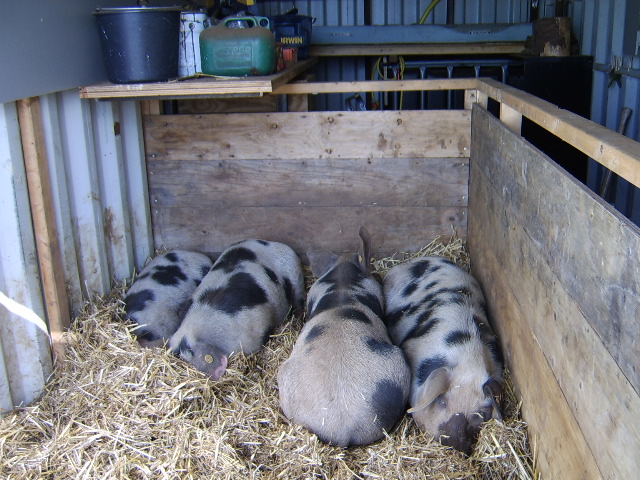
Increasingly, I come to think the other way around; how awful that I eat an anonymous pig who had an anonymous life together with a few million others and who’s parts are being used in at least 187 products without us knowing. How horrible that this piece of meat sealed in a plastic box with a number of ‘stars’ (see Keuringsdienst van Waarde) does not really link my thoughts to a concrete animal. How outrageous that I shovel my food in without thoughts about that little piglet grubbing around, to the wiggling of a fully grown pig tail while he is playing pig, to the socializing that they do, to the little naps they take, to the way they run to be fed.

Anna, Bom, Rinus and Alie were not only literally digging up the border but they also symbolise the border between a pig and our food (see the wonderful report with lots of pictures of assistant farmer Onno van Eijk). A culture that values their food, is a culture that knows their food. Once you know, fed and cared for Rinus, his meat becomes precious, the slaughtering an intense and difficult ritual and nothing of him will be spoilt or mindlessly consumed (see also the Volkskrant article).

The care and attention which naturally appear when you are involved in all aspects of the food leads to a quality which is recognised elsewhere in the world as a strong food culture. The majority of us, however, are made to value brands instead of food.

Staggered by Queen’s speech

Yesterday Queen Beatrix held her annual Queen’s speech (Troonrede). I was astonished by her words about the Dutch agricultural sector. The text – written by our ‘demissionary cabinet’ – promoted a production- and export-oriented agriculture based on new technologies and innovations.

  “Nederland is de op één na grootste exporteur van land- en tuinbouwproducten. Het innovatieve en duurzame karakter van onze agrarische sector staat wereldwijd hoog aangeschreven. Ons land kan een belangrijke bijdrage leveren aan de mondiale voedselzekerheid door te blijven werken aan verbetering van de huidige technologieën. De overheid schept hierbij randvoorwaarden voor duurzame productiemethoden.” – Troonrede 21 september 2010 

These words could have been written decades ago – in the era of maximizing agricultural production when high levels of technology promised to solve the problems – only this time such promises are headed under the name ‘sustainable production methods’. But by now, we should have learned our lessons over time; technology can help to find solutions, but only if these also fit into our social and cultural world.

Listening to the Queen’s speech, maybe I am the one who’s mistaken here. Apparently, we are in this era of maximal production, maybe even more than we have ever been. Despite alarming societal organizations and increased social concerns about for example the way animals are treated in our society, ‘we’ keep on producing food in a production-oriented way. I was astonished by the lack of the nuances in this speech: what about regional production? and organic agriculture? What about animal welfare issues? What about environmental load? What about the consequences of our production for African agriculture and food supply? Do the writers of this speech really believe that we can solve such issues by merely focusing (and hoping!) for new technologies?!

I appreciate – just as many citizens in my research (see former blogs) – several achievements of technological developments, but it is all about making trade-offs. How far do we want to go? Unfortunately such decisions are often money-based without giving much thought to social consequences. I am really disappointed that our ‘demissionary cabinet’ carries out such a message. Moreover, my concerns about the future of agriculture and equal food production – both in the Netherlands and world-wide – had been confirmed: Where are we going?! I had hoped for a more nuanced vision, including themes such as regional production, animal welfare and the environment.