
Op FoodTube, met naar eigen zeggen de grootste en leukste online verzameling Nederlandse filmpjes over eten, staan ook aantal filmpjes over een excursie naar de Corsicaanse varkenshouderij, over het ras en de wijze waarop ze worden gehouden, het slachten en het uitbenen en verwerken, de moderne opslag van typisch Corsicaanse droge producten en bereiden van ragout. In de Boerderij van 2 juni j.l. is een uitgebreid artikel ‘Leven van 120 dieren‘ verschenen over de Corsicaanse varkenshouderij van Monica Commandeur (monicacommandeur@yahoo.com), die ter plekke onderzoek heeft gedaan, en Boerderij-redacteur Leo Tholhuijsen.
Category Archives: Agriculture
Kringlooplandbouw – CLM-rapport
Op de site ‘Duurzaam boer blijven‘ meldt Frank Verhoeven, zelf trekker van kringloopdenken (zie eerdere blog), het verschijnen van het CLM-rapport over kringlooplandbouw ‘Van top down naar bodem up‘ :
In dit rapport wordt, aan de hand van interviews en bronnenonderzoek, een omschrijving gegeven van kringlooplandbouw in de melkveehouderij. Daarbij wordt uitgegaan van een bedrijfsvoering waarin optimaal gebruik wordt gemaakt van op het bedrijf beschikbare en geproduceerde hulpbronnen en voorraden. Onderzoek naar en praktijkervaringen met op kringlopen gebaseerde melkveehouderij geven aan dat meer aandacht voor kringloopdenken maatschappelijk gewenst is. Daarbij wordt vooral gedacht aan certificering van kringloopmelkveehouderij, meer aandacht voor kringlopen in het agrarisch onderwijs en een uitvoerig communicatietraject richting gangbare melkveehouderij.
The role of the state in the food system
Last Friday, I presented ideas and examples of the state as emerging actor in sustainable food consumption to the sociology department of Iowa State University. In Europe, there are more and more examples of different levels of government, – state, region or city governments – taking initiative to integrate sustainability concerns in new ways of food provisioning. They realize that they are a very large buyer of food, for public canteens, in hospitals, elderly homes, schools and other public places. Their purchase behavior can make a huge difference in shifting our agriculture production and food consumption towards more sustainable practices.
Morgan (2008) has pointed out, that this is still largely a case of ‘untapped potential’. However there are examples, amongst others coming from the city of Rome, Italy and Copenhagen, Denmark which show that things can be done different. By using additional award criteria for catering contractors aimed at organic, fresh, regional or typical products, public sector buyers can cause a sea change towards more environmentally sound and healthier food menus in public canteens.
The current economic crisis might be a window of opportunity now neoliberal market fundamentalism has been discredited. A year ago, who could have imagined that the state would intervene so heavily in banks and the (car) industry? Things can change. Or will they? The lively discussion after the presentation concluded that change might not be expected soon from the US government.
The irony is that the US government is already a large buyer of food. They not only heavily subsidize farmers, they also buy large quantities of food commodities, at times when farm prices drop. The problem is that these practices stay hidden behind the strong illusion of market-ideology. It is not seen as procurement or as food purchase policy, but it is seen from the producer’s point; buying up produce is done to keep the farmer in place, while the bought food goes to public institutions such as prisons.
![movie_poster-large[1]](https://ruralsociologywageningen.nl/wp-content/uploads/2009/06/movie_poster-large1.jpg?w=584 "movie_poster-large[1]") This is once again an illustration of the lack of connection between agriculture and the food that is eaten here. A number of critical documentaries, such as the film Kingcorn, have shown various aspects of the disastrous effects of this lost connection. And yet a new film Food, Inc by Robert Kenner is about to be released mid June, showing
This is once again an illustration of the lack of connection between agriculture and the food that is eaten here. A number of critical documentaries, such as the film Kingcorn, have shown various aspects of the disastrous effects of this lost connection. And yet a new film Food, Inc by Robert Kenner is about to be released mid June, showing
“the highly mechanized underbelly that has been hidden from the American consumer with the consent of our government’s regulatory agencies, USDA and FDA.”
I will definitely try to see it. (see also this interview)
Localising food in context; Marshall county
“Over the past four years momentum has grown for sustainable agriculture” Angie Nelson said as part of the introduction to the meeting for interested people in the County of Marshall to start joining forces for localizing the food economy. The meeting was held in the Community College in Marshalltown and it was entitled ‘Finding Food in Marshall County’. It is one out of three meetings during the summer to build partnership and engagement for establishing a local food infrastructure. Invited speaker Ken Meter of Crossroads Research Center gave a very revealing overview of Marshall county, Iowa and US food economy through lots of figures and tables (see also his website for more details). Marshall county is one of the 99 counties of Iowa, with 39.000 residents and 928 farms on a total of 92.856 farms in Iowa (2007).
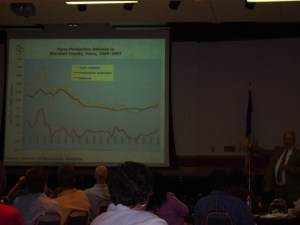 He convincingly showed how bankrupt the current monoculture commodities agro-industry is and how, corrected for inflation, there is no progress in farm income since 1969. The main commodities in Marshall county and Iowa in general are corn, soybean and hog production.
From census data, Ken showed that for Marshall county the total farming income was 175 million dollar, with 171 million dollar going to costs, leaving 4 million dollars income from farming, a positive figure because of a good year 2007, in 2002 it would have been negative. Other income (rents) counted for 11 million dollar. However, the biggest income source was subsidies, with 80% of the farmers receiving 18 million of farm subsidies in 2007. He also estimated that as much as 90 million dollar of the 104 million dollar Marshall county consumers spend on food is going to food from outside the county, bought in one of the 5 big groceries which have 49% market share nationally (Wall Mart as market leader). In total, he estimated that 166 million dollar is leaving the county each year through the current system of placeless production and consumption. He questioned why farmers are given subsidies to keep on farming while money leeks out of the community to the big corporations that are in the middle; the farm input industry and the retail industry and made a plea for localizing the food economy.
It is not the first time while being here that the strong emphasis on ‘local’ and on ‘community’ as part of the solution towards sustainable forms of agriculture strikes me. However, driving around in this state and looking at these figures, you get a sense of the overwhelming dominance of this industrial agro-food system, the vastness of its scale and the high level of vertical chain integration. In the heart of rural America, food production is an anonymous business with land purely as one of the production factors rather than as a meaningful connection to people and food. In constructing the practice and discourse of sustainable agriculture, therefore, scale matters a lot in this context. A more sustainable agriculture here also means a more humane agriculture, a more humane scale, through which people are able to relate to the food they eat. Only 43 acre (13 farms) is registered in use for producing vegetables together with 25 acre of farm orchards. No doubt there is grown a bit more than this in gardens and small unregistered farms but there seems to be room for locally grown fresh produce in Marshall County and Iowa without amounting to the size of one single agro-food industry farm, let alone ‘threatening’ the industry as a whole.
Localising food in Marshalltown
 Today I visited the Community Gardens in Marshalltown for the second time. Last Sunday I went there with Jan Flora and Diego Thompson to meet with the group of migrant Hispanic growers to discuss their progress and needs.
The community garden project runs its first year and aims to diversify the availability of locally grown vegetables in this area, while giving new people a chance to start their (part time) business in agriculture through direct selling at farmers markets. The current group of growers, Hispanic and American, followed an eight week course at the Community College (in cooperation with Iowa State University, ISU) this winter called ‘The diversified farm’. After this course they had the opportunity to start growing vegetables on organic certified grounds for a symbolic 50 dollars a year. Each of the growers has a plot of land between 1 and 3 acre. Hispanic migrants, who came to work in the meat processing industry- also in Marshalltown, have agricultural knowledge as they often came from rural areas. One of them told me how he enjoyed being back on the land.
 The neighboring Community College and colleagues from ISU support the project with facilities such as a greenhouse and the use of the tractor, with agricultural and technical knowledge as well as with (helping) to solve practical problems.
Currently, one of the practical issues is the supply of water for irrigation, which now has to come from further down with a small tank behind the tractor which is very labour intensive. However, in a month’s time, water might come from the fire brigade facilities directly neighboring the plots. By that time, pest control will be high on the agenda as crops start to grow now. The first year will be a steep learning curve for all involved, hopefully with promising results.
 Rural Sociology Wageningen University