Esmee van Schuppen finished her Master International Development Studies with an excellent thesis on the aspiration of youth in Ghana. In her thesis she argued that the aspired livelihood trajectories of youth in Ghana are poorly understood. Her thesis moves beyond the binary representation of rural youth aspirations in academic research, in which these aspirations are portrayed in a dichotomy of rural versus urban and farming versus non-farming.
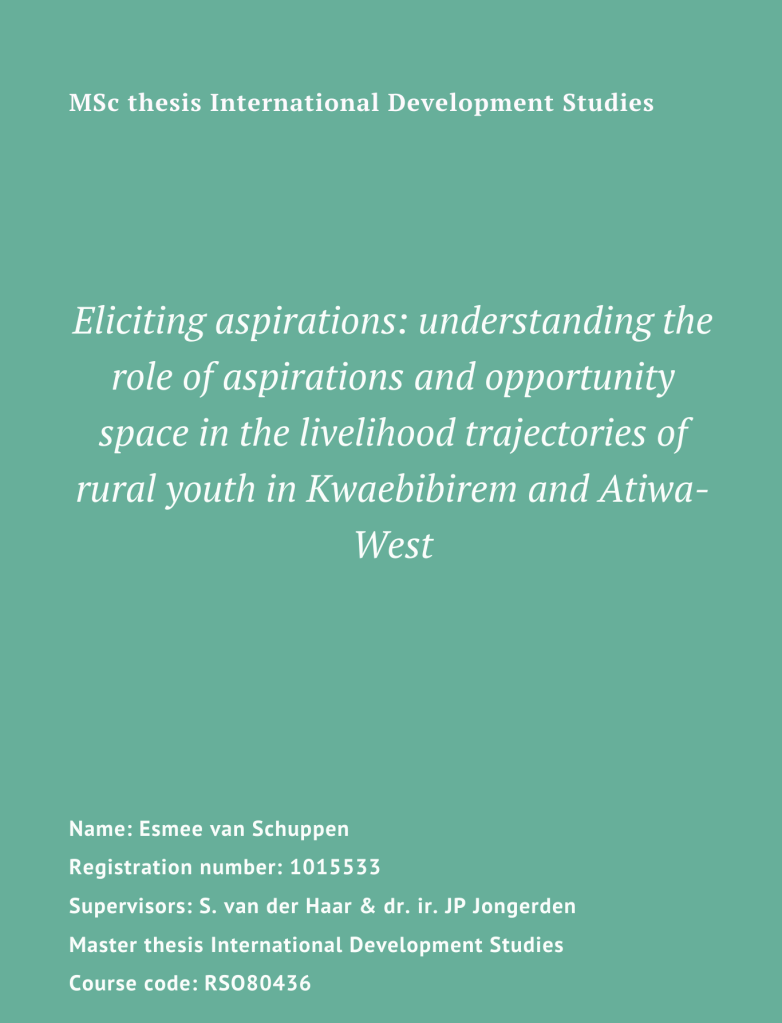
“Eliciting aspirations: Understanding the role of aspirations and opportunity space in the livelihood trajectories of rural youth in Kwaebibirem and Atiwa-West”, MSc Thesis Rural Sociology by Esmee van Schuppen. See the abstract below.
Abstract
With a third of Ghana’s population currently between 15-35 years old, efforts to revitalise the agricultural sector in Ghana are increasingly geared towards youth. However, the full range of aspirations of rural youth and the opportunities and constraints that shape them, are often overlooked in policy and academic research.
This thesis aimed to elicit the role of aspirations and the opportunity space – the spatial and temporal distribution of viable options that a young person can exploit to establish an independent life – on the livelihood trajectories of rural youth. A total of 41 life history interviews and eight FGDs were conducted in order to gather data on the aspirations, opportunity space and livelihood trajectories of rural youth in Kwaebibirem and Atiwa-West, in Ghana’s Eastern Region. The results suggest that rural youth especially aspire occupations in waged employment, but that the options for waged employment are limited in Kwaebibirem and Atiwa[1]West. As a result, the majority of youth engages, and aspire to engage, in mixed livelihood trajectories, in which the capital generated from one activity is invested in the farm, and vice versa. This thesis therefore found that even though youth do not aspire to engage in farming full-time, agricultural activities do play an integral part of the livelihood trajectories and aspirations of rural youth. The perennial crops that are dominant in the landscape, cocoa and oil palm, can help youth to claim temporary ownership over the land and can therefore serve as an investment, a means to guarantee a stable retirement and a way to leave a legacy for their children. However, this thesis also found that the opportunity space for farming is narrowing due to a decrease in the availability and affordability of land and an increase in prices for inputs and hired labour. Moreover, climate change and a decrease in the quality of natural resources make farming a risky investment, subsequently making youth hesitant to engage in farming in the future.
This thesis concludes that the opportunity space plays an important role in shaping the livelihood trajectories of youth. It appears that youth re-evaluate their life and their livelihood at the moment an important change occurs, and change the course of their livelihood trajectory as a result. However, this thesis also suggests that aspirations also play a role in the livelihood trajectories of rural youth, by demonstrating that rural youth does have the capacity to navigate through the opportunity space and take steps towards those futures by employing different strategies, such as adjusting their aspirations to fit with the opportunity space, by putting aspirations on hold or for instance by exploiting the distant opportunity space. In pursuit of their aspirations, youth are able to enforce their agency to expand their opportunity space and shape their livelihood trajectory according to their aspirations. As this thesis only captured the perspectives of youth residing in Kwaebibirem and Atiwa-West, where perennial crops are dominant, future research is needed to expose how the aspirations and opportunity space of youth differ from youth in regions where annual crops are dominant. Moreover, due to the oversampling of youth who did not migrate, future research could focus on how the aspirations and opportunity space of migrated youth enabled them to move down a different trajectory than the youth who stayed behind. Policymakers should consider making more comprehensive agricultural policies for youth, hereby not only focusing on improving the conditions for young farmers, but also on the provision of off-farm opportunities, as mixed livelihood activities are central in the aspirations and livelihood trajectories of rural youth.




 Rural Sociology Wageningen University