Die Produktive Stadt / Carrot City – Designing for Urban Agriculture

Carrot City is a traveling exhibit that shows how the design of buildings and cities can enable the production of food in the city. It explores the relationships between design and urban food systems as well as the impact that agricultural issues have on the design of urban spaces and buildings. The focus is on how the increasing interest in growing food within the city, supplying food locally, and food security in general, is changing urban design and built form. Carrot City showcases projects in Toronto and other Canadian and American cities, as well as relevant international examples from around the world. The exhibition contains a mix of projects that were recently completed or are currently under way, and visionary, speculative design proposals by both professional designers and students, which illustrate the potential for design that responds to food issues. The exhibit explores these issues at different scales, the city scale, the community scale, housing, rooftops and the products that make all of this possible.

Main curators of Carrot City are Mark Gorgolewski, June Komisar and Joe Nasr of Ryerson University Toronto (Canada). It has traveled to New York City, Montreal and Casablanca. Carroty City is now coming to Europe with exhibitions at the Technical University in Berlin (30 September – 30 October 2011) and the Technical University in Munich (8 – 26 November 2011). For more information about the exhibits and opening ceremonies have a look at the flyer.

Harvesting the fruits of labour

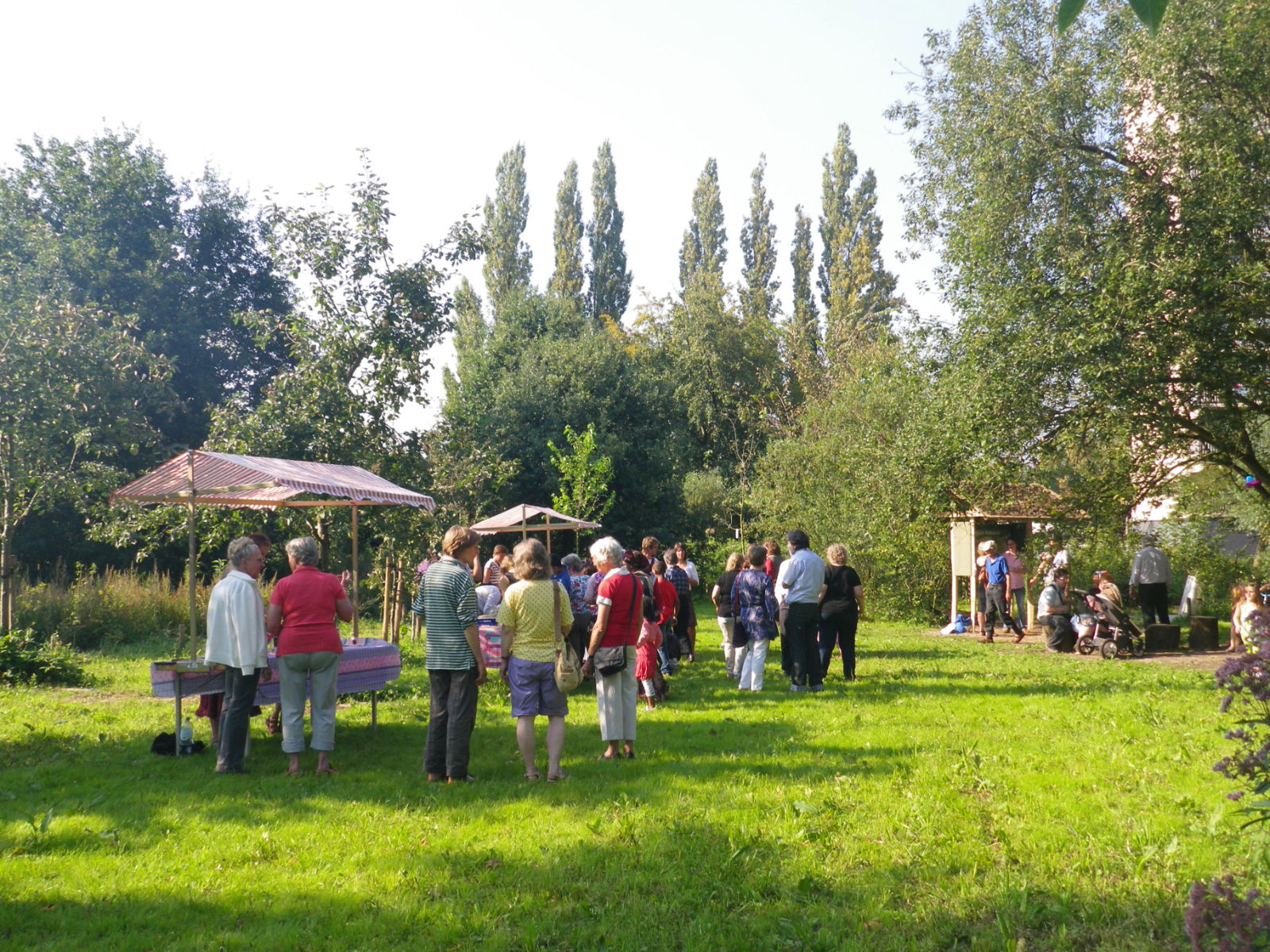
Exactly two years after a film eveningorganised by Transition Town Vallei united some people of the neighborhood, the ‘forest garden’ in the Pomona neighborhood in Wageningen was officially opened by municipality Alderman Lex Hoefsloot on the 3rd of September. The implementation of the design made by the neighborhood (see previous blogs) was finished just in time. After planting many different fruit trees and bushes in March and April, numerous watering sessions during the dry spring and some rainy working days in May and June, we used the summer to build a few wooden structures such as a pergola, a tree- trunk bench and an information panel. Also…..the weeds kept appearing and we sowed grass which is regularly cut by one of the residents. Additional plants were planted too, offered by a resident who maintains them. In the week before opening, the community centre went into the garden with children to harvest the first apples. Not from the newly planted trees but from those trees we rescued from under the brambles. The apples were used by children in the weekly cooking class run by the centre to make apple pie. This was precisely how we envisaged the function and use of this ‘garden’ when we started writing the plan two years ago. I love it when a plan comes together. (pictures below; making fruit juice on the spot and garden excursion)

Surinam bami, Georgian beet-salad and Turkish baklava

The allotment gardeners of De Koekelt have gathered for a potluck in De Koekelt on Saturday, third of September. Surinam, Turkish, Italian, Georgian, and Dutch gardeners prepared food with the vegetables of their garden which, all together, made a very tasty and varied lunch.
I am doing my thesis on De Koekelt, trying to find out how to strengthen sense of community and participation of the gardeners. De Koekelt is an allotment garden in Ede with gardeners of twelve different nationalities. By walking around one can recognize great differences between the gardens. Some grow more flowers, others more vegetables, some gardeners build a place to sit down and enjoy, while others use their space in the most efficient way to produce as much food as possible.
These differences are appreciated by the gardeners, but create friction as well: “Why do foreigners need to grow so many beans?” or “Why do Dutch women only grow flowers and weeds on their garden?”
With help from three gardeners, I organized the potluck, where the gardeners had a chance to appreciate the differences between themselves, by tasting the different meals each gardener proudly prepared from their own garden products. By eating together, they used the opportunity to speak with gardeners they usually never spoke with. For example, a Georgian woman and a Turkish man discovered that they used to be neighbours, since the villages they come from are both situated on the border of Georgia and Turkey.
The board of De Koekelt, who was sceptical about this activity (“do you really think the gardeners will do all this effort of cooking and bringing their own plates?”) was also present and enjoyed the gathering. They had experienced a sense of losing control, but they seemed to realize that gardeners initiative should be stimulated, not constrained. They saw how little organization is needed to bring the gardeners together, and although they initially objected against this activity, they concluded that this should be organized more often

Lise Alix, MSc-student Rural Sociology

Conference call – Agriculture in an Urbanizing Society (new deadlines)

In June I published a post about the upcoming conference ‘Agriculture in an Urbanizing Society: International Conference on Multifunctional Agriculture and Urban-Rural Relations’, which included a call for Working Group proposals. The deadline for submitting Working Group proposals was 1 September 2011. This post is to announce that the deadline for submitting Working Group proposals has been postponed to 15 september 2011. If you would like to convene a working group but don’t have time to write a proposal, you can also express your interest by sending me an e-mail (han.wiskerke@wur.nl). Have a look at the conference website for an overview of the working group themes that have been proposed by the scientific committee. The deadline for abstracts will also be postponed by 2 weeks to 15 December 2011.

Notes from the ESRS conference (5)

Back in Wageningen, I am still digesting all the inspiration, material and knowledge that was floating around freely last week at the ESRS conference in Chania, Greece. For example, related to the earlier blog on the conference (2) the Working Group “New forms of citizen-consumer engagement in food networks: diversity, mechanisms and perspectives” had much to offer in addition to our own working group. Indeed, of all the types of consumer driven initiatives, such as food coops, CSA, consumer purchase groups, adoption schemes and landshares, the grow-it-your-own was largely absent. We concluded that a fusion of self-provisioning strategies and consumer driven engagement initiatives are necessary to understand the full spectrum of engagement with food growing.  Another conclusion of the Working Group was that the driving force behind an initiative does not need to correspond with the nature of the initiative. Examples from Czech Republic showed how citizens had set up a farmers market, which is usually seen as a producer initiative. Also here, new terms and definitions were considered such as “civic food networks” or “pro-sumers” to move away from the consumer – producer dichotomy, a distinction which obscures more than it reveals.

The enormous differentiation in initiatives was another key finding when one looks across the presentations in this Working Group. We concluded that it is difficult to discover ‘hidden realities’ and that we most likely underestimate the number of alternative food networks around. Initiatives have different names across countries or sometimes do not want to be known in statistics and databases as they deliberately try to operate outside ‘the system’. The last point includes a tension. We would like to show and make visible the size of the alternative food networks, also to show its significance. But it also reminded me of a paper which I use in a course on political sociology on “Governmentality and territoriality” by Jonathan Murdoch and Neil Ward (1997). Statistics are a useful instrument to govern at a distance and one of the technologies of government now widely used and abused, but which we take for granted now. The paper, however, showed how the collection of statistics of Britisch agriculture from the 19th century onwards failed “not least because of a relunctance on the part of many farmers and landowners to cooperate, based on their belief that the exercise was an interference in their private affairs” (1997: 314). All governments depend on modes of representation by which the domains to be governed become visible. Freedom, according to Foucault, is “the art of not being governed quite so much” (Oksala 2008). A careful approach to visibility sounds healthy to me.