
Last Friday, I presented ideas and examples of the state as emerging actor in sustainable food consumption to the sociology department of Iowa State University. In Europe, there are more and more examples of different levels of government, – state, region or city governments – taking initiative to integrate sustainability concerns in new ways of food provisioning. They realize that they are a very large buyer of food, for public canteens, in hospitals, elderly homes, schools and other public places. Their purchase behavior can make a huge difference in shifting our agriculture production and food consumption towards more sustainable practices.
Morgan (2008) has pointed out, that this is still largely a case of ‘untapped potential’. However there are examples, amongst others coming from the city of Rome, Italy and Copenhagen, Denmark which show that things can be done different. By using additional award criteria for catering contractors aimed at organic, fresh, regional or typical products, public sector buyers can cause a sea change towards more environmentally sound and healthier food menus in public canteens.
The current economic crisis might be a window of opportunity now neoliberal market fundamentalism has been discredited. A year ago, who could have imagined that the state would intervene so heavily in banks and the (car) industry? Things can change. Or will they? The lively discussion after the presentation concluded that change might not be expected soon from the US government.
The irony is that the US government is already a large buyer of food. They not only heavily subsidize farmers, they also buy large quantities of food commodities, at times when farm prices drop. The problem is that these practices stay hidden behind the strong illusion of market-ideology. It is not seen as procurement or as food purchase policy, but it is seen from the producer’s point; buying up produce is done to keep the farmer in place, while the bought food goes to public institutions such as prisons.
![movie_poster-large[1]](https://ruralsociologywageningen.nl/wp-content/uploads/2009/06/movie_poster-large1.jpg?w=584 "movie_poster-large[1]") This is once again an illustration of the lack of connection between agriculture and the food that is eaten here. A number of critical documentaries, such as the film Kingcorn, have shown various aspects of the disastrous effects of this lost connection. And yet a new film Food, Inc by Robert Kenner is about to be released mid June, showing
This is once again an illustration of the lack of connection between agriculture and the food that is eaten here. A number of critical documentaries, such as the film Kingcorn, have shown various aspects of the disastrous effects of this lost connection. And yet a new film Food, Inc by Robert Kenner is about to be released mid June, showing
“the highly mechanized underbelly that has been hidden from the American consumer with the consent of our government’s regulatory agencies, USDA and FDA.”
I will definitely try to see it. (see also this interview)
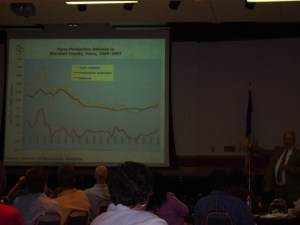 He convincingly showed how bankrupt the current monoculture commodities agro-industry is and how, corrected for inflation, there is no progress in farm income since 1969. The main commodities in Marshall county and Iowa in general are corn, soybean and hog production.
 Today I visited the Community Gardens in Marshalltown for the second time. Last Sunday I went there with Jan Flora and Diego Thompson to meet with the group of migrant Hispanic growers to discuss their progress and needs.
 The neighboring Community College and colleagues from ISU support the project with facilities such as a greenhouse and the use of the tractor, with agricultural and technical knowledge as well as with (helping) to solve practical problems.
 The last few days I jointed the fieldwork which Cornelia and Jan Flora are doing with their master students in Columbus Junction on the Hispanic immigrant communities.
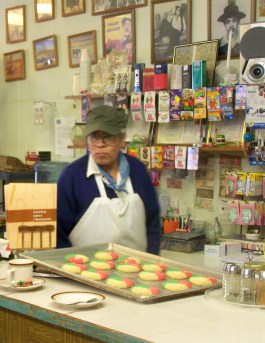 Some of the legal migrants, however, see a chance to start their own business. In fact, the main street in Columbus Junction has most of its shop signs in Spanish and we have been eating tacos, fajitas and other good Mexican food, among which at this bakery.
 t).
t).
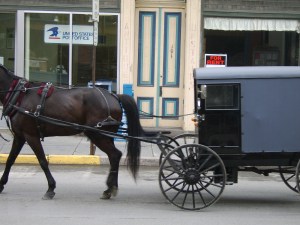 For their dairy farm of 80 cattle they did use some electricity for milking for example with an electric generator. They also had tractors, however, here too the use of it was restricted. This could be noticed by looking at their hey wagons, which had no rubber but metal wheels, to prevent the seduction of using them on the road behind the tractor. Much of the thinking behind this is centred around labour force available and sustaining communities by not out-competing each other. At the other hand, they do use ‘modern’ instruments such as chemical pesticides, chemical fertilizers, and artificial insemination of cows.
