Since Saturday I am staying in Keams Canyon, in the Hopi Reservation in Arizona. For the last ten years, Cornelia Flora has been doing research and extension work with a colleague from Arizona State University, Matt Livingston and organizations at the Reservation. This visit therefore includes some meetings on current projects.
Hopi Indians are a pueblo tribe living in 13 villages located on the 2472320 acres (just over a million hectares) of the Hopi Reservation in north-central Arizona. With their ancestors coming from the south, they are sometimes categorized under as Anasazi; southern based tribes sharing a coming language root. However, we learned in the Archeology Museum in Blending, Utah, that this is a name taken over into English from Navajo. In Navajo (themselves coming from north) it means something like ‘ancient enemy’. A more correct way to talk about the different tribes that came from the south, therefore, is Ancestral Puebloans. The Hopi Reservation is surrounded by the Navajo Reservation and there is an Apache Reservation nearby.
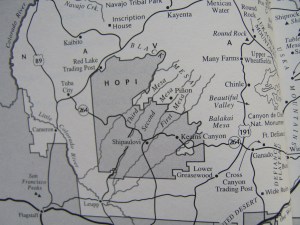 The Hopi villages are mostly located on three peninsular “mesas” that are the southwestern “fingers” of Black Mesa, high ridges elevated around a 1000 meters above the Canyon land plateaus. The Hopis are the oldest continuous inhabitants of northern Arizona; some of their ancestors may have lived in the region as early as A.D. 700 (Linford 2005).
“I never saw so much empty land”, I remarked to Matt in the car yesterday. Indeed, books talk about this desert land as some of the most desolate country in the United States. “It might seem empty to you” Matt replied, “but it is not for the Hopi”. It might not seem ‘productive’ in any Western economic sense, but this land represents many things for them. “There can be trails or holy places where their shrines live”. And, “their cattle graze here and they cultivate their indigenous ground races maize” Matt explained. In such an extensive way that it is hardly visible for the eye! With approx 300 millimeters rainfall a year and no rivers in the neighborhood they are adapted to their circumstances, quite different from the Dutch wetlands….
 One of the projects is centered around Hopi food. The aim of the project is to help communities to understand Hopi traditional food, to collect best practices about growing and gathering food as well as to appreciate the spiritual aspect of food. It is an awareness raising project, helping people realize what they already know. One of the result so far has been a Hopi traditional cook book and follow up activities are now planned, such as intergenerational cooking workshops.
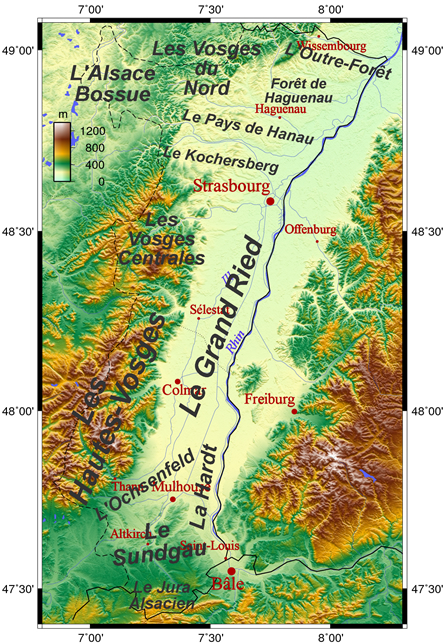 ck the bird (by starting breeding programs) and now storks can be found on roofs of houses and public buildings everywhere. All these things are characteristic to the Alsace region.