Values and relationships in the diverse economy of De Ommuurde Tuin: an illustrated ethnography

inez thesis coverLast year Inez responded to a RSO thesis advert to join a research team exploring the social economy of food and nature in Gelderland in connection with several science shop projects coordinated by Jan Hassink. Inez completed her research at de Ommuurde Tuin in Renkum, and took the opportunity to further explore visual and creative methods, documenting her results in an illustrated ethnography that was shared with stakeholders at our most recent network gathering Nijmegen. Thanks for being part of our research team Inez ! 

Inez Dekker, MSc student Sociology of Development (MID) Wageningen University

Below please find the abstract of the MSc  minor thesis Values and relationships in the diverse economy of De Ommuurde Tuin: an illustrated ethnography

The full thesis can be downloaded from the WUR-Library by clicking on the hyperlink

Summary : In the last decades a growing number of alternative food and care initiatives emerged in North-America and Europe. Due to uncertain situations within current neoliberal economic systems such as the recent recession, ongoing outsourcing and environmental depletion, and alienation from production (Morgan and Kuch, 2015), these initiatives offer an alternative to an existing neoliberal model. Moreover, they inspire to create a more diverse pallet of economies alongside dominant economic and social systems. Important to mark here is that their decisions and actions are not merely led by dominant economic models, but intentionally done to create worlds that are environmentally and socially just (Gibson-Graham et al., 2013). Often these initiatives fit in an alternative economic framework where a diverse, interdependent, rich and prolific disarray of ‘good life’ are central for their economies. One of such frameworks is the diverse economic research framework based on the work of Gibson-Graham (2008) where the economy is one based on a myriad of human and non-human social relationships that go beyond capitalist economic models. While there seems to be an emerging interest for practices within alternative economic frameworks, such as in community supported agriculture (CSA) or care farms, there is an absence of how human and non-human relationships create values that form an (diverse) economy. Moreover, in conventional economic thinking, practices occurring outside current economic system remain often unrecognized and unseen, though, these are essential for an economy to exist. Therefore, I aim to strengthen a network of diverse economic initiatives focus on initiatives located in the Dutch province Gelderland. To do this, I created a visual illustration that highlights the diverse practices and human and non-human relationships in the organic horticulture business located in Gelderland called ‘De Ommuurde Tuin’. I add to the scholarship of diverse economies by describing and showing the processes that produce a diversity of values in De Ommuurde Tuin’s daily economic practices. These processes are not only led by relationships among humans but include human and non-human relationships as well. To do this, I not only use a written form, but foremost I used visual and sensory research methods that highlights relationships between humans-humans and humansnonhumans. By putting forward the senses, the visual and emotional, this research concerns the processes in daily economic practices through a study of an economy that is lived and experienced. Moreover, I make alternative and diverse frameworks of economy/is more visible for a wider public through presenting my outcomes in a visual manner in booklet form. This approach tries to display and recognize economic alternatives, which helps to connect and build a coherent and powerful social movement for another economy (Miller, 2008; Gibson-Graham, 2008; Gibson-Graham and Miller, 2015)
Searching for a master thesis topic? Write your master thesis about community fridges in The Hague!


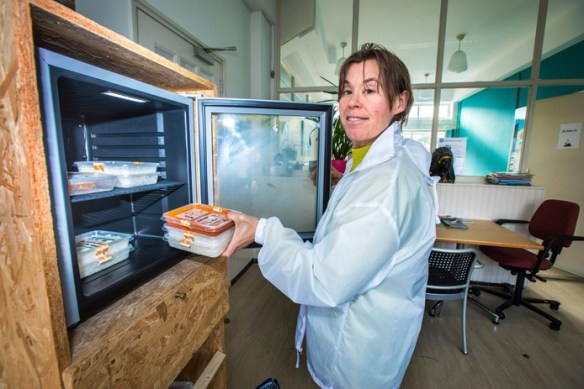
fridge foto hagueWhat are community fridges?

Community fridges are refrigerators located in a public space, for example in a neighborhood or community centre. These refrigerators enable food to be shared within a community. In The Hague, community fridges are utilized primarily to share left-overs from restaurants with people facing hardship, with the goal of offering easy access to fresh, nutritious food. The initiative aims to simultaneously reduce poverty and food waste. To read more about the specific case in The Hague, visit their website: https://www.versenvrij.nl/

vers frij hague

Interested in writing your master thesis about this initiative?

In cooperation with LUMC (Leiden University Medical Center – Campus The Hague), we are searching for a master student who wants to do a thesis research about community fridges in The Hague.

Topic 1: To explore user experiences and the role of these fridges in addressing food insecurity.

Topic 2: To explore how users manage risk and safety in the distribution of surplus food, and the care of community fridges.

We will encourage you to actively design your own research and hope you are eager to use various methods.

You are :

  • interested in the issues of food insecurity and food waste
  • willing to engage actively in designing a research about community fridges
  • willing to conduct research in The Hague (think about travel-costs)
  • experienced in doing qualitative research; e.g. participant observation, semi-structured interviews, the photo-voice method, focus groups
  • interested in mixed methods; combining qualitative with quantitative data (e.g. surveys or questionnaires)
  • a native Dutch speaker and willing to write your thesis in English
  • able to start this spring (possible to start immediately)


If you are enthusiastic about this research topic, please send an e-mail to thirza.andriessen@wur.nl , L.A.van_der_Velde@lumc.nl , & oona.morrow@wur.nl

Postdoc vacancy – Developing An Integrative Approach to Regenerative Agriculture, Circular Agri-Food Systems, and Convivial Conservation

We are recruiting a postdoc for the three-year research project ‘Tackling Crises in the Countryside: An Integrative Approach to Regenerative Agriculture, Circular Agri-Food Systems, and Convivial Conservation‘. Apply before January 20, 2020.

Food, farming, and conservation face major, interrelated challenges in the countryside, yet are treated as largely independent in research and policy. This postdoc will explore regenerative agriculture and convivial conservation as two paradigms that aim to address these challenges. The key questions are (1) how can the two paradigms be integrated into a holistic approach, and (2) how can this integrative approach help sustain biodiversity, livelihoods, social equity? Next to developing an integrated approach and assessing the impacts of its application at different integrative levels, the postdoc is expected to disseminate findings and develop an acquisition portfolio.

The postdoc will be positioned at the chair groups of Rural Sociology and Sociology of Development and Change under supervision by Dr Dirk Roep (Rural Sociology) dirk.roep@wur.nl and Mindi Schneider (Sociology of Development and Change): mindi.schneider@wur.nl

This is one of the 15 vacant postdoc positions at the Social Sciences Department of Wageningen University. For more information on requirements and selection procedure see: We-are-looking-for-15-Postdocs-in-social-sciences

Third @voedselanders (Food Otherwise) Conference 2020 – call for participation

The third national Voedsel Anders (Food Otherwise) conference in Wageningen will take place in February 2020. The conference organization team calls all those interested to participate and make the third edition again successful. Some general information below. See Voedsel Anders conference 2020 for more detailed information.

Voedsel Anders is a movement of people in the Netherlands and Belgium working towards just and sustainable food systems. A lot has happened since the first conference and the drafting of our manifesto. Political as well as societal attention for the challenges and opportunities of the agri-food system have grown significantly and the urgency to ignite a transition is bigger than ever.

During the Voedsel Anders Conference 2020, we will identify and reflect on wins, barriers and solutions in our joined quest to an alternative food system. We will touch upon questions such as: What have we already achieved and what were the factors of success? How can we identify and deal with barriers? What possibilities and opportunities lie ahead? Can we strengthen the food movement whilst making it more inclusive and diverse?

If you have further question, want to organize a workshop or sponsor the conference, you can send an email to info@voedselanders.nl

Food Self Sufficiency in a Community: Dream or Reality? A documentary by MSc-student László Bartha

Food Self Sufficiency in a Community: Dream or Reality? a documentary by László Bartha, MSc-student Organic Agriculture of Wageningen University.

During his internship at the Wageningen student organization Otherwise, László Bartha made a documentary of his MSC thesis research for the ecovillage The Vlierhof. It has been hard work, but it has become a very nice, and respectful documentary of a decision-making process regarding the future development of the ecovillage. “The Vlierhof” approved the creation and online publication of the documentary. Below a brief introduction to the documentary. 

Intentional communities and ecovillages are present in almost every country in the world. People decide to live in these places because they want to explore and experiment with new organizational forms and alternative livelihoods. “The Vlierhof” is one of these communities with the vision “to promote awareness and peace on earth. We want to make a contribution to the social and environmental problems faced by society today, living as self-sufficiently as possible.” According to this vision, they also grow part of their food. But is the amount of food that they produce enough to sustain themselves? In this short documentary, we can learn about the community, its members and find answers to this question. The film has been created from the recorded materials of an action research project. Among the audio-visual research methods interviewing was the main data collection method. The purpose of the research was to explore social dynamics in the community and follow a decision-making process regarding the future of the community garden.