Time Magazine about multifunctional agriculture, some thoughts about the farmers’ identity

While waiting for my train at Utrecht Central station – I tend to kill my time looking around in the book/magazine shop – the cover of the latest Time Magazine struck my eye, heading: “France’s Rural Revolution, traditional French farmers are dying. Can farmers make money from town dwellers’ love of the land?”. Interested about the heading – and teased by the astonishing landscape on the cover – I bought a copy for the second part of my trip to Rotterdam.

Bruce Crumley (the author) poses the question what eventually will save rural France. French farmers are hit by a shrinking agricultural sector, falling food prices (globalization) and tightening E.U. support (so called CAP reforms (Common Agricultural Policy) in 2013). These developments are not exclusive to France, farmers in many other E.U. member states are facing these problems. However, future CAP reforms are considered to be critical especially to French farmers, since the French receive nearly 20% of the total CAP funding.

By illustrating the developments on three French farms the author focuses on one of the ways to get out of this tightening trap by diversifying the farm business with new (‘non-farming’) activities. A strategy also known as multifunctional agriculture. The farmers mentioned in the article developed new activities in rural tourism and the production and selling of regional products like beer and ham. Interestingly, the article has many parallels with the conversations I had myself (in relation to our research project on (Dutch) multifunctional agriculture). Apparently, many farmers (eventually) don’t regret their step on the multifunctional pathway. On the contrary, many farmers say to enjoy the new farm dynamics, contacts with new people and some even claim to have reinvented entrepreneurship. However, we needn’t to underestimate the step of ‘just’ diversifying your farm to survive. In the article colleague rural sociologist François Purseigle argues many farmers simply refuse to find new sources of income as they see diversification as a betrayal of the agricultural profession they took on. As a parallel, I experienced many interviewed Dutch farmers – who have made the step or are still hesitating in some way – have or are still struggling with their identity of being a ‘real farmer’: “It’s not just running a business” – one farmers stressed – “it’s a way of life!”. I think the notion of multifunctional agriculture has matured but still often perceived as something for losers or nothing ‘real farmers’ should deal with. Often the environments of hesitating farmers aren’t ready for this new way of farming, yet.  

The article can be found on the Time website. The page also offers a great picture gallery about the topic.

Who’s ‘the’ farmer?

Yesterday (Tuesday) 42 first year students , Paul Hebinck and I visited two Dutch farms for the course ‘Agricultural and Rural Development: Sociological Perspectives’ (RSO 20806 ).

We firstly visited the multifunctional farm ‘Eemlandhoeve’ of Jan Huigen. In an inspiring talk, Jan explained about the development of the Eemlandhoeve and the future plans. The farm has different functions, such as care farming, recreation, herb production, beef production and education for schoolchildren. After a nice walk around the farm and the calming farm yard (see picture), we walked to the neighbouring farm. 

The neighbouring farm ‘Hoeve ‘t Witte Schaap’ follows another path of development: a large scale dairy farm, with about 300 dairy cows and four milking robots. For most students, it was the first time they visited such a large dairy farm. The shed is large and high, with a lot of light and fresh air. Gerrit (the farmer) talked engaged about his farm, including the technology and animals. Two workers take care of the cows and by feeding them and looking after their health. The cows are fed with grass and maize of the farm and hardly received any concentrates (only in the milking robot). The farmer applies all the manure on his land. In fact, his way of farming is not that far from organic regulations.

After both visits we gathered, where Drees of ‘Willem & Drees’ gave an inspiring talk about regional production and sale of fruit and vegetables in five regions the Netherlands.

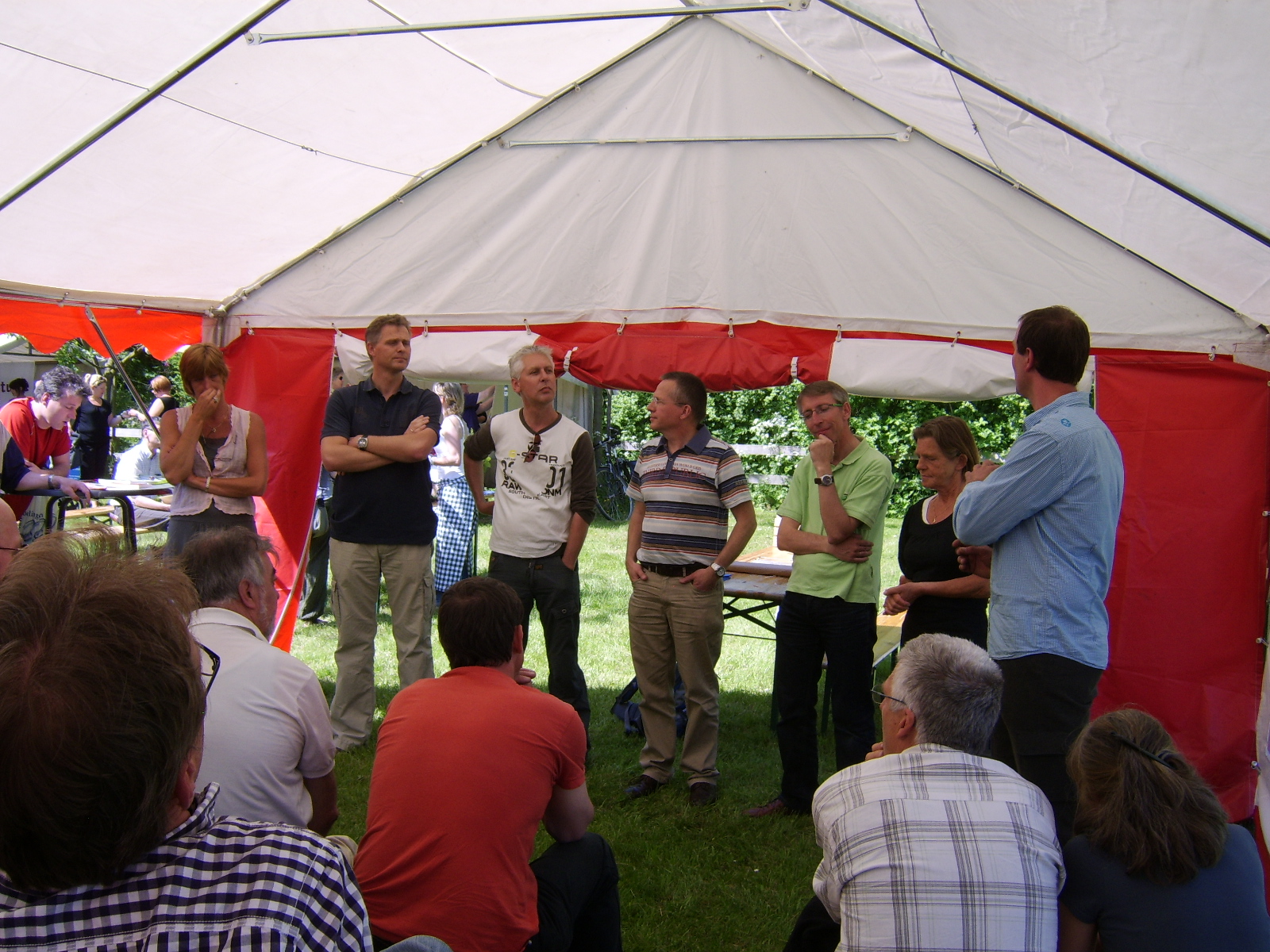
During the discussion, the students raised interesting questions. Firstly, one of the students asked Jan Huigen ‘How much of your income comes from food production?’ This – of course – was a limited amount and several students seemed concluded that he was not ‘a real farmer’, but more an entrepreneur in the countryside. Thereafter, the large scale farmer was asked how often he was actually among his animals, which was limited, since he had two workers to take care of the animals. The students seemed to conclude that he was neither ‘a real farmer’, because he had limited animal contact. Instead, he was more a ‘manager’.

To conclude, it was an inspiring excursion, which showed two very different development paths of contemporary farming in the Netherlands and gave students a great opportunity to think about the question what a farmer is nowadays.

Sustainability Festival & Biodiversity

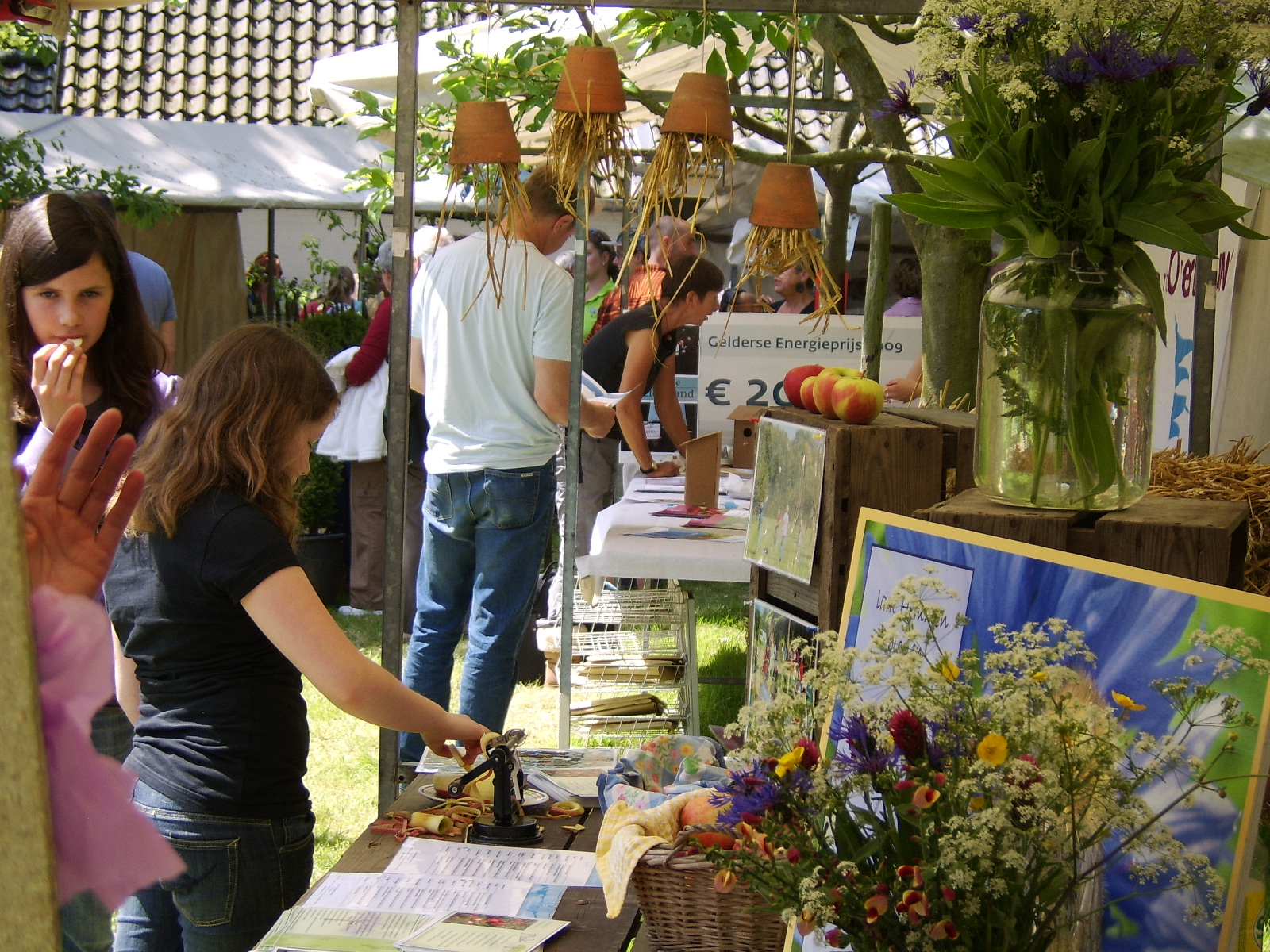
It was great weather at the Sustainability Festival in Hemmen last saturday. And buzzing with people at the various places in Hemmen where small scale activities were organised. At the Smidse, which was the main organiser, there was a market with sustainable products such as ecological garden design, electric cars, sustainable paint and a collective who wants to develop a housing site with straw/wood constructed houses.

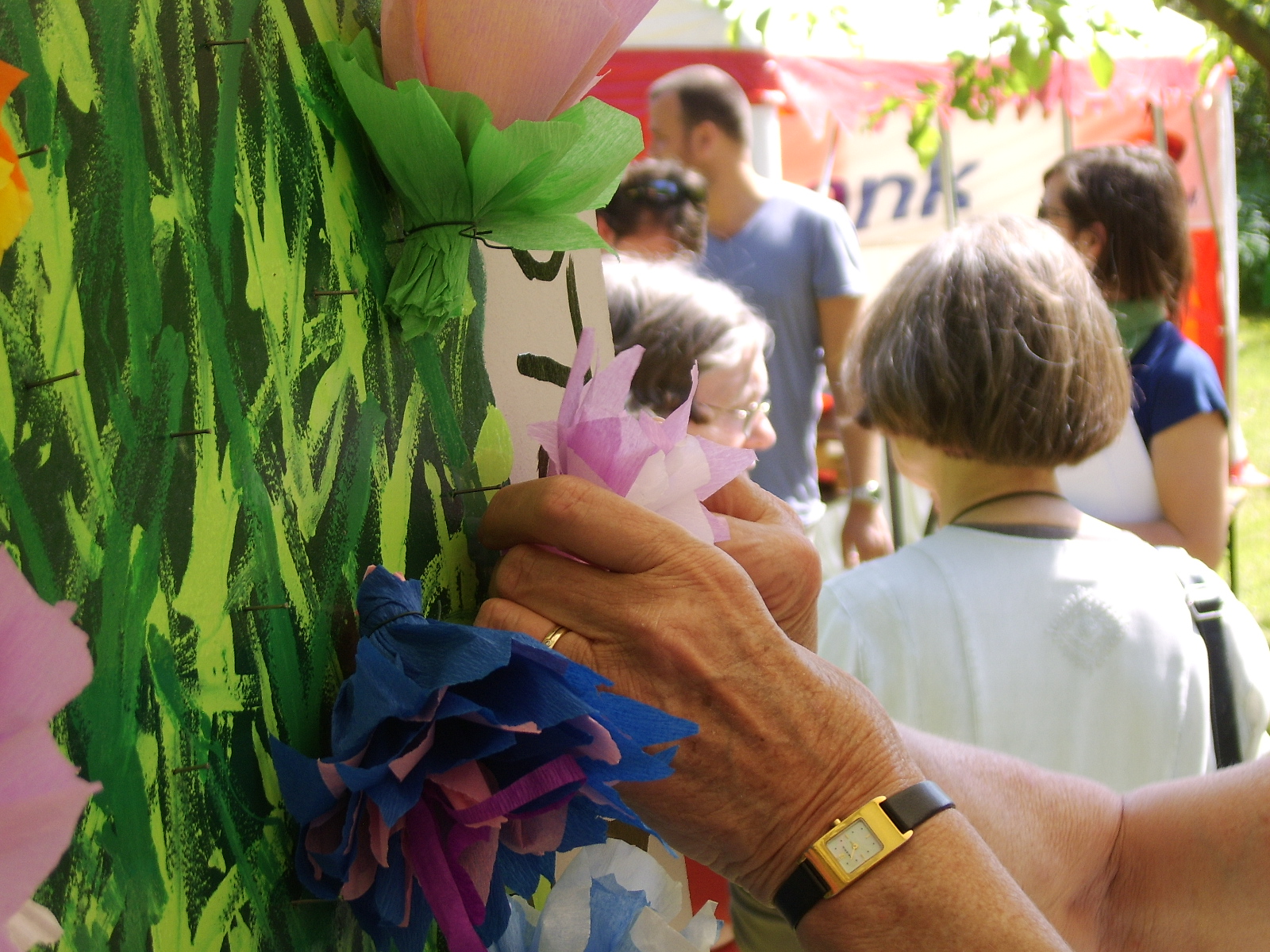
As ngo Stichting Hemmens Land we also had a stall to launch our new project “Hemmens Land in Bloei”. More than 30 people adopted pieces of 15 square meters of flowery field margin. There are too few flowers which affects the butterfly, the Gelderlander had just reported that same day. Indeed, the adoption of 15 square meter of flowery field margin serves multiple purposes which all come down on enhancing biodiversity, which again the Gelderlander noted down during the festival.

It helps the organic farmers in Hemmen in their pest control, it enriches the landscape and it supports the bees and butterflies which are under treat. On two pieces of land in Hemmen, one of which is opposite the bee-stall which will receive hives from Wageningen during this year, we have sown 3000 m2 with a mixture of more than 20 field flowers fitting the clay soil of this area. The two pieces will be marked with a sign where adopters can see the landscape and pick some flowers. In fact, the year subscription to a piece of flowery field margin is not more expensive than an average bundle of flowers from a shop.

The municipality of Over-Betuwe was well represented during the political debate in the afternoon. All parties in the council were present to give their vision on sustainability in Over-Betuwe. The municipality has a very ambitious sustainability policy with no less than 73 action points to become climate neutral in 2030. A much debated policy since the current times of budget cuts and elections make priorities necessary.

A citizen initiative that actually aims to enhance biodiversity, one of the points in the action plan was therefore welcomed by the municipality. After the political debate, it was time for all ‘sustainability’ initiatives in and around Hemmen to present their projects and businesses. During the presentation of the field margin project of our ngo, the municipality came forward with a donation of 250 euro for our “Hemmens Land in Bloei” project, which we appreciate very much.

With their support and the first 30 citizens as adopters we made a good start last saturday. Coming sunday we have a stall at the fair in Elst. Quite a few adopters more we need before we have the 3000 m2 covered. And if we succeed we are dreaming for next year of a longer field margin along the Hemmensestraat which would make a beautiful entrance to the village.

Integrated-regional food paradigm

In the current second year Bsc course ‘Agrarische en rurale ontwikkeling; sociologische perspectieven’, students have to make assignments in groups connected to documentaries which subsequently provide input for discussion tutorials. During the first week we worked with the concept of ‘paradigm’ and compared current competing agro-food paradigms. The agro-industrial paradigm (see e.g. Ploeg 2010) and the integrated-regional paradigm (see e.g. Wiskerke 2010).

It led to interesting discussions on feeding the world and the future of our resources. Very remarkable was that the integrated-regional paradigm changed names in the student reports to the ‘traditional’, or ‘local & artisanal’ paradigm. When asked, this turned out to be no conscious choice. It revealed implicit images of the integrated-regional paradigm which influences judgements about the feasibility of this alternative. It also revealed that the practice and future potential of this paradigm is still partly unimaginable.

Earlier this year, other Msc students went to see the integrated-regional paradigm in practice in Hemmen, just at the other side of the river Rhine. Here, several entrepreneurs in organic agriculture and retail are integrating their businesses while keeping their independence and are regionalising their practices step by step. This may still sound abstract. A true explanation needs more than one blog. Here, for now an example of what ‘integrated’ could mean.

Organic arable farm Lingehof (aprox. 80 hec. and 14 mainly contract crops) includes in its rotation scheme space for the gardeners of the Stroom, who run an organic vegetable box scheme for approx. 200 households. Together they also make it possible for people to adopt a (high-stem) apple tree. The dairy farm Opneij and the Lingehof together function as a mixed farm, exchanging manure and straw, rotating grassland and fodder crops. Organic shop the Smidse sells vegetables from the Stroom, meat from Opneij and bread from wheat of the Lingehof. Last year they also started collaboration on another level through the ngo Stichting Hemmens Land (and see earlier blog). One of the activities of this ngo is to set up thematic excursion arrangements to offer groups (such as the Wageningen students) the possibility to visit all involved entrepreneurs around a coherent (educational) program such as closing the nutrient cycle. This can be seen as an integrated (farm)diversification strategy and will create a source of extra income.

Can farmers inform policy about multifunctional agriculture?

By Leonardo van den Berg (MSc. student International Development Studies, Wageningen University) & Klarien Klingen (graduate International Land and Water Management, Wageningen University).

On the 8th of October we participated in the mini-conference about multifunctional agriculture organized by the Rural Sociology Group. We would like to share some thoughts about the conference and relate them to our thesis research experiences in Brazil.

Gianluca Brunori spoke of the benefits of multifunctionality in Tuscany. Here, farms are not merely production spaces rather:

  • Educational sites where children learn about biodiversity and breeds of animals.
  • Sites where farmers are community leaders and negotiate with public institutions.
  • Sites where food quality is negotiated with consumers and subsequently created. This not only entails consumers’ feedback on wine but also farmers educating consumers on what other parts of a cow are edible.

These thoughts turn past and present public concerns of educating farmers upside down and coincide with our thesis experiences in Brazil, where we studied a movement of innovative peasants. Here, farmers refused to be assigned a role as a poor class and instead re-established their role as experts over production, consumption and the environment. Their knowledge, farming systems, and achievements surprised social and natural scientists.

Roberta Sonnino and Katrina Rønningen focused on state policies. Sonnino criticised the little support UK policy grants to multifunctional agriculture. She argues that the UK equates best value with low costs. The few developments in multifunctional agriculture have occurred despite rather than thanks of state action. An exception is the Scottish case where an increase in organic and locally produced school meals gained €150.000 of regional revenues. Rønningen showed us another picture: in Norway multifunctionality has been embedded in society for a long time. She says it started with market demand and that it is now supported by policy: the government aims at having 20% of the food locally produced by the year 2020. Farming as a profession is highly appreciated by the public: farmers are seen as managers of cultural heritage and as producers of healthy food.

Two things struck us about these two cases. First, the UK case shows how difficult it is to penetrate the neo-liberal armour that defines not only political but also much of our own rationality. Policies are often perceived as an obstacle rather than as enabling factors. It was this hostile context in which Brazilian peasants operated. Through diversification, agroecology, and community forms of exchange these peasants have increased their autonomy enabling them to pursue their own values. Second, the case of Norway gives us a taste of the role public policies could play in the valorisation of farmers as (re)producers of healthy food, nature, landscape, biodiversity, and public health. That most governments are lacking this is no secret, even according to a market oriented, middle size farmer in our research area:

I could fence a water source, buy some wire and provide some poles. If it were more, how do you say; all this imprisonment of all that is commerce, if it were more humane, looked more at the human side, I think there would be more left and all of society would gain from this (interview November 2009).

In short: we would argue that that the lessons from the third world should not be underestimated. Our experience learns that some of these cases may be running well ahead of theory and policy practice.