“I bike, so I am” (or was it…”I am, so I bike”?) – Jan Schakel in Rennes – Part 3

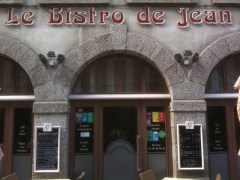
Tomorrow I will leave Rennes and go the  countryside (to Villarceaux) to assist a field practical on sustainable indicators in the rural area. But I already miss the city. As I wrote before, Rennes is an special city: it has character, class and culture. And after three weeks you’re getting to feel at home: I know my way around, do my daily shopping’s, shake hands, have a kiss here and there (‘des bisous’, more ‘cheek to cheek’…), etc. After three weeks you also get a rhythm:  I buy a Dutch newspaper at the station, have  a coffee on the terrace and a late dinner at the bistro (see picture).
Rennes is a very beautiful city, also due the fact that they have a major that is very well respected and who is major for over 30 (!) years already. So compared to other cities, Rennes has a very sustainable and constant policy, and you can feel and see the results of that everywhere.  I will show you two –also for me – very interesting examples. First : Rennes urban strategy (and at the same time: rural). Rennes, with almost 200.000 inhabitants within the city, is a very ‘compact’  city. Also due to ecological and rural motives, the city of Rennes decided over 30 years ago to  concentrate housing within its walls, and by that, saving the qualities of the surrounding countryside. So the policy was to intensify the density of its buildings, but according to very high architectural standards. So indeed, you don’t see any suburbs, industrial zones or slumps within the city: it all has quality and a very special atmosphere.

Continue reading

Second European Sustainable Food Planning Conference – a last reminder

As mentioned in one of my previous blogs the  Urban Performance Group of the University of Brighton (UK) will host the second European Sustainable Food Planning Conference on 29 and 30 October 2010 under auspices of the Association of European Schools of Planning (AESOP). Although the deadlines for submission of abstracts and selection of papers and posters have passed, there are still a few places available to attend the conference. It promises to become an interesting conference due to the diversity of disciplinary and interdisciplinary contributions and the geographical range of cases and experiences that are going to be presented. And, furthermore, it also seems to be a vary timely conference; the attention for urban agriculture, food and health, food and urban design and food governance is rapidly increasing, not only in the academic realm but also in political and societal debates.

For more information about the conference you can download the conference brochure or have a look at the conference website.

Boer-burger ontmoetingen – een essay

In opdracht van het Trendbureau Overijssel hebben we met vijf collega’s van Rurale Sociologie een essay geschreven over boer-burger relaties. Samen met drie andere essays (door Jandirk Hoekstra van H+N+S, Tia Hermans van Alterra en Geert Boosten van Stichting DoTank) en een LEI-rapport over landbouw in Overijssel moet ons essay bijdragen aan een discussie in provinciale staten en gemeenteraden over de toekomst van de landbouw in Overijssel. De vijf bijdragen worden t.z.t. op de website van het Trendbureau geplaatst bij het onderdeel Toekomst verkenning landbouw.

Onze bijdrage ‘Palet van boer-burger ontmoetingen‘ gaat over de wisselwerking tussen boeren en burgers en hoe boer en burger elkaar op allerlei manieren ontmoeten en met elkaar verbonden zijn in een web van relaties en gedeelde praktijken. De veelzijdigheid en dynamiek in boer-burger relaties typeren we aan de hand van zeven uiteenlopende boer-burger ontmoetingen, zijnde:

  1. Goeie buren
  2. Zorg voor en met elkaar
  3. Gezamenlijk natuur- en landschapsbeheer
  4. De tegenreactie
  5. Het boerenleven beleven
  6. Streekeigen consumeren
  7. De virtuele marketing relatie

In het essay wordt e.e.a. nader toegelicht en uitgewerkt. We zien deze typering als een voorlopige schets. Een interessant vraag is in hoeverre boeren en burgers zich hier in herkennen. De vraag is ook hoe al deze ontmoetingen uitpakken voor de ontwikkeling van een gebied en of de diversiteit en dynamiek van boer-burger interacties een houvast bieden voor het (bij)sturen van ontwikkelingen.

Food: The Link between City and Countryside

In spring 2007 the Amsterdam Food Strategy entitled Proeftuin Amsterdam , which was inspired by the London Food Strategy, commenced. Proeftuin Amsterdam combines policies, initiatives and activities which serve the following objectives in Amsterdam and the surrounding region:

  • Provide naturally-grown and preferably local food for everybody while minimizing environmental impacts;
  • Promote healthy eating habits, especially among children & young people;
  • Achieve a balance between the demands of urban consumers and the supply of food products from the surrounding countryside;
  • Preserve the surrounding agricultural landscapes of Amsterdam.

In order to achieve these objectives Proeftuin Amsterdam seeks to act as lubricant for existing and emerging initiatives, as a facilitator for new alliances between public and private parties and as an initiator of new initiatives. Some examples of the targets of Proeftuin Amsterdam are:

  • The availability of organically produced and preferably local food in:
    • all school canteens;
    • municipal canteens, hospitals and care institutions;
    • the tourist industry;
    • local day markets.
  • Preserving agriculture in the immediate surroundings of the city for the long term.
  • Kitchen amenities in new schools.
  • Every primary school to have access to a nearby school working garden.
  • Simplified regulations for retail and day markets for organic and local food.
  • Reduction of food miles, lower emissions as a result of cleaner transport.
  • School curricula to include life style and eating habits.

According to a DG Regional Policy document about Proeftuin Amsterdam[i] the

“action programme for healthy and sustainable food chains has shown impressive impact and resonance. … This is especially evident for initiatives in the field of education (schools gardens, school meals, farm-related projects) and the promotion of regional markets to connect producers and consumers. All in all the Proeftuin Amsterdam testifies to the good sense of connecting environmental and health aspects of food systems with the preservation of the peri-urban area around Amsterdam. … Such regional food strategies can be instrumental in meeting the challenges Europe will have to face with respect to changing global food markets and demographic developments.”    

Despite the fact that Proeftuin Amsterdam has achieved, albeit sometimes partially, many of its initial goals and has inspired other cities in the Netherlands to incorporate food in urban development plans, the municipality has decided to end the programme by the end of this year, although some projects will continue in the Amsterdam boroughs. To mark the end of 4 years of Proeftuin Amsterdam a special issue of Plan Amsterdam, the magazine of the spatial planning department, about food has been issued entitled ‘Voedsel – Schakel tussen Stad en Platteland’. This special issue, in Dutch but with an English summary, reflects on Amsterdam’s food strategy but also contains a very interesting article about the history of the Amsterdam food markets.


[i] See http://www.proeftuin.amsterdam.nl/aspx/download.aspx?file=/contents/pages/100532/case_study_amsterdam_food_strategy.pdf

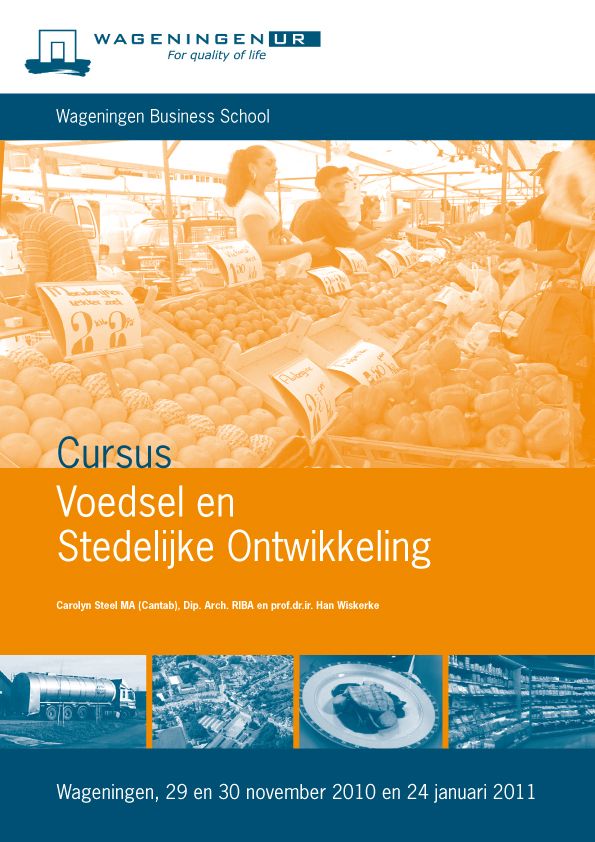
Cursus ‘Voedsel en Stedelijke Ontwikkeling’

Op 29 en 30 november 2010 en 24 januari 2011 verzorgen Carolyn Steel en ik voor Wageningen Business School een cursus over de relatie tussen voedsel en stedelijke ontwikkeling. Deze cursus is toegankelijk voor een breed publiek: beleidsmakers, architecten, landschapsarchitecten, stedelijk ontwerpers, eco-ontwerpers, docenten en mensen die in de landbouw, voedingsmiddelen- of gezondheidsindustrie werken. Daarnaast is iedereen die geïnteresseerd is in duurzame (stedelijke) ontwikkeling van harte welkom.

De aanleiding voor deze cursus is gelegen in de trend van bevolkingsgroei en voortschrijdende verstedelijking en het daarmee samenhangende spectrum aan sociale, economische en ecologische uitdagingen. Klimaatverandering, slinkende olie voorraden en het uitputten van natuurlijke hulpbronnen, gecombineerd met sociale kwesties als armoede, honger en obesitas, vormen de achtergrond voor complexe beleids- en planningsvraagstukken. De verbindende vraag in deze is hoe steden in de toekomst te voeden op een rechtvaardige en duurzame manier.

Als de toekomst inderdaad verstedelijkt is, moeten we dringend (her)definiëren wat dit inhoudt. Huidige aannames over verstedelijking, ontstaan in een tijd die voornamelijk ruraal was, zijn verouderd. We hebben een nieuwe visie nodig op steden en de relatie die zij hebben met het platteland dat hen moet voeden. Als wijzelf en onze toekomstige generaties “goed” willen kunnen leven, moeten we nieuwe inzichten ontwikkelen met betrekking tot wonen, ontwerpen en samenwerkingsverbanden. Hoe we dat moeten doen, is de kern van deze cursus.

Deze cursus is gebaseerd op en geïnspireerd door het boek Hungry City van Carolyn Steel. Hierin analyseert ze stedelijke ontwikkeling vanuit het perspectief van voedsel. Voedsel is de verbindende factor tussen tal van stedelijke uitdagingen, variërend van de ecologische footprint en klimaatverandering tot welzijn en gezondheidsvraagstukken. Door de verbinding met voedsel zichtbaar te maken, krijgen planners en beleidsmakers een middel in handen om hun aanpak te herdefiniëren en deze meer toe te spitsen op een duurzame stedelijke en rurale ontwikkeling. Cursisten leren door dit perspectief de relatie te zien tussen voedsel en verschillende publieke domeinen. Door deze relatie te begrijpen, wordt inzicht verkregen in de kwaliteit van beleid, in de samenhang van beleidsterreinen en in de verbanden tussen lokale en globale kwesties. Cursisten leren werken in multi-disciplinaire teams, waarbij voedsel als gemeenschappelijke taal en verbindende factor gebruikt.

Klik op de volgende links om je in te schrijven of om de cursusfolder te downloaden.