Embracing and exploring diversity in sustainable transition pathways to food and nutrition security

A recent post on the local case-studies in TRANSMANGO. A diverse selection of 18 case-studies in Europe (and Tanzania) represent the Fragmented Foodscape that will improve our understanding of transition pathways to a sustainable food system.

Aniek Hebinck's avatarTRANSMANGO

Through the project TRANSMANGO we hope to contribute to a better understanding of sustainable transition pathways to changing food systems. Especially in WP6 we put focus on the diverse food practices performed on the local level all over Europe and their contribution to food and nutrition security[1]. The European ‘fragmented foodscape’[2] is constituted by a range of various and often contrasting social practices that co-exist and interact with another. Hence we have selected a diverse range of food practices all over Europe in order to explore whether and if so how they enhance food security. These practices range from urban food (policy) initiatives in the UK to food assistance in Italy.

The 18 diverse case-studies that have been selected for WP6 illustrate the European[3]  heterogeneity in Food and Nutrition Security (FNS) practices and transition pathways. The selection covers predominantly ‘counter movements’andmore radical FNS transition…

View original post 844 more words
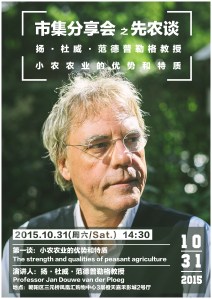
Farmers’ Markets in Beijing – an impression by prof. Jan Douwe van der Ploeg

By prof. dr ir Jan Douwe van der Ploeg

Poster lecture by prof. Van der PloegAt the end of October I had the opportunity to meet a large group of social activists involved in the development of Farmers’ Markets in Beijing. I gave a short presentation in a meeting with some 150 people (see the announcement). It took place in a cinema with my Power Point Presentation projected on the screen normally used for films. The good thing was that the projected images were now up to 5 times larger than me myself. I felt reduced to the right proportions. Afterwards we had a lengthy conversation on the construction of new markets, peasant agriculture and new peasants. The nearby Farmers’ Market (that frequently changes location: it travels through Beijing) impressed me very much: it was, as it were, a perfect illustration of the discussion we had inside the cinema. Many peasants, many new peasants as well. Continue reading →

Request for a MSc student on leadership of place

Picture leadershipThe Rural Sociology Group is looking for a MSc student who is willing to do his/her master thesis research on leadership in 2 Dutch regions in the context of an international comparative research in the spring of 2016.
The central question is how leadership plays a role in rural and metropolitan regional development. Continue reading →

Visiting scholar Claire Baker – how global transformations affected a small rural community in Australia

Claire Paradise 2

Claire Baker visiting the social care farm ‘t Paradijs: http://www.boerderijparadijs.nl

By Claire Baker, PhD-student from the University of New England in Australia.

Working title of my PhD-project: ‘Experiencing change in a globalising agricultural economy: An Australian ethnographic case study 1945-2015′.

I have been very fortunate to have spent some time with the dynamic Rural Sociology Group at Wageningen University as a Visiting Scholar over the last couple of weeks. This has been an intensive period of discussion and reading during which I have further refined the theoretical and methodological framework for my research project. Continue reading →

“We need policy rupture not incremental conservatism”: Toward a #commonfoodpolicy

Quote

Transmango

The EU-project TRANSMANGO is focussed at sustainable pathways to changing the food system. This project aims to combine and integrate different theoretical approaches to gain insight into Food and Nutrition Security (FNS).
In light of that, TRANSMANGO’s Terry Marsden has written an opinion paper about transitioning from the CAP to a Common Food and Nutrition Policy to start the debate.

Join the debate: 

A Common Food and Nutrition Policy for Europe?
Having been fortunate enough to have attended and participated in several international conferences and working groups over the spring and summer of this year, and had a change to explore and discuss the current ‘state of play’ in what seems to be the increasingly dysfunctional global food system, I have recently begun to seriously reflect on European policy, and the questions of radically changing the current EU CAP into a Common Food and Nutrition Policy. This was mentioned by Damien Canare, from Montpellier at a meeting of the FLEDGE research programme in Waterloo in September this year, and in my preparation and discussions for a presentation on the TRANSMANGO EU project at the Agriculture and Urbanising Society Conference in Rome thereafter.

“Some have perceived this as being something of a naive question, given the overall complexity and political inertia in the glacial process of CAP reform experienced over the past 25 years”

Continue reading →