June 2016 Katharina Prause completed her MSc-thesis for the Master of Organic Agriculture of Wageningen University. The full thesis is available here. Below an abstract of her thesis. Continue reading
Category Archives: RSO-student
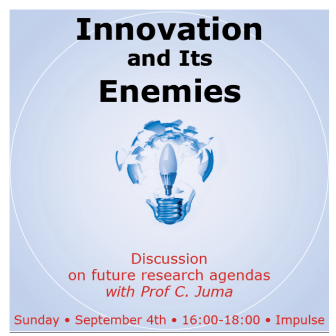
Innovation and Its Enemies: Discussion on future research agendas

The Opening of the Academic Year is fast approaching. Register now for an opportunity to discuss the future of innovation research with this year’s Keynote Speaker, Professor Calestous Juma (Harvard University) and Cees Leeuwis,Professor of Knowledge, Technology and Innovation (Wageningen University).
Date: Sunday September 4 2014
Time: 16:00-18:00
Location: Impulse (building number 115)
Agenda
16:00 Welcome and Introduction by Dr Sylvia Karlsson-Vinkhuyzen
16: 10 Presentation by Prof Calestous Juma
16:30 Reflections by Prof Cees Leeuwis
16:40 Discussion moderator Dr Jessica Duncan
17:10 Closing remarks by Dr Sylvia Karlsson-Vinkhuyzen
17:15 -18:00 Drinks, snacks and meet and greet

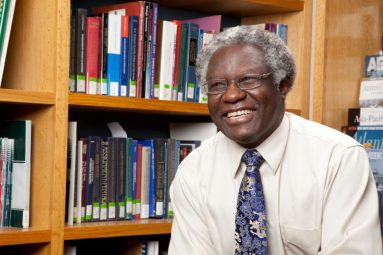
Professor Calestous Juma- Keynote Speaker for Opening of the Academic Year 2016-2017
BSc Thesis vacatures: o.a. Gezondheidszorg & Krimp en Vluchtelingenopvang
BSc Thesis vacatures: o.a. Gezondheidszorg & Krimp en Vluchtelingen opvangMocht je geïnteresseerd zijn in één van de volgende onderwerpen, dan zouden we je graag begeleiden tijdens het schrijven van je BSc Thesis. Momenteel zoeken we studenten voor de volgende onderwerpen:
Bachelor Gezondheid en Maatschappij:
- Verkenning van onderzoek naar initiatieven om (eerstelijns) gezondheidszorg op een nieuwe manier veilig te stellen in plattelandsgebieden, die te maken hebben bevolkingsdaling. Daarbij gaat het mij met name om ervaringen elders in Europa. Het achterliggende probleem is dat het steeds moeilijk wordt om huisartsen te vinden die zich willen vestigen in plattelandsgebieden. Ik ben betrokken bij een groep huisartsen in Nederland die nieuwe mogelijkheden willen verkennen om huisartsenzorg zo te organiseren die tegemoet komt aan de zorgvraag vanuit de bewoners maar het bieden van zorg ook aantrekkelijker maakt voor de nieuwe generatie huisartsen.
BSc Thesis opportunity: The Human Factor in Place-shaping
We are looking for motivated BSc students that are interested in writing a thesis with the Rural Sociology Group on the topic of place-shaping. The student will engage in a literature-based study, starting literature will be provided by the supervisor. The report will preferably be written in English.
- The (re-)appreciation of places; paying attention to socio-cultural practices; people’s sense of place; regional identities, narratives and story-lines, and branding of places[1];
- Individual values and collective culture as the ‘inner’ dimension of sustainability; addressing questions such as: why would people get engaged in sustainability initiatives and self-organization; how and why do people value places but also oppose to the spatial planning of new projects, such as wind-energy parks; how are citizens initiatives and place-shaping influenced by awareness, culture, identities and values; Which ‘policy scripts’ can be identified addressing the role of culture in places?
- Collective agency, emerging grassroots initiatives, alliances and coalitions; addressing the questions: how can spatial development enable the ‘energetic society’? How do people on the local and regional administrative level reflect on and negotiate the conditions of their engagement in place-shaping, how do they express agency and create a countervailing power in rural and urban development; how can effective (public-private) alliances and coalitions be build?
- Leadership of place; which acknowledges the role of shared, collaborative (knowledge) leadership in building collective agency, in attuning the institutional setting to the specificities of place, thus enabling a place-based approach.
- Methodology; Qualitative case-study research; Participatory approaches; Action-research; Value-oriented approach, Appreciative Inquiry.
BSc Thesis Opportunity: Social Value of Neighbourhood Apps
In recent years several ‘apps’ have been developed in order to help people exchange both tangible items such as materials or food, and intangible issues such as knowledge and information. Examples are ‘nextdoor’, created to exchange news and other information between neighbours, ‘peerby’, designed to help people lend each other tools and utensils, and ‘thuisafgehaald’, a website facilitating people to cook for others in their neighbourhood. Besides offering practical solutions to ‘use the power, the knowledge and the stock of the masses’, such applications are also often viewed in terms of social cohesion and strengthening neighbourhoods.
Continue reading