Urban Agriculture in Romania

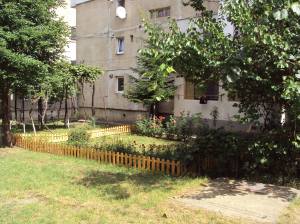
11879645_1022934331074106_583476184_o-2This MSc thesis by Anamaria Alupoaie (MSc Organic Agriculture) investigated the reasons for failure of urban gardens, and the impacts of gardens on resident’s ‘sense of place’, in Dorohoi city in Romania.

Urban Agriculture plays a different role in the food system then agriculture in rural areas. In some cases, it represents a source of income or builds  sociological relations between citizens, through participation in the garden. In other cases, urban agriculture may originate from rural agricultural habits and traditions. With these inherited habits, urban farmers improve the existing environment through their practices, and with these practices they inspire others to take action in maintaining their own ‘green corners’ in the public space.

11882459_1022933601074179_396130938_oThe study was undertaken in Dorohoi region, a city situated on the north side of Romania, a small city with  31,093 inhabitants. In the last 20 years, the city experienced a period of decline due to the closure of big factories that offered jobs for more than half of the inhabitants. Since then the unemployment rate grew, and reached 80-85 %, in 2009. And it is estimated that now over 50% of the population lives below the country’s poverty line, as a result of the loss of the big industry. The availability of resources and income has triggered city dwellers to rely to a greater extent on local food production. Among the existing gardens, new ones started to flourish around the apartment buildings, in urban public spaces, and residents grew their edible greens. As such, in the area proposed for investigation, Dorohoi, urban agriculture continued through the communities of rural people that had moved into the urban center. They developed gardens in the green spaces of the city as a traditional habit inherited from their rural life. But this period of prosperity didn’t last, and about a decade ago, the city gardens were destroyed, with no significant grounds left. Continue reading

Thesis opportunity: Effective strategies for civil society engagement in global food security governance

New Thesis Opportunity with Rural Sociology Group, Wageningen University

Proposed title: Effective strategies for civil society engagement in global food security governance: An analysis of CSO interventions in the Committee on World Food Security

Key words: Food security; civil society; policy; global governance; Committee on World Food Security; Civil Society Mechanism; theories of change

Context: The world food price crisis of 2007/08 shook global food governance. Pressured to find solutions for unprecedented prices increase of led to the development of new global initiatives and the reform of old ones.  One of the most promising actions was the reform of the United Nation’s Committee on World Food Security (CFS), who transformed itself from “the most boring UN body of all” – in the words of an experienced diplomat based in Rome – to the foremost inclusive international and intergovernmental platform for food security, with substantive participation of different actors including member states, civil society and private sector. Continue reading

Request for a MSc student on leadership of place

Picture leadershipThe Rural Sociology Group is looking for a MSc student who is willing to do his/her master thesis research on leadership in 2 Dutch regions in the context of an international comparative research in the spring of 2016.
The central question is how leadership plays a role in rural and metropolitan regional development. Continue reading

PhD course on spatial thinking in the social sciences

2014 a 2013 IMG_2719Today, the concept of socially produced space appears in publications with little apparent need for justification or explanation. Yet it was not so long ago that “space” was generally ignored in social theory. In this course we critically engage with the spatial turn in social sciences. This spatial turn brings into focus a relational approach, showing how the social comprises the spatial, and the spatial comprises the social.

Building upon a brief introduction about the return of spatial thinking in the social sciences, we will discuss three themes: the construction of the rural, in relation to the urban, our understanding of local in relation to the global, and constructions of nature. The course ends with a special session by prof. Ash Amin of Cambridge University on the spatial dimensions of democratic renewal.

The course “Spatial thinking in the social sciences ” is meant for PhD students in the social, environmental and political sciences. In the course we will switch between close reading of texts, workshops, and discussion. Students following this course will not only learn to think about place as an analytical category, but also learn to ‘work with place’ by applying various perspectives to concrete cases.

The course will be given from April 22 to April 29, 2016.

For more information contact Joost Jongerden at joost.jongerden@wur.nl

On Becoming: MSc Thesis on Undocumented Migrants in the Netherlands

On Becoming: An Ethnographic Account on the Importance of Social Relationships for Undocumented Migrants in the Netherlands

This ethnographic and descriptive account argues for the importance of personal relationships for the ‘integration’ of undocumented migrants in the Netherlands from the perspective of those who ‘live it’. Following three personal stories we can see that social networks are crucial as they provide access to necessary resources and enable undocumented migrants to practically arrange their existence. But in addition, because these interactions are built on personal connections and allow for intimacy they enable a deeper sense of belonging. This indicates that, although undocumented migrants are formally ex­cluded from any state services, they may in fact participate economically and socially due to their personal social network. As such, they enable a different perspective on the mean­ing and methods of integration. Because in a domain highly controlled by the state these three personal stories show that integration may also be seen as a trajectory of becoming; as a constant social process based on affective and personal relationships that take place in the social domain. Integration as such should not be seen as a procedural process as only described by the state but instead as an affective process in which people assemble socially. This enables a reconceptualization of integration and a re-envisioning of the role of the state in social life.

On Becoming is a MSc thesis written by Vera Ribbens and supervised by Alberto Arce (SDC) and Joost Jongerden (RSO). The thesis can be accessed by following this link: http://edepot.wur.nl/356124