Research in the Amazon: experiences of a RSO MSc student

My name is Carlo and I am currently conducting field research for my MSc-thesis in the Ecuadorian Amazon, with one of the seven indigenous ‘nationalities’: the Waorani. They inhabit a territory that has been recognised as an ethnic reserve by the government and which is partially encompassed by the famous Yasuní National Park. Because of its natural resource richness this has become a highly contested area: on one hand it is one of the global bio-diversity hotspots while on the other it lies above substantial crude oil reserves, the country’s main export. Oil exploration and extraction efforts have created the basic infrastructure, i.e. gravel roads, that allow for access in what would otherwise be remote areas of the jungle. They also have control over who has access to this area.P1120603

The Waorani inhabit their territories in small settlements (less than hundred inhabitants), which they refer to as communities. In most cases one community is not further away than a day or two walking distance from the other. However some communities are situated in very remote areas that can only be accessed via canoe or plane.

Life in the communities has its own pace as nature provides to many of the basic needs of everyday life. Lush vegetation provides abundant and constant supplies of food and copious rainfall is collected to be used for cooking, drinking and personal hygiene.

DSCN0340Visitors and foreigners are not that common but are kindly welcomed to the communities. A genuine interest is displayed by the inhabitants, especially by the children. A lot of patience is required to conduct research in this environment as the whole community tends to gather around the visitors, curious to witness whatever is being done, significantly slowing down the process as a result. The experience however is uniquely beautiful and absolutely unparalleled: a reminder of difference.

‘Gij zult participeren’: Een discoursanalyse van moestuin-projecten voor minima in Nederland (MSc-thesis)

Door Monique Jongenburger (Boerefijn) – MSc-student International Development Studies

Vijf jaar Internationale Ontwikkelingsstudies in Wageningen hebben me kritisch gemaakt op ontwikkelingshulp en interventie. Worden de deelnemers van projecten serieus genomen? Ik was dan ook geboeid door de uitzending van EenVandaag over moestuin-projecten voor minima in Nederland: “Geef geen geld maar groenten”. Kunnen Nederlandse ‘armen’ niet met geld omgaan? Ik besloot dat ik dit onderwerp verder wilde onderzoeken. Dit leidde tot de onderzoeksvraag van mijn thesis: Welk discours leeft er bij de initiatiefnemers van moestuin-projecten voor minima in Nederland over minima?

Om mijn vraag te beantwoorden heb ik een discoursanalyse toegepast. Ik heb me hierbij gebaseerd op de theorie en methoden van Foucault en de politicologen Bacchi en Yanow. Voor de analyse heb ik documenten verzameld over de projecten en bij zeventien initiatiefnemers een semi-gestructureerd interview afgenomen.

In heel Nederland bleken soort gelijke projecten te zijn opgekomen: voedseltuinen, minimatuinen en volkstuintjes voor minima. Al snel bleek dat de projecten in de eerste instantie op elkaar lijken maar verschillende doelen hebben. Dit leidde tot een typologie van vier soorten projecten: de voedselbank-tuin, de duurzaamheid-tuin, de dagbesteding-tuin en voedselzekerheid-tuin. De initiatiefnemers presenteren elk een eigen probleem waar hun tuinproject een oplossing voor is; een tekort aan groenten bij de voedselbank, afstand tussen mensen en voedsel, inactiviteit van minima en te dure groenten. Continue reading

Global dynamics and empowerment of the local street food network: a case study on the Ghana Traditional Caterers Association

By Hilde-Marije Dorresteijn, MSc International Development Studies at Wageningen University

For my MSc thesis within the RSO chair group I did research on street food in Ghana. During the master programme I became more and more interested in food issues and its possibilities for local development. These possibilities are beautifully illustrated by the following quotation with which I started my thesis:

“Food provides an answer. Our landscapes and cities were shaped by food. Our daily routine revolves around it, our politics and economies are driven by it, our identities are inseparable from it, and our survival depends on it. What better tool, then, with which to shape the world.” (Steel, 2012 in Viljoen & Wiskerke, 2012:36).

HM Dorresteijn blog picture 1

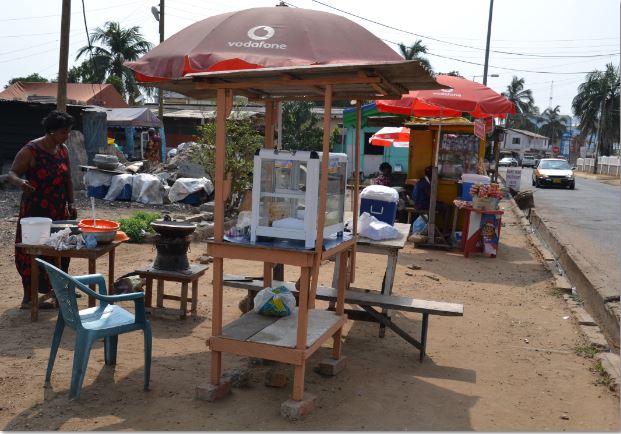
Despite its importance I found little scientific research on street food, a phenomenon that is particularly relevant in developing countries. Street food can be defined as: ‘ready to eat food or beverages prepared and/or sold in the street and other public places for immediate consumption or at a later time without further processing or preparation’ (FAO, 2012). I decided to look into this topic within the context of Ghana’s capital Accra. An estimated 85% of the urban population in Ghana patronize it, cutting across socio-economic boundaries and thus also designating the important cultural role of street food In Accra, from early morning till late at night all sorts of food are being sold on the streets. Also, there is a great variety in the professionalism of microenterprises. There are many hawkers walking around trying to sell their products, well established enterprises that have fixed stands and seating facilities, and the informal eating houses called ‘chop bars’. Street food make an essential contribution to nutrition of the urban population by providing easily accessible and affordable food, as well as they provide a good livelihood strategy by creating employment and increasing incomes for a large number of urban dwellers. Hereby street food thus makes a great contribution to the local economy. This informal sector requires low start-up capital and low levels of education are needed, making it a good business opportunity for especially women.

The cheapest way to make money, is to cook food. You are a secretary, or you have a shop, and the shop collapses. You can buy a pot, buy silver, cooking utensils, buy water, the pepper, yam and you cook and you’ll get people to buy. Very, very cheap. So day in day out people have been coming into the system. That is why they are plenty. And automatically when you cook, you will get people to buy.” (Mr. Ansong, PRO GTCA, 13 Jan. 2014) Continue reading

Quality characteristic of TSG Farmhouse Gouda cheese is farm specific – Msc-thesis tested micro and meso terroir models

By Marcell Kustos, Master Food Technology Wageningen University (marcell.kustos@wur.nl)

MSC-thesis: The authority of novel terroir models: Case study on quality characteristics of Traditional Speciality Guaranteed Gouda Farmhouse cheese

Boerenkaas-met-kievitIn my MSc-thesis research I tested novel terroir models on Farmhouse cheese (Boerenkaas) originating from the Green Heart area in the Netherlands, also known as the traditional farmhouse cheese area surrounding cities like Gouda and Leiden historically linked to the traditional Gouda type and Leiden type of Famhouse cheese. The latter or Boeren Leidsekaas has been certified a product with a protected designation of origin or PDO by the EU-Quality regulations in geographical indications and traditional specialities in 1997. It has a strict demarcation of the production area or terroir and a strict code of practice. In 2007 the Boeren Goudsekaas was certified as a Traditional Speciality Guaranteed or TSG, that is less strict then a PDO: it guarantees only some traditional product methods. Basically that is made of raw milk and that while processing it should not be heated above 40°C or pasteurized. Unlike PDO the TSG has no regulations with regard to cattle breed, cattle feed or cheese manufacturing, as e.g. the Comte has to some extend. And a TSG  has no geographical demarcation and can thus be produced at any farm. Continue reading

Voedselvisie “Ede, de proeftuin voor Food”

Door Lara Sibbing, MSc-student Organic Agriculture (contact: lara.sibbing@wur.nl)

Voedselvisie EdeTijdens mijn stage bij de gemeente Ede heb ik bijgedragen aan het opstellen van een beleidsvisie rond voedsel. Dit heeft geresulteerd de notitie ‘Ede, de Proeftuin voor Food’ die in het voorjaar aan het college van B&W is aangeboden.De voedselvisie van Ede is te downloaden van de webpagina Ede kiest voor Food waar ook een korte toelichting wordt gegeven.

Met deze visie, die voortborduurt op de toekomstvisie Ede 2025, laat de gemeente Ede zien waar zij op in wil zetten op foodgebied: proeftuin voor Food worden door Ede en Edenaren, bedrijven en organisaties te stimuleren en te inspireren op drie hoofdthema’s: (1) Innovatieve bedrijvigheid in de regio, (2) Sociaal & Gezond en (3) Onderwijs & werkgelegenheid. De nieuwe gemeenteraad zal zich binnenkort over de voedselvisie buigen. Op dit moment wordt er hard gewerkt om samen met Edenaren een strategie op te stellen om de doelstellingen uit de visie te bereiken.