Like last year (see the respective blog on the field trip and the rather amateuristic video clip I made of it) students attending the course Origin Food: a market for identity made a field trip to the Rhederoord estate to learn more about the passion for local food and actually taste excellent local cuisine. Jidi Xu, one of our enthousiast students made a ‘cool’, dynamic video clip of the field trip that will especially be appealling to young people, although I liked it very much too!
Category Archives: Rural Development
Intensive rural experience in the Italian Dolomites
In the impressive mountain area of the Italian Dolomites, province of Belluno, four female students from the Wageningen University spent the first two weeks of April. They participated in this year’s Intensive Program on Rural Development. The IP was about “the role of agriculture in territorial identity” of Belluno Province. To read more about their experiences, click on the links below.
– People in the IP – Suzanne de la Fonteijne
– Methods used during the IP – Lise Alix
– (Food)culture – Annemijn van der Schaar
– Role of Wageningers in the IP – Marina van Maanen
DERREG Policy Seminar in Brussels
Last Thursday March 31, a Policy Seminar had place to discuss the relevancy of the results from the EU-funded reserach project DERREG for EU-policies. Although the project and the work is not yet completed, emerging outcomes and policy recommendations were presented by the project coordinator prof. Michael Woods and the four coordinators of the respective workpackages on Rural business networks, Rural migration patterns, Sustainable development and Rural regional learning. The emerging outcomes and recommendations are also capitalised in the European Policy Brief published at the DERREG website.
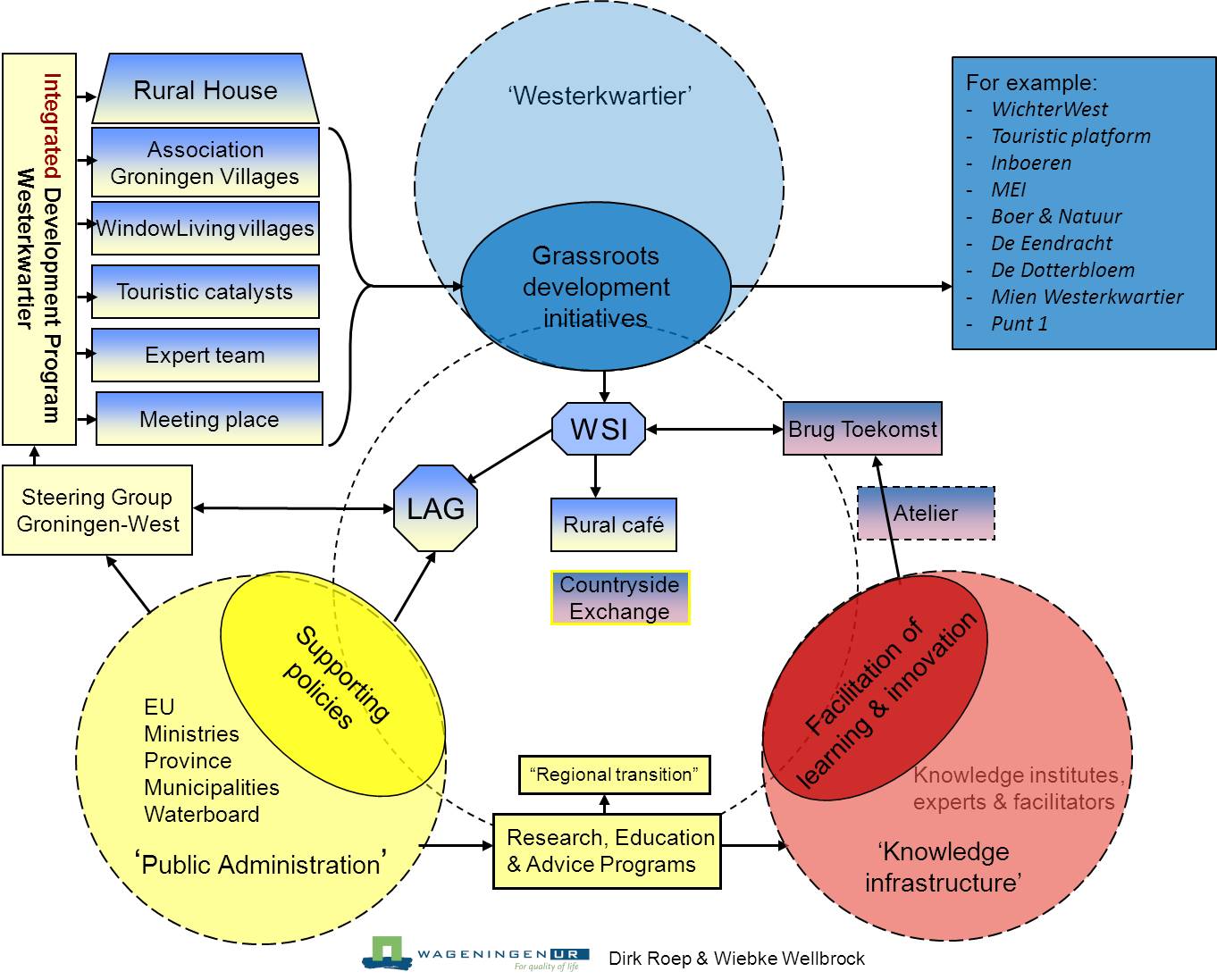
WU is coordinator of Workpackage 4. We focussed on how public support and faciliation of joint learning and innovation in grassroots (place-based) development activities can be best arranged. We have explored, mapped and analysed various such arrangements in six case study areas. See the example of the map of the ‘governance of joint learning and innovation’ in the Westerkwartier below.
These arrangements and the support or faciliation given was evaluated by the beneficiaries (see earlier posts on case-study area Westerkwartier, Alytus, Dresden and Comarca de Verin).
Although we will extend our analysis and specifically elaborate more on ‘promising or good practices’ revealed, Wiebke Wellbrock and I presented the main findings and policy recommendations (see our presentation).
Key to our findings is that the effectiveness of support policies depends on well working operational interfaces between public policies, grassroots development initiatives and (knowledge) facilities to support joint learning and innovation. These interfaces get shaped in agreements between various public and private partners but it are operational agents or agencies fulfilling various intermediary task and roles connecting different ‘worlds’ that make them work (well).
“Urban Development with Rural Consequences”
As part of the course Understanding Rural Development, a group of master students from France, Cameroon, Taiwan and the Netherlands plus staff from the Rural Sociology Group went on a study trip to Nijmegen-Lent to learn more on the developments in this area. The group was met by Karolien Andela, from the Municipality of Nijmegen. Gathered around a scale model of the area in the information centre De Waalsprong, she informed us on projects such as: ‘Space for the river Waal’, ‘the Waal Jump’ (new urbanisation in Lent), the ‘Waal front’ (reconstruction of an industrial area) and landscape development.
Her story revolved around the central meaning of the river Waal in the expansion of the city. The carrying capacity of the river is becoming too limited for the amount of water flowing through. In 1995 this already led to flooding in several parts of the city and as the water level tends to rise this is expected to have more negative consequences in the future. This is of course a concern to both local government as well as its citizens. In the past, the response to rising water levels in the Netherlands has been to strengthen dikes and increase its height, but this is not a long term solution. Therefore on a national level, the government decided to change its approach to this threat and introduced the idea to give more space to the river (“Geef de Rivier de Ruimte”) meaning to give the river more capacity. This is done for example by returning flood lands to the river, construct side dams, dig channels along the polder or streamline vegetation. The national government appointed 39 spots where this concept should be applied, concerning the rivers Maas, Waal and Lek. Most of these projects are located in predominantly rural areas but in this case it is right in the middle of a city.
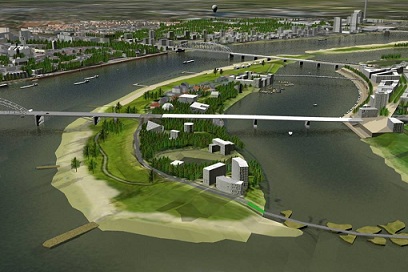
In the case of Nijmegen, the suggested plan by the government entailed to relocate the existing dike more land inwards and in addition dig a channel in front of it to increase the capacity of the river and thus lower the water level. As a result, an island is created which will give opportunities for housing, recreation and cultural activities as well as nature development.
At first this plan was faced with a lot of public opposition as it implied the removal of houses and farming enterprises as well as other negative impacts such as a rise in the ground water level. The group of protesters even came up with an alternative plan which was accepted by the city council but eventually rejected by the national government who favoured the original plan. Initially the city was reluctant with this decision but managed to change it into an opportunity for urban development and even get the necessary public support. One of the factors enabling this public support was the creation of a platform that is involved in different stages of the plan development and gives voice to various interest groups including a group of affected households.
The group from Wageningen was interested in aspects like: What is the effect of the plans on local farmers? Are the planned green spaces in the new part of the city going to be interconnected or just loose patches of green? How do the citizens of the village of Lent feel about the plans as they suddenly becoming part of a city? How are the urban planners going to create a shared feeling of identity between the inhabitants of the old and the new part of the city? What are the effects of the economic developments on the plan? And are sustainability concepts taken into account in the design of the area and its houses?
After this informative talk by the Municipal spokesperson, the group took a short stroll over the bicycle bridge that connects the city of Nijmegen with the village of Lent. From here the group could see, with a bit of imagination, what the effects of the planned developments will be. Suddenly it became clear which households were going to be on the “wrong” side of the new dike and will not be able to escape the new course of the river.
To voice your opinion about the plans you can interact with the project team on twitter (www.twitter.com/waalsprong) or follow the developments on YouTube (www.youtube.com/waalsprongnijmegen). The work is planned to start in 2013.
Rural regional learning in the Comarca de Verín, Galicia, Spain
Within the European research project DERREG, we are investigating how public policy can best be arranged to stimulate capacity building within development initiatives operating at grassroots level in rural areas across the European Union.
To find out how public policy interventions can best be arranged, we and our research partners have spoken to various stakeholders in different rural regions across the European Union to find out how they intend to support and facilitate learning and innovation and- most importantly- how the support and facilitation agreed upon is actually provided to the grassroots development initiatives. To find out what is working well and what isn’t working well yet, we have spoken to a number of grassroots development initiators in the participating DERREG case study areas and ask them to evaluate the current support and facilitation received.
To be able to compare the results obtained in the different case study areas, I have travelled to Alytus County, Lithuania in October and Oberlausitz, Germany in December of 2010. In January of this year, I was able to visit our colleague Lola Dominguez Garcia of Universidade de Vigo in the Comarca de Verín in the South-West of Galicia, Spain. In this blog, we intend to share our experiences. Continue reading