AUTONOMY IN AGRARIAN STUDIES, POLITICS, AND MOVEMENTS: AN INTER-PARADIGM DEBATE

Kees Jansen and Leandro Vergara-Camus

Autonomy has been a word that has been rolling off the tongues of leftist activists and academics for decades and has been the subject of countless articles and books. It has been theorised from Marxist, Anarchist, Post-Marxist, Foucauldian and Feminist perspectives. Historically, the term autonomy has often been used to express the ability of individuals or collective subjects to escape, in one way or another, the rule of capital or the control of the state. More recently, academic interventions on autonomy have been fundamentally about assessing how global capitalism operates and what kinds of subjects, spaces, and practices can resist it and build alternatives to it. Within agrarian studies and peasant movements, the concept has referred to the ability of peasants to mount collective responses to the dominant actors in the globalised market or within the state, while remaining independent from political parties or politicians. For indigenous movements, the term autonomy has been associated with a struggle or a project to take back control over their ancestral territories by challenging the nation-state. Discussions about autonomy are thus necessarily about the collective agency of social subjects within capitalism.

The idea of a special issue on autonomy in agrarian studies, politics and movements then was triggered by discussions within the Agrarian Change Working Group at the IIPPE annual conference in Lisbon and Pula. We followed this up with a workshop with contributors, hosted by Kees Jansen, at Wageningen University in the Netherlands in December 2019, just before the pandemic. This was a unique workshop where we debated, as social scientists, ontological and epistemological questions: the current nature of capitalism, its different manifestations in rural settings across the world, the ways different rural groups are inserted within it, and the struggles that different agrarian movements have led to resist it economically, politically and culturally. Coming from different theoretical traditions or positions, we had different understandings of markets and market relations, the role of collective action as well as the dialectical relationship between agency and structure.

This lack of consensus has been preserved in the Special Issue as well, which we hope can contribute to an inter-paradigm debate within agrarian studies on this topic. At the same time, in keeping with the tradition of the Journal of Agrarian Change, the different uses of the term (and the perspectives on) autonomy have been critically discussed from a critical agrarian political economy approach and placed within contexts of contradictory and complex class, ethnic and gender relationships.

The contributions critically analyse and assess different experiences of autonomy (peasant, indigenous, women, and guerrilla) by focusing on the varying spheres from which autonomy is sought (the market, the state, development, patriarchy) and on the type of collective action adopted by the different groups (economic, political, ethno-cultural). It includes contributions covering Latin America, the Middle East, and South-East Asia that are organised around the following four themes:

i) Capitalism in the Countryside and in Agricultural Production: The first discussion of autonomy revolves around a critical assessment of the type of agency that emerges around the demand and search for autonomy and the conditions that make it possible. Characterisations of contemporary capitalism in the countryside, the nature of small-scale farming, and the class position and consciousness of subaltern agricultural producers are central to this discussion. Natarajan and Brickell engage with feminist scholarship on women’s reproductive labour and combine it with Henry Bernstein’s critique of the notion of the autonomous ‘peasant’. They explore how the deeper market integration of women in rural Cambodia, through distress sales of land or use of land as collateral for microfinance borrowing, simultaneously renders women more dependent on markets whilst also constituting a temporary path towards an aspirational autonomy. Jansen, Vicol, and Nikol, on the other hand, develop a critique of van der Ploeg’s book The New Peasantries which presents the struggle for autonomy as central to the peasant condition. They dissect the book’s peasant bias, the usefulness of the notion of autonomy in a human society saturated with social relationships and the neglect of the complexities of agrarian class formation and differentiation at the local level.

ii) Autonomy from the Market or via the Market: The second discussion of autonomy has to do with the different ways of conceptualising markets, especially the relationship between capitalist relations and non-capitalist relations. Sankey shows how different histories, levels and types of market integration within Colombia lead to different kinds of exposure to the imperative of the market and responses to the crisis of small-scale agriculture triggered by neoliberalism. Using the case of O Circuito, an extended market in Brazil constructed by a peasant movement and its urban allies, the paper by van der Ploeg and Schneider develop the notion that autonomy is a political collective project that can rest on the construction of ‘nested markets’.

iii) Social Movements, Autonomy in State and Non-state Politics: All the contributions address questions of class, state and politics, but these questions are the central focus of the contributions by Bretón et al., Guimarães and Wanderley, and Jongerden. Bretón et al. draw from four emblematic cases of peasant and indigenous autonomy in Latin America (the MST in Brazil, the indigenous movement in Ecuador, the indigenous and Afro-descendants in the Pacific Coast of Nicaragua, and the peasant movement in Mexico) to critically analyse the promises, achievements, and contradictions of projects of autonomy during the era of neoliberalism across four dimensions: political independence, economic relations, ethno-cultural goals, and the internal politics.

Following a fundamentally political understanding of autonomy inspired by Cornelius Castoriadis, Guimarães and Wanderley build a Polanyian analysis of the different forms of organisation and struggles that indigenous peasants adopted in Bolivia. Still another approach emerges in the paper by Jongerden who argues that agricultural development by the Kurdish movement in Rojava and North and East Syria is better seen as a third, self-constituting, or autonomous mode of ordering. He traces the influence of Murray Bookchin’s autonomist thought on Kurdish intellectuals and discusses the recent Kurdish agrarian policies in Rojava to rebuild the war-ridden agrarian economy on the principle of autonomy.

iv) Autonomy and Technological Revolutions: While several other papers discuss this theme tangentially, for Stone, the question of autonomy is centrally one of technology and knowledge. He shows how the emerging surveillance farming seems to be replicating earlier phases of agricultural development. Stone also raises concerns about how the big data revolution in agriculture could lead to agricultural deskilling and loss of farmer’s autonomy.

A deeper understanding of autonomy in political theory and practice, as developed through this Special Issue, sheds new light on how to conceptualise class within the continuum of a basically economic category or the outcome of a political process. It asks what makes certain social subjects, be it peasants, indigenous peoples or revolutionaries develop an ideology and political projects that present autonomy (from the market, the state or development) as a desired horizon.

Read the full introduction by the Special Issue editors here.

Read the full Special Issue here – Free access for three months.

75th Anniversary Rural Sociology – The After Movie

75th anniversary event

On 13 May 2022, we celebrated the 75th anniversary of the Rural Sociology Group of Wageningen University with a public event entitled “Rural Sociology: past, present and future”. The event took place in Akoesticum in Ede and was attended by approximately 130 people: current and former staff members, current and former MSc and PhD students, and current and former collaborators in (inter)national research projects. In addition to this event we wrote and edited a book entitled ‘On Meaningful Diversity: Past, present and future of Wageningen rural sociology’ and a group of (former) PhD students put together a PhD magazine. Both are open access publications.

The entire anniversary event was filmed and a 16 minute compilation video of the day can be found here:

Compilation video of the 75th anniversary event of the Rural Sociology Group

In addition all presentations and talks are available online in order of the program of the day:

  1. Opening by Arthur Mol (Rector Magnificus of Wageningen University)
  2. Keynote by Han Wiskerke: Meaningful diversity: Past, present and future of rural sociology
  3. Keynote by Haroon Akram-Lodhi: From peasant studies to critical agrarian studies
  4. Rural Talk Show:  Interactive session including invited guests and audience participation. The Talk Show was chaired by Matt Reed, with Jan Douwe van der Ploeg as a permanent table guest, and changing table guests around the following three themes:
    • Session 1– Societal engagement or academic distance; with Jessica Duncan, Aya Kimura, Han Wiskerke
    • Session 2 – Discussing the rural-urban dichotomy; with Henk Oostindie, Sally Shortall, Esther Veen
    • Session 3 – A continuing debate: agency and structure; with Bettina Bock, Bram Büscher, Mark Vicol
  5. Closure morning session by stand-up musician Bart Kiers
  6. Keynote by Hannah Wittman: Bridging rural and urban through agroecological networks: cultivating agrarian citizenship in a climate crisis
  7. Presentation of Research Agendas: Imagining the next 25 years of rural sociology. Interactive session around three research agendas, briefly pitched by RSO staff, followed by an open floor exchange of ideas and discussion:
    • Pitch 1– Agriculture – introduction Kees Jansen
    • Pitch 2 – Place – introduction Joost Jongerden
    • Pitch 3 – Food – introduction Jessica Duncan
  8. Closure afternoon session by stand-up musician Bart Kiers


75th Anniversary: 58) Research at the Rural Sociology Group: Agrarian Movements and Transitions in the Global South

Lisette Nikol, PhD candidate at the Rural Sociology Group

How do small farmers in the Global South secure their livelihoods? How do capitalist dynamics and agrarian movements striving for alternatives shape these livelihoods? How can agrarian transition pathways address possible tensions between the needs of rural development, sustainable agrarian futures and a growing world population? What role do and should farmers play in imagining and realising these transition pathways and agrarian futures? How do we analyse and explain agrarian transitions in general and the farming systems realised by agrarian movements in particular?

These abstract questions summarise my research interests. My interests are motivated by a concern for an agrarian future that is socially just and environmentally sustainable, in which our farming populations and natural environment can thrive rather than be exploited.  

In my PhD research, I investigate diverse facets of an ongoing agrarian struggle in the wake of agricultural modernisation and the development of agrarian capitalism, paying particular attention to the concept of peasant autonomy. Peasant autonomy locates core critiques of modern agriculture with the commodity nature of production relations (Jansen et al. 2021). While the critiques alone are relevant, I find that research into agrarian movements is more interesting and useful if it examines how different agricultural systems promote distinct production relations and transition pathways that entail different dependencies on wider production relations, agro-ecosystems, social relations and agrarian movements. As a sociologist concerned with theory, I find it relevant to inquire into how various conceptual ideas of peasant autonomy, varying dependencies on diverse production relations and socio-material relations of farming systems can help us both explain ongoing transitions and imagine and realise future transitions .

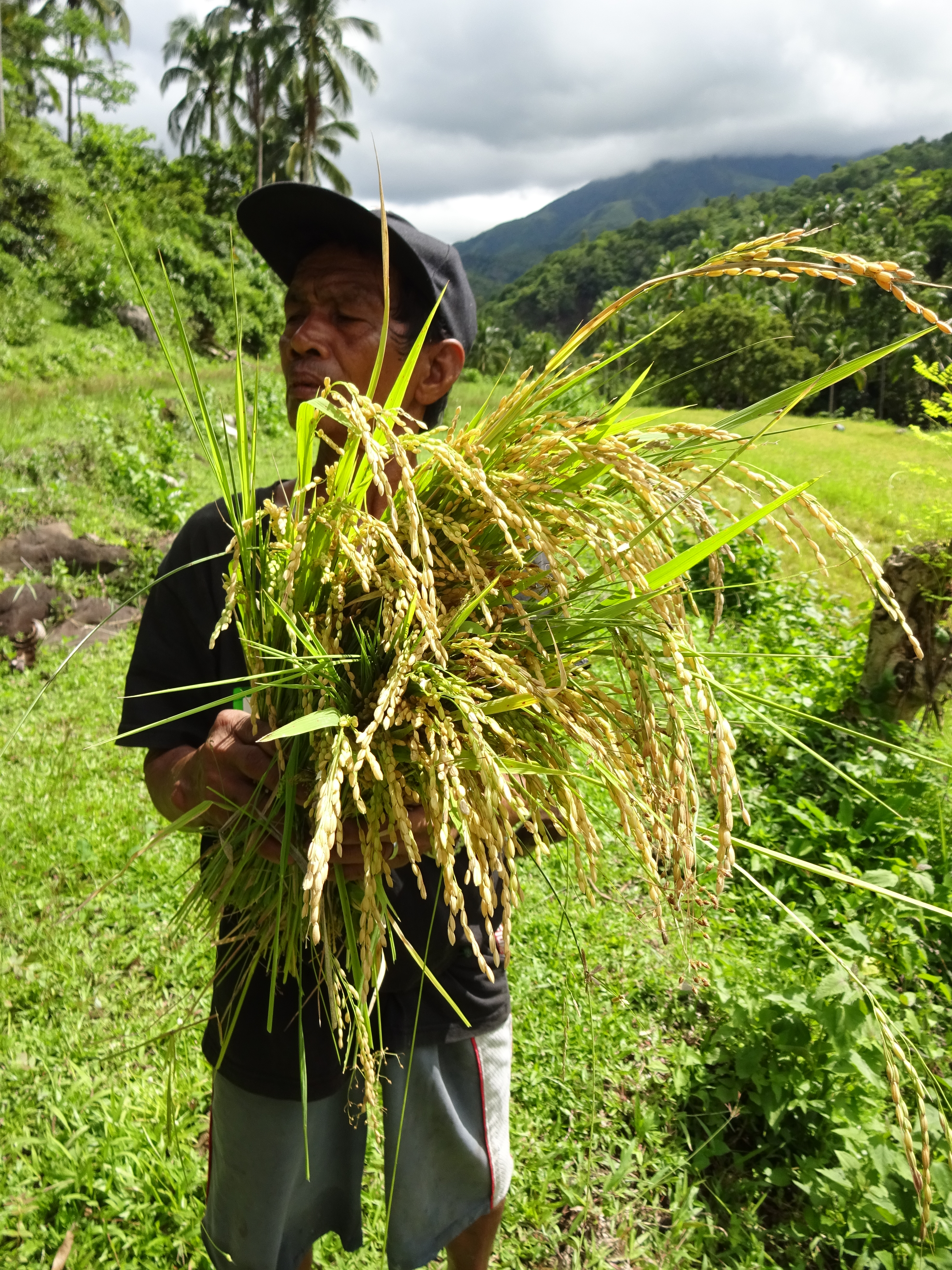
Specifically, I am investigating an organic agriculture movement in the Philippines that is responding to the challenges posed by decades of Green Revolution-oriented agricultural policies. Providing alternatives to the agricultural modernisation programmes of the state, this farmer network facilitates a farmer-led rice breeding programme, trainings on organic cultivation and complementary livelihood-related aspects, and a Participatory Guarantee System to market organic produce locally.

I locate my work within a contemporary body of agrarian political economy that critically reflects on the broader effects of the capitalist dynamics in agriculture and the countryside (see e.g. Guthman 2004, Kloppenburg 2004, Bernstein 2010, Jansen 2015). Another body of theoretical work that informs my research agenda is an anthropology of technology development that looks at technological change in the context of agrarian development and transformation as contingent, society-technology relations (e.g. Bray 1986, Almekinders 2011, Jansen & Vellema 2011). Combining these two approaches allows for an interesting set of questions capable of addressing both social and material aspects that are vital to an overall understanding of agrarian movements and transitions.

An important part of my research looks at peasant autonomy and food sovereignty questions as concerning farmers’ relations to their means of production. Agrarian movements seemingly aim to reverse the separation of farmers from their means of production, such as seeds and the wider agro-ecosystem, as achieved by agricultural modernisation and development following a capitalist, industrial model. But how do efforts to mend this situation play out in particular empirical settings? In this question, I centralise the material dimension of farming and agro-ecosystems in interaction with social relations and farmers’ practices. I address two important sets of production relations.

First, I analyse the sorts of relations around seed that emerge in situations where seed activist initiatives are realised. It is important to understand how these relations are caught between agrarian capitalism and seed activism. Second, I focus on soil fertility management – a core of organic approaches often presented as key to realising an autonomous agro-ecosystem – as a site of tension and performance. How does a view on farming as ‘performance’ (cf. Richards 1993) or simply ‘making do’ to survive relate to views on farming as performing political farming narratives?

Another aspect of agrarian movements I find intriguing is their functioning as organisations, themselves firmly embedded in relations with and among farmers. When the work of agrarian movements gains importance for the livelihoods of rural and agrarian peoples, how should we understand the relation between movements and members, or the movement’s practical work in the context of agrarian livelihood strategies? Additionally, movements take on emancipatory roles, organising farmers politically and advocating on their behalf at various levels of government (Nikol and Jansen 2020). How do their narratives of agrarian futures and rural development relate to the narratives of its differentiated constituency, as well as those of the government?

A last avenue of my inquiry looks into the dynamics shaping and participation of farmers in national organic sectors. Participatory Guarantee Systems (PGS) are promoted on a global scale as a cost-efficient and trustworthy alternative to third-party certification. Interestingly, the development of organic agriculture is caught in a tug-of-war between capitalist dynamics prompting its ‘conventionalisation’ and committed pioneers promoting values that critique the industrialised agricultural model (Nikol and Jansen 2021). I further investigate dynamics in the development of organic agriculture, specifically how PGSs seem a tool modelled after and complying with demands from conventional agriculture, as well as a tool to organise farmer participation, reclaim the narrative of organic agriculture and reorganise the relations that compose this sector.

How to explain ongoing agrarian transitions, and how to imagine and realise agrarian transitions in the future? In researching seed systems and plant-breeding, soil fertility management and integrated farming systems, the organisational and advocacy work of social movements and tensions between capitalist dynamics and ‘pioneer’ approaches in organic agriculture development, I aim to contribute relevant insights grounded in lessons from an agrarian movement in the Global South.  These questions and the experiences of the Philippine organic movement, will no doubt continue to engage me in the future and inspire future contributions to the literature. 

Almekinders, C. (2011). The Joint Development of JM-12.7: A technographic description of the making of a bean variety, NJAS-Wageningen Journal of Life Sciences, 57(3): 207-216.

Bernstein, H. (2010). Class Dynamics of Agrarian Change. Halifax: Fernwood Publishing.

Bray, F. (1986) (1986). The Rice Economies: Technology and Development in Asian Societies. Oxford [etc.]: Blackwell.

Guthman, J. (2004). Agrarian Dreams: The Paradox of Organic Farming in California. Oakland: University of California Press.

Jansen, K. (2015). The Debate on Food Sovereignty Theory: Agrarian capitalism, dispossession and agroecology, Journal of Peasant Studies, 42(1): 213-232.

Jansen, K. and S. Vellema (2011). What is Technography? NJAS-Wageningen Journal of Life Sciences, 57(3): 169-177.

Jansen, K., M. Vicol and L.J. Nikol (2021). Autonomy and Repeasantization: Conceptual, analytical, and methodological problems, Journal of Agrarian Change (special issue on Autonomy in Agrarian Studies, Politics and Movements).

Kloppenburg, J.R. (2004). First the Seed: The Political Economy of Plant Biotechnology. Madison: University of Wisconsin Press.

Nikol, L.J. and K. Jansen (2020). The Politics of Counter-Expertise on Aerial Spraying: Social movements denouncing pesticide risk governance in the Philippines, Journal of Contemporary Asia, 50(1): 99-124.

Nikol, L.J. and K. Jansen (2021). Rethinking Conventionalisation: A view from organic agriculture in the Global South, Journal of Rural Studies, 86: 420-429.

Richards, P. (1993). Cultivation: Knowledge or performance? In M. Hobart (Ed.), An Anthropological Critique of Development: The Growth of Ignorance,pp. 61-78. London:Routledge.

75th Anniversary: 57) Research at the Rural Sociology Group:  Researching Mexican coffee policies resulting from a political regime change

Claudia Oviedo, PhD candidate at the Rural Sociology Group

Mexican coffee policies of recent decades have been highly criticised. Farmers, coffee organizations, academics, and development organizations have claimed that programmes implemented to promote coffee production in Mexico have been limited to assuring mere survival of farmers rather than promoting the necessary transformation of their livelihoods. One of the main criticisms of such programmes is that while the state provided plants, fertilizer, and sprayers through farmers’ organizations, due to clientelism many farmers did not receive the inputs they had been promised. Other criticisms include that such programmes have failed to involve effective commercialization strategies and have not provided adequate technical assistance, particularly with respect to disease management.

Collecting coffee beans – Photo by Erik García. 

In December of 2018, “leftist” President Andrés Manuel López Obrador (AMLO) took office. Criticising previous neoliberal administrations’ lack of attention to rural areas, he promised his administration would benefit small farmers and that he would end corruption. To achieve this, his administration implemented the rural programme Sowing Life (Sembrando Vida) through the Ministry of Well-Being, providing approximately €250 monthly to farmers to plant deforested areas with fruit trees and annual crops using agroecological practices. The Ministry of Agriculture also launched the programme Production for Well-Being (Producción para el Bienestar), which also promotes sustainable coffee production, although with a much lower amount.

This PhD research analyses coffee policies implemented in 2019—he first year of AMLO´s administration, addressing the state’s conceptualization of farmers—essentially based on the size of their landholding—as well as its strategy for incorporating them principally into the organic market. Based on a Value Chain approach as well as Political Economy concepts, I found that those that farmers the state considers to be “small-scale” vary with respect to their level of control over the means of production. Furthermore, I conclude that selling to the organic market does not necessarily benefit all farmers and suggest the need to re-conceptualise the approach of public policy to “incorporating” coffee farmers into the market.

This study also addressed the political configuration of coffee programmes by unpacking the relationship among farmers, the state, and the coffee processing industry—namely Nestlé, as well as the interests of each of these actors and their strategies for obtaining their objectives. Two coffee trajectories were identified: one involving production of high-quality organic coffee and a high level of participation by the state and farmers´ organizations in policy development. The other trajectory is that of instant coffee, involving sale of lower-quality coffee to Nestlé. While several farmers’ organizations reject the latter trajectory, many farmers perceive benefits from cultivating coffee for this industry. Therefore, I urge policymakers and development agencies to allow for a variety of productive options rather than pre-determining a single production system.

Finally, this study addressed AMLO´s policy to reduce involvement of intermediaries by providing subsidies directly to farmers rather than through farmers´ organizations. Given that during previous administrations many representatives of these organizations retained a large part of the subsidies, many farmers welcomed this policy. However, its implementation has been characterised by operative problems and tensions between organizations and state personnel.  Some farmers´ organizations assured that not all such organizations are clientelistic; rather, they hold that they provide an essential mechanism for farmers to access more profitable marketing options. Meanwhile, the reactions of personnel from Sowing Life and Production for Well-Being contrasted significantly: as Sowing Life is extensively promoted by AMLO, and it does not stem from previous programmes, most personnel supported the reduction of intermediary policy. However, some staff of Production for Well-Being defended the work they had developed with farmers’ organisations and highly objected to the changes.

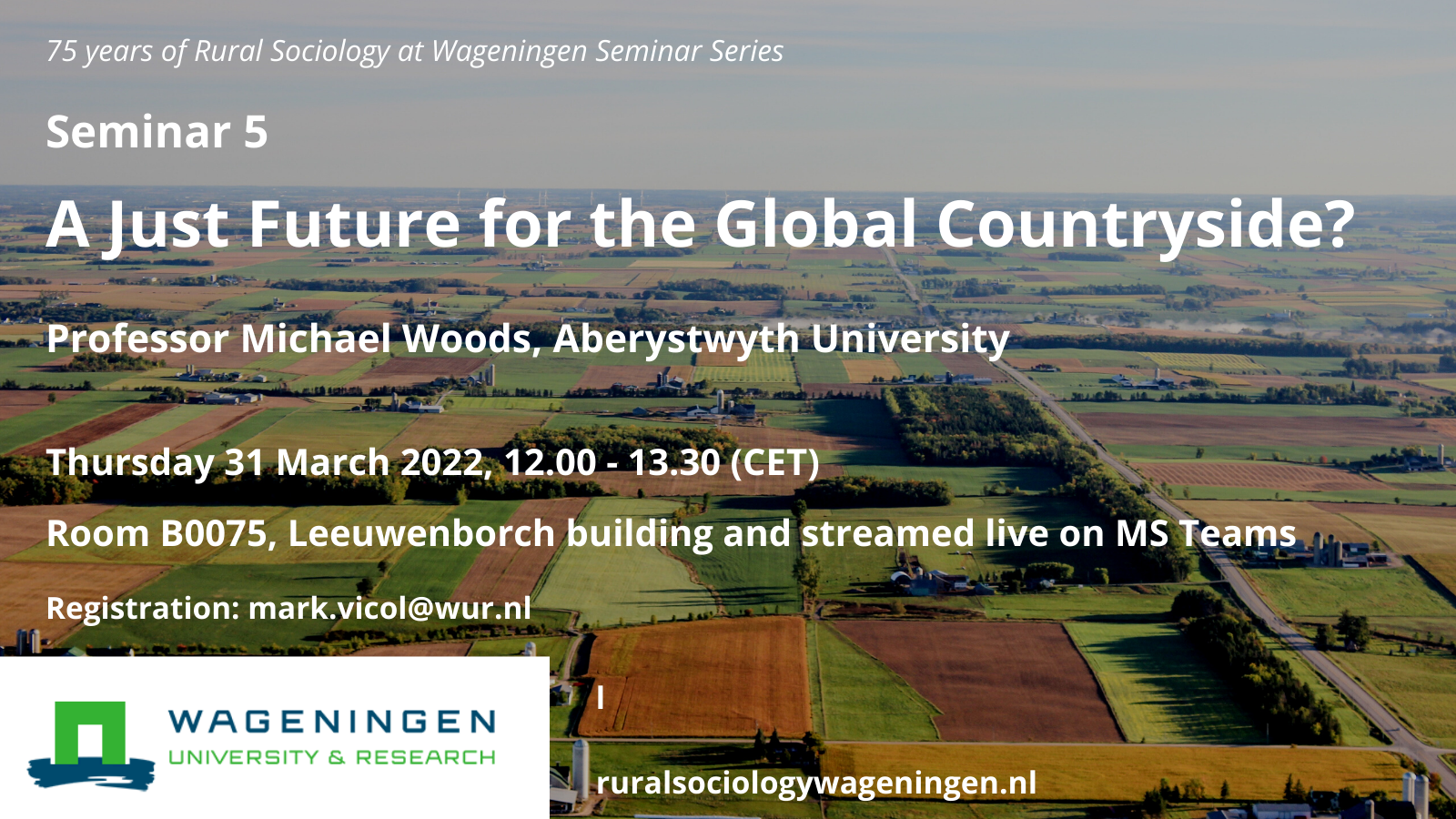
Webinar 5: A Just Future for the Global Countryside? by Michael Woods @WoodsZzp

A Just Future for the Global Countryside? by prof. Michael Woods, Aberystwyth University, Thursday March 31, 2022, 12.00-13.30 (CET).

The talk is part of the Rural Sociology 75th Anniversary webinar series ‘Looking back, Looking Forward: Setting a future agenda for rural sociology’. Watch recordings of the webinars series at Rural Sociology Youtube channel.

The event will be streamed by Teams. Email to mark.vicol@wur.nl to register yourself.