Back in Wageningen, I am still digesting all the inspiration, material and knowledge that was floating around freely last week at the ESRS conference in Chania, Greece. For example, related to the earlier blog on the conference (2) the Working Group “New forms of citizen-consumer engagement in food networks: diversity, mechanisms and perspectives” had much to offer in addition to our own working group. Indeed, of all the types of consumer driven initiatives, such as food coops, CSA, consumer purchase groups, adoption schemes and landshares, the grow-it-your-own was largely absent. We concluded that a fusion of self-provisioning strategies and consumer driven engagement initiatives are necessary to understand the full spectrum of engagement with food growing. Another conclusion of the Working Group was that the driving force behind an initiative does not need to correspond with the nature of the initiative. Examples from Czech Republic showed how citizens had set up a farmers market, which is usually seen as a producer initiative. Also here, new terms and definitions were considered such as “civic food networks” or “pro-sumers” to move away from the consumer – producer dichotomy, a distinction which obscures more than it reveals.
The enormous differentiation in initiatives was another key finding when one looks across the presentations in this Working Group. We concluded that it is difficult to discover ‘hidden realities’ and that we most likely underestimate the number of alternative food networks around. Initiatives have different names across countries or sometimes do not want to be known in statistics and databases as they deliberately try to operate outside ‘the system’. The last point includes a tension. We would like to show and make visible the size of the alternative food networks, also to show its significance. But it also reminded me of a paper which I use in a course on political sociology on “Governmentality and territoriality” by Jonathan Murdoch and Neil Ward (1997). Statistics are a useful instrument to govern at a distance and one of the technologies of government now widely used and abused, but which we take for granted now. The paper, however, showed how the collection of statistics of Britisch agriculture from the 19th century onwards failed “not least because of a relunctance on the part of many farmers and landowners to cooperate, based on their belief that the exercise was an interference in their private affairs” (1997: 314). All governments depend on modes of representation by which the domains to be governed become visible. Freedom, according to Foucault, is “the art of not being governed quite so much” (Oksala 2008). A careful approach to visibility sounds healthy to me.

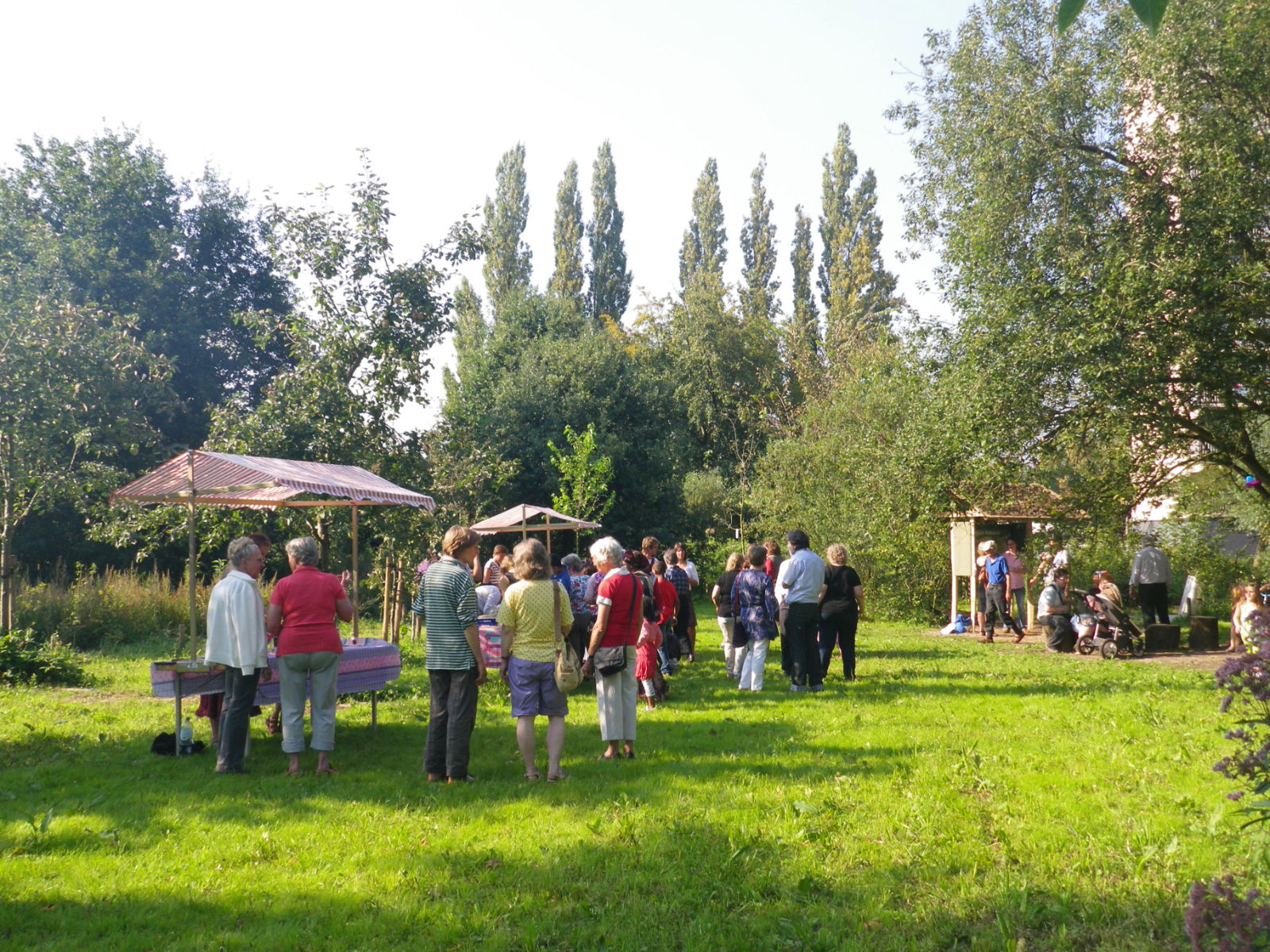
 Exactly two years after a film eveningorganised by Transition Town Vallei united some people of the neighborhood, the ‘forest garden’ in the Pomona neighborhood in Wageningen was officially opened by municipality Alderman Lex Hoefsloot on the 3rd of September. The implementation of the design made by the neighborhood (see previous blogs) was finished just in time. After planting many different fruit trees and bushes in March and April, numerous watering sessions during the dry spring and some rainy working days in May and June, we used the summer to build a few wooden structures such as a pergola, a tree- trunk bench and an information panel. Also…..the weeds kept appearing and we sowed grass which is regularly cut by one of the residents. Additional plants were planted too, offered by a resident who maintains them. In the week before opening, the community centre went into the garden with children to harvest the first apples. Not from the newly planted trees but from those trees we rescued from under the brambles. The apples were used by children in the weekly cooking class run by the centre to make apple pie. This was precisely how we envisaged the function and use of this ‘garden’ when we started writing the plan two years ago. I love it when a plan comes together. (pictures below; making fruit juice on the spot and garden excursion)