The history of Dutch potato breeding (1888-2018): from hobby to industry

On the 15th of May 2019 Jan van Loon defended his PhD thesis about the history of Dutch potato breeding. This thesis was written in Dutch (see thesis cover below). Over the past two years we (Jan and his supervisors) have been working on a paper in English, summarizing the main findings of his thesis (which is over 400 pages). This was quite a challenging endeavor, but we are pleased that the paper was accepted by Potato Research and was published online this week as an open access article.

Abstract of the paper
The Netherlands has a world-leading position in potato breeding, but little is known about the factors that led to this success. This paper analyses the factors that have influenced the development of potato breeding in the Netherlands. This study is based on research of the grey and scientific literature and interviews with various representatives from the Dutch potato breeding sector. We distinguish four periods: (i) Before 1888, no potato breeding in the Netherlands existed whereas in other countries first crosses occurred. (ii) 1888–1940, more individuals started breeding out of interest and hobby to overcome the commonly observed degeneration of potato. (iii) 1940–1967 the emergence of a corporate set up of breeding by private companies collaborating with small breeders. (iv) 1967–present, towards full-fledged breeding industry supported by the new Seeds and Planting Materials Act (ZPW) in 1967 including the breeders’ rights. Many factors including cultural practices, diseases, and market that determine the strategy of breeding have been analyzed. The development is most of all ‘crop driven’ to maintain the level of production. But it was also ‘export driven’ leading to the development of an export-oriented seed potato sector. The conclusion is that three elements were dominant in the development of a strong potato breeding sector: (1) the broad cooperation among all players in the potato chain, (2) the design of the institutional infrastructure, and (3) the remuneration of the breeding work through legislation regarding plant breeders’ rights. The study ends with an outlook on future trends, one of them leading from an open to a more closed business culture.
Beyond farming women: queering gender, work and family farms

The issue of gender and agriculture has been on the research agendas of civil society organisations, governments, and academia since the 1970s. Starting from the role of women in agriculture, research has mainly focused on the gendered division of work and the normative constitution of the farm as masculine. Although the gendered division of work has been questioned, the idea of binary gender has mostly been taken as a given. This explorative research shifts the attention from the production of (traditional) gender roles to the making and unmaking of binary gender. An ethnographic study of four farms in Switzerland is drawn on to explore queer farming practices and investigate how queer farmers navigate gender normativity and what this tells us about gender in agriculture more broadly. After considering the mechanisms through which queer farmers are discouraged from farming as a livelihood on the basis of their sex, gender or sexuality, this article argues that queer farmers de- and re-construct gender and farming identities differently, which has research and policy implications for a more diverse and resilient rurality.

Keywords Performativity · Agricultural practices · Swiss faming · Ethnographic research · Gender · Queer farmers

Read the full article by Prisca Pfammatter and Joost Jongerden here: https://doi.org/10.1007/s10460-023-10449-z

Migrant workers in Spain’s Agri-Food Industry and the Ceuta ‘March for Dignity’

Merissa Gavin, Master’s Student, International Development Studies at Wageningen University

Re-negotiating precarity: Migrant fruit pickers in southern Spain
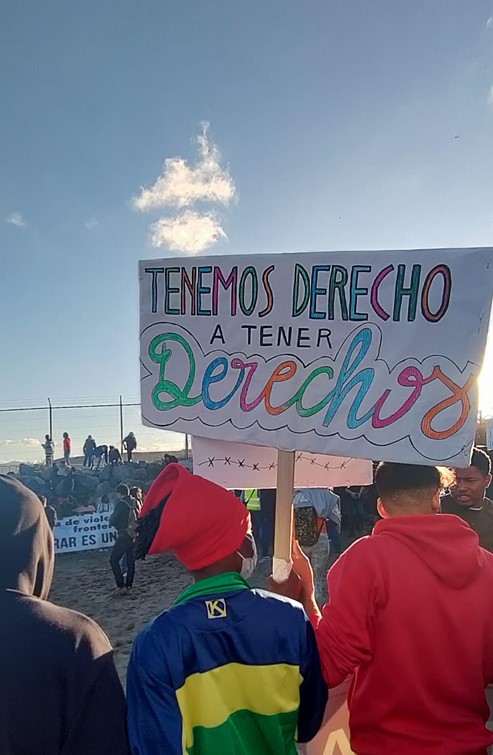
For my ongoing thesis research, I am interested in how migrant workers in Spain’s agri-food industry navigate politically induced precarity. Precarity, within the scope of this research, refers to the instability of immigrants’ status in society as they embody the paradox of being essential for the economy yet ostracised from socio-political life and unprotected by the state. To deepen my understanding of this phenomenon, I have come to Huelva, Andalusia, in the south of Spain to meet the people harvesting the fruit supply of Europe, from oranges and lemons, to strawberries and blueberries. An industry kept afloat by the work of undocumented migrants, the seasonal fruit harvest attracts thousands of migrant workers to rural Andalusia every year, with parts of the region largely populated by migrants of African descent living in makeshift roadside settlements, las chabolas. My research focuses on the lived experience of these workers as they struggle for the conditions of a dignified life.

“Tenemos derecho a tener derechos” (We have the right to have rights). Photo taken by the author at the March for Dignity
Continue reading

REMINDER: Assistant Professor Rural Sociology vacancy (Tenure Track) – application deadline 12 September 2022

A month ago we posted a job opening for an Assistant Professor in Rural Sociology (Tenure Track position). If you are interested to apply or know of potential candidates, please be aware that the deadline for submitting applications is approaching. Applications can be submitted up to and including September 12th 2022 via the apply button on the vacancy page.

75th Anniversary Rural Sociology – The After Movie

75th anniversary event

On 13 May 2022, we celebrated the 75th anniversary of the Rural Sociology Group of Wageningen University with a public event entitled “Rural Sociology: past, present and future”. The event took place in Akoesticum in Ede and was attended by approximately 130 people: current and former staff members, current and former MSc and PhD students, and current and former collaborators in (inter)national research projects. In addition to this event we wrote and edited a book entitled ‘On Meaningful Diversity: Past, present and future of Wageningen rural sociology’ and a group of (former) PhD students put together a PhD magazine. Both are open access publications.

The entire anniversary event was filmed and a 16 minute compilation video of the day can be found here:

Compilation video of the 75th anniversary event of the Rural Sociology Group

In addition all presentations and talks are available online in order of the program of the day:

  1. Opening by Arthur Mol (Rector Magnificus of Wageningen University)
  2. Keynote by Han Wiskerke: Meaningful diversity: Past, present and future of rural sociology
  3. Keynote by Haroon Akram-Lodhi: From peasant studies to critical agrarian studies
  4. Rural Talk Show:  Interactive session including invited guests and audience participation. The Talk Show was chaired by Matt Reed, with Jan Douwe van der Ploeg as a permanent table guest, and changing table guests around the following three themes:
    • Session 1– Societal engagement or academic distance; with Jessica Duncan, Aya Kimura, Han Wiskerke
    • Session 2 – Discussing the rural-urban dichotomy; with Henk Oostindie, Sally Shortall, Esther Veen
    • Session 3 – A continuing debate: agency and structure; with Bettina Bock, Bram Büscher, Mark Vicol
  5. Closure morning session by stand-up musician Bart Kiers
  6. Keynote by Hannah Wittman: Bridging rural and urban through agroecological networks: cultivating agrarian citizenship in a climate crisis
  7. Presentation of Research Agendas: Imagining the next 25 years of rural sociology. Interactive session around three research agendas, briefly pitched by RSO staff, followed by an open floor exchange of ideas and discussion:
    • Pitch 1– Agriculture – introduction Kees Jansen
    • Pitch 2 – Place – introduction Joost Jongerden
    • Pitch 3 – Food – introduction Jessica Duncan
  8. Closure afternoon session by stand-up musician Bart Kiers