Urban Agriculture: Havana as inspiration for the Hague

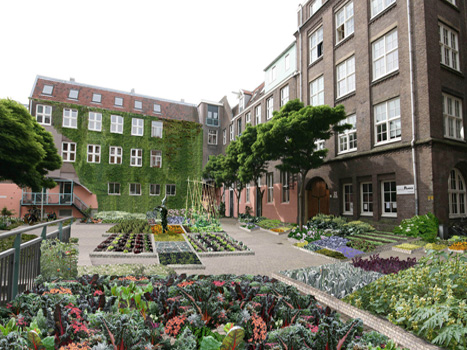
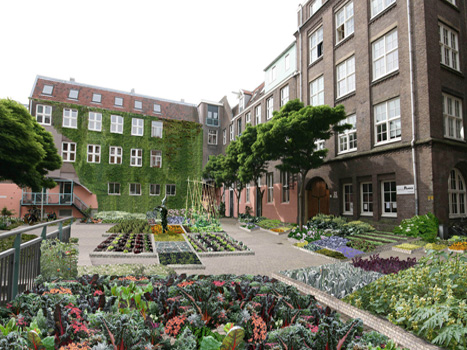
Yesterday the movie ‘Borders in Our Mind’ about urban agriculture in Havana and the Hague had its premiere at Stroom in the Hague. The documentary was made by artists Annechien Meier and Gaston Wallé. Central theme of Annechien’s work is the communication between people in urban and rural environments. With her installations she tries to rouse people’s curiosity about their interaction with the environment around them. Producing food in the city, is one way of doing this. She departs from the idea that allotment gardens reflect values of a culture in a specific time and place and give possibilities for people to come in touch with each other and the (natural) world around them.

Annechien also started the project ‘Panderplein’ in the Brouwersgracht in the Hague. Here, she built a vegetable garden in cooperation with the inhabitants. Since this summer, the first vegetables have been harvested! It is amazing and wonderful to discover such a green spot in the center of the city, and moreover the project contributes to social cohesion in the neighborhood.

For the film ‘Borders in Our Mind’, Annechien went to Cuba, Havana, to learn more about the possibilities for urban agriculture. Havana has a history of urban agriculture since the 1990s  due to petrol shortages, food shortages and economic crisis. Today more than 50% of Havana’s fresh produce is still grown within the city limits. No wonder Annechien choose this city to visit as inspiration for her work in the Netherlands. In the one-hour- movie many different forms, features and possibilities of urban agriculture pass in review. The result is indeed inspiring for anyone who is engaged in or concerned about food production in urban areas.
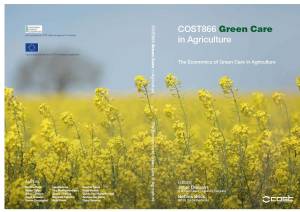
The Economics of Green care in Agriculture. Edited by Joost Dessein and Bettina Bock

Recently published and available on line The Economics of Green care in Agriculture, edited by Joost Dessein and Bettina Bock.


The publication is part of our participation in COST Action 866 ‘Green care in Agriculture’. This COST action brought scientists and practitioners together who are working in the broad domain of ‘green care in agriculture’ with the purpose of increasing the scientific knowledge on green care, its potential for improving human mental and physical health and on the best way to implement green care in agriculture throughout Europe. The COST action consisted of different working groups that looked into health effects of green care, the economics of green care and policies related to green care (http://www.umb.no/greencare/). This publication reflects on the Economics of Green Care and the possibility to measure and evaluate its costs and benefits, taking into account the wide variation in Green Care arrangements throughout Europe. A limited number of free copies is also available at the Institute for Agriculture and Fisheries Research Merelbeke, Belgium (www.ilvo.vlaanderen.be), where Joost Dessein works (email: joost.dessein@ilvo.vlaanderen.be).

Time Magazine about multifunctional agriculture, some thoughts about the farmers’ identity

While waiting for my train at Utrecht Central station – I tend to kill my time looking around in the book/magazine shop – the cover of the latest Time Magazine struck my eye, heading: “France’s Rural Revolution, traditional French farmers are dying. Can farmers make money from town dwellers’ love of the land?”. Interested about the heading – and teased by the astonishing landscape on the cover – I bought a copy for the second part of my trip to Rotterdam.

Bruce Crumley (the author) poses the question what eventually will save rural France. French farmers are hit by a shrinking agricultural sector, falling food prices (globalization) and tightening E.U. support (so called CAP reforms (Common Agricultural Policy) in 2013). These developments are not exclusive to France, farmers in many other E.U. member states are facing these problems. However, future CAP reforms are considered to be critical especially to French farmers, since the French receive nearly 20% of the total CAP funding.

By illustrating the developments on three French farms the author focuses on one of the ways to get out of this tightening trap by diversifying the farm business with new (‘non-farming’) activities. A strategy also known as multifunctional agriculture. The farmers mentioned in the article developed new activities in rural tourism and the production and selling of regional products like beer and ham. Interestingly, the article has many parallels with the conversations I had myself (in relation to our research project on (Dutch) multifunctional agriculture). Apparently, many farmers (eventually) don’t regret their step on the multifunctional pathway. On the contrary, many farmers say to enjoy the new farm dynamics, contacts with new people and some even claim to have reinvented entrepreneurship. However, we needn’t to underestimate the step of ‘just’ diversifying your farm to survive. In the article colleague rural sociologist François Purseigle argues many farmers simply refuse to find new sources of income as they see diversification as a betrayal of the agricultural profession they took on. As a parallel, I experienced many interviewed Dutch farmers – who have made the step or are still hesitating in some way – have or are still struggling with their identity of being a ‘real farmer’: “It’s not just running a business” – one farmers stressed – “it’s a way of life!”. I think the notion of multifunctional agriculture has matured but still often perceived as something for losers or nothing ‘real farmers’ should deal with. Often the environments of hesitating farmers aren’t ready for this new way of farming, yet.  

The article can be found on the Time website. The page also offers a great picture gallery about the topic.

Romashki or a Life Less Ordinary, part 3

By Thomas Macintyre

…Belka the squirrel had been swishing her tail back and forth, and when I looked at her she held out a walnut for me to take. “This is a present” she said, as I took the nut. “It is a nut that was too high for you to reach in the tree. We must all help each other you know – humans and animals and all other life on earth.”  Having thanked Belka I waved a last farewell to my friends and began the walk back through the reeds. Just as I was about to begin the walk up the hill I heard a loud croak from Irenushka the frog and then the words of the Water Fairy being sung across the reeds: “Tom, we also have a gift for you. Keep walking, you will feel it soon.” I heard soft chanting words blowing in the breeze: “Earth fire wind and hail; open the realm of the fairytale.”

Soon after, as I reached the road that would take me to that other world, I heard a roaring thunder and saw the heavens open up as a torrential rain began to pour. Soaked in seconds I trudged along, my socks squelching in unison with the klomp, klomp of my wooden shoes on the road. For a second I felt a twinge of annoyance at being wet and cold, but then I stopped on the road and felt a sense of goodness swell up inside of me. Looking up at the sky as rain drops pounded my face I thought to myself: ‘the blessed water in a fairytale – the parting gift from Romashki.’ (Excerpt from page 153). Continue reading

Intensive Program Slovakia

By Marlies Meijer, MSc student

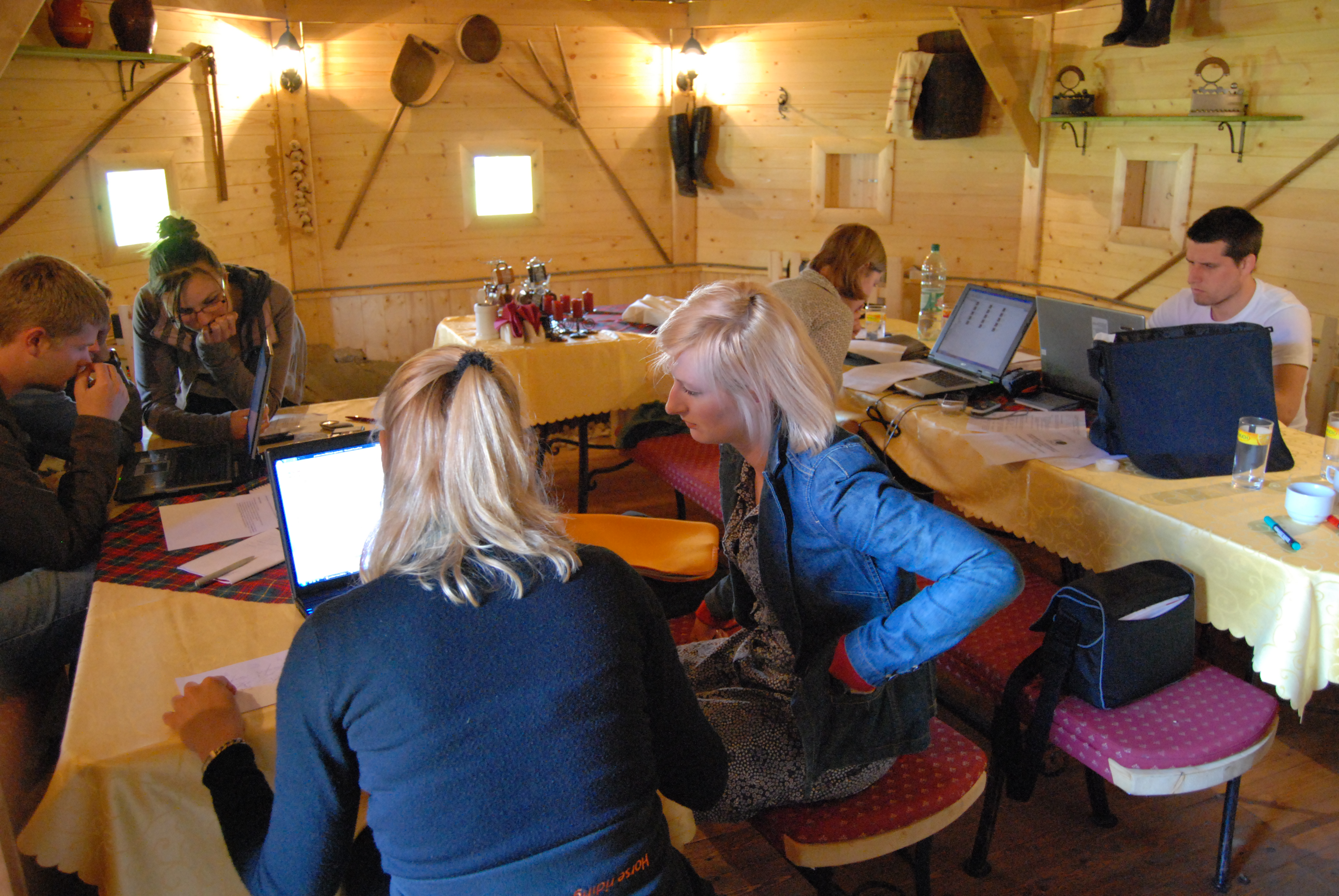
When I first heard about the Intensive Programme in Slovakia, I did not really know what to expect. The core of my MSc lies at land use planning, but for my thesis I choose a combination with rural sociology. What triggered me the most was the country. I’ve never been to Eastern (or Central) Europe and saw in the IP a great opportunity to experience transition from communism to capitalism and into EU-membership recently. On the first day the exchange with other students (about 40 from 12 universities, and even more countries) turned out to be just as interesting. Encouraged by cheap beer we had long discussions about everything, but still, mostly about the role of agriculture in the different countries.

For me the three day excursion to different villages in the Nitra-region was definitely a highlight. We were divided into small groups, each with a different region. My group stayed in a small cottage, north of Nitra. We were introduced to mayors of the small villages. I liked to see the differences between the Dutch planning system, where everything is arranged from paving stone to strategic master plans for 2030; and the project-based development in the little Slovakian villages: “if we have the money, we’ll think about constructing a sewerage system next year”. It makes all problems we have on the Dutch countryside (like “verrommeling”) relatively small.

The second day we went to a large cooperative farm. The size was overwhelming: 3000 ha., 120 employees, 800 cows and immense fields of rapeseed. But this was not everything; the cooperative farm (a legacy from communist times) had supporting departments in almost all layers of the market. We visited a bakery, a tool shop and a local grocery store (“Our Home”), all embodied in the cooperative. It put quite a different perspective on the development of short-supply-linkages. Small farms struggle in Slovakia, and we did not see many small scale (innovative) initiatives. What surprised me the most was that agriculture seemed to be disintegrated from all kinds of regional developments. There were no relations between local administration and the agricultural sector, and agriculture was not seen as a positive contribution (or even part of) to the landscape. Moreover the EU LEADER programme focussed in this region on social and economic developments; agriculture was not mentioned in the main objectives. Not surprisingly, since many villages suffer from more urgent problems, like ageing, unemployment, depopulation and a lack of basic social services.

But still, it pointed out that rural development cannot be just about agriculture, it is about the development of rural region entirely as well. Apart from farmers there are so many local actors that also could and should be included. For me it also pointed out that land use planning and rural development are not so different in essence. While approaches could be different, in the end it is about the same: sustainable development of (rural) regions.