Regional identity and wine walks in the Alsace region (Fr)

I recently traveled to France for a short walking spring break. In the north eastern part of the country I visited the Alsace region. I stayed in the area left of the city of Colmar near the village called Munster (well known for its ‘smelly’ cheese). Although the break was a way of resetting my brain, I couldn’t stop myself from observing some interesting things.

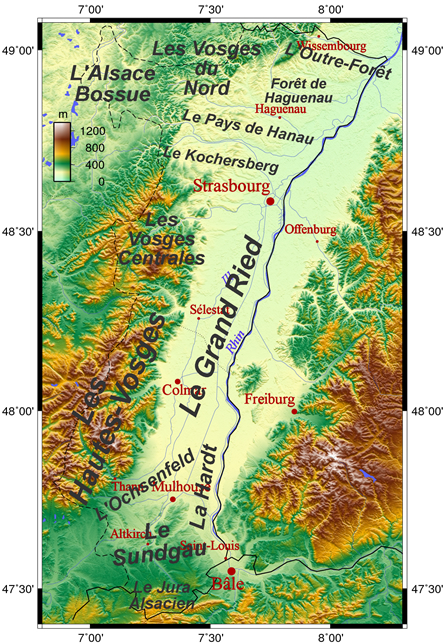
The Alsace region
Although the Alsace is French, the area is characterized by many German influences. Not surprisingly because the area changed hands many times. The area has a strong regional identity which expresses itself physically, culturally and historically (architecture (timber framed houses), landscape, dialect, kitchen and regional products). The stork can be seen as the region’s main symbol and almost disappeared in the 1970’s. The region put a lot of effort in bringing baThe Alsace region (Wikipedia)ck the bird (by starting breeding programs) and now storks can be found on roofs of houses and public buildings everywhere. All these things are characteristic to the Alsace region.
Wine walks
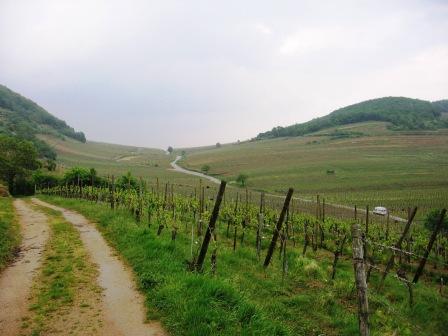
An important and unnoticeable regional product is wine (Vin d’Alsace) like Riesling, Gewürztraminer and Pinot Blanc. Since Roman times the Alsace has a strong tradition in growing grapes and over time has developed as a centre of viticulture. The area has an excellent terroir: good weather, climate, fertile soils and sunny slopes. Part of the rocky hilltops every small piece of the area is cultivated for growing grapes. This viticulture can bee seen as the (historical) backbone of this region into which over time whole sets of other activities got interwoven: visiting historical villages, local products / food, touristic walks etc. Central to this all is the wine and the attractiveness of the region. On my break I explored one of these really nice walks near the village of Kaysersberg. The walk started in climbing a woody and rocky hill and lead through the village of Riquewihr and via extensive vineyards back to were we started. In the vineyards information panels were placed to give information growing techniques, pruning, different varieties and the winemaking process. During the walk we stopped at several wine farmers / cooperatives for some refreshments and wine tasting. 

These wine walks are an interesting way of using regional identity and products for regional development. The combination of activities, services and goods attracts tourists, strengthens the regional economy and contributes to the vitality and livability of this specific region. I got the impression the Alsace region is very succesful in this!
Wine walk

Selective breeding in organic dairy farming

Tuesday June 2, Wytze Nauta will defend his PhD-thesis ‘Selective Breeding in Organic Dairy Production’. 

Family herd

A family herd

Organic dairy farming doesn’t have a distinct breeding system. Farmers are free to breed with a farm bred bull or Artificial Insemination (AI) bulls of conventional breeding programmes. Organic farming thus directly and indirectly depends on conventional breeding goals and modern selection and reproduction techniques such as multiple ovation and in vitro embryo production and transfer (ET). As naturaless and animal integrity are basic principles of organic farming, the direct and indirect use of these modern reproduction techniques is questioned, from organic farmers as well as from societal interest groups favouring organic farming. Moreover organic farming intends to maintain or even contribute to bio-diversity. It supports the use of different (traditional, regional) breeds. Finally, in organic farming animals are kept for different purposes and in a different, more extensive production environment then conventional agriculture. This further questions the dependency on conventional breeding programmes, since these programmes select breeding animals that perform best in intensive, high input production systems. Practice learns that on the whole these cows are genetically not well equiped to perform in an organic environment and this was sustained by research (see paper Genotype x Enviroment Interaction). So one can argue that organic farming has its own demands towards breeding, that may even differ with different farming strategies (see paper Different Strategies, Different Demands). Organic farming is highly diversified and organic farmers are known for their on-farm experiments, also with regard to breeding.

The question is not so much if selective breeding in organic dairy farming needs to be more in line with the intentions and principles of organic farming, all stakeholders agree on that, but to what extend and how to realize that. Then opinions diverge and different positions are taken (see Discussion paper).

Wytze Nauta explores this question throughout his PhD-thesis. He finally discusses the pro’s and con’s of three options that meet organic principles to a different extend: 1) a pragmatical one, i.e. using conventional breeding programmes, but with the exclusion of modern reproduction techniques, although an exception is made for AI; 2) a distinct organic breeding programme with distinct breeding goals and exclusion of modern breeding techniques and 3) a distinct breeding system based on natural mating.

The more exclusive, the more organic, but also the more difficult to realise. However, for an individual farmer it is more easy to decide to start breeding with a bull at the farm for natural mating. For option one and two more stakeholders need to come to an agreement. But all options imply a ‘system innovation’: radical change of practices at different levels of different actors in different positions lacking appropriate knowledge to come to a well grounded breeding system for organic farming. So, the ultimate recommendation of Wytze Nauta is not to impose a new breeding system, but to start joint learning processes involving organic farmers as well as other stakeholders based on the three options provided. This would best respect diversity organic farming.

Wytze Nauta (w.nauta@louisbolk.nl) is researcher Animal breeding at the Louis Bolk Institute.

Terugblik Dag van de Zorglandbouw

Dinsdag 21 april bezocht ik, in het kader van ons onlangs opgestarte onderzoek ‘dynamiek en robuustheid multifunctionele landbouw’, de Dag van de Zorglandbouw. Onderweg naar Apeldoorn kwam er via Radio 1 al een opwarmertje langs. Een Brabantse zorgboerin sprak in het interview haar zorgen uit over de gevolgen van de wijzigingen in de AWBZ (Algemene Wet Bijzondere Ziektekosten). Ook één van de Tweede Kamerleden gaf een voorproefje op de dag. Ik zat er al helemaal in en dat terwijl het programma nog moest gaan beginnen! Continue reading

Comparing farming in China and Europe

I’m a PhD candidate from China Agricultural University. I have a major in rural development and management. Now I am a visiting researcher at the Rural Sociology Group for one year and I like it very much. Each eduaction period I attend one or two courses.

yong-dsc056362

Chinese farm

Recently, I wrote an article about a Chinese farmer’s note book, with my supervisor prof. Jan Douwe van der Ploeg. I encountered this note book during my field work in Northeast China in July 2008. It’s been nearly three months since we began writing this article. Today, we finally finish the article, both in English and Chinese. In this farmer’s note book, monetary expenses and monetary entrances are all registered in a chronological order. Meanwhile, it also shows some of the networks the farm is embedded in. We also make some comparisons between China and Holland (or Europe). The data show that there is considerable dynamism; they also make clear that basically we are dealing here with a peasant-like way of farming. The article concludes with an overview of the structure of the rural economy in this part of China. I will write more about that in later blogs.

To be honest, I think there are many research experiences in rural sociology we should learn from Wageningen, especially in the field of sociology of farming. At the same time, I mind to consider the differences in social context between Western countries and China. The main problems in rural China we concluded are about “farm, farmer and farming”, which are also the hot research topics in academic field. Take farmer for example: there are about 0.73 billion of people living in rural area, but they don’t have enough land to sustain their livelihood, so many farmers go to urban as migrant workers and leave their family members home. These family members are left-behind population. My college members did a lot research on this group of people. As for my PhD thesis, I focus on applying the social capital theory in the context of rural China. To quote Jan Douwe van der Ploeg: “the theories are not in the air, they are in the people’s everyday life”. I will this mind during my research.

Places worth caring about

This week I have discussed, in my MSc course Understanding Rural Development, the modernization of Europe’s agriculture and rural areas in the post World War II era. By showing pictures, tables and figures I have tried to demonstrate how drastically the rural landscape, the agrarian structure and the food supply chain have changed in a period of several decades. Multifunctional countrysides were transformed into places for specialized and high-tech forms of food and fibre production, the number of farms decreased by some 80% in 50 years time, the average farm size increased enormously, agricultural employment decreased drastically, an ever increasing part of the agricultural products are processed by the food processing industry and the supermarket has become the dominant outlet for most food products. There are, of course, differences between regions and countries, but this is the prevailing development trend in EU member states that have been subject to the EU’s original Common Agricultural Policy. The agricultural modernization project has been very successful in terms of creating food self sufficiency in Europe at low prices for consumers, but this has also come at a cost. By the 1990s the negative side-effects of modernization became widely acknowledged. When talking about negative side-effects topics as environmental pollution, degradation of biodiversity, declining farmers’ incomes, animal welfare concerns and consumers’ distrust in the modern food system are usually brought to the fore.

Inspired by a humorous and thought-proviking presentation of James Howard Kunstler at the TED 2004 conference (“The tragedy of suburbia” ) as the analogy between suburbian development and agricultural modernization is astonishing, another side-effect came to mind: the loss of a sense of place and a sense of belonging due to the (feeling of) expropriation of local self control (e.g. due to centralized spatial planning) and due to the eradication of many specific and distinctive regional assets (cultural history, landscape, traditional products and processing techniques, etc…). Rural regions that were subject to the agricultural modernization project have de facto become non-places and are thus easily interchangeable. And as a result many rural regions have become, quoting Kunstler, places not worth caring about … and places not worth caring about are places not worth protecting or defending.

Looking at rural development from this point of view sheds an interesting light on its dynamics. Continue reading