Going global and remaining local: challenges of Poland in implementing climate change policies

RUW Foundation and the Rural Sociology Group organized a studytrip to Poland. In a 10 day intensive program different cities and rural areas in Poland were visited, interesting people and organizations met and farm work is done. The theme of the trip is “Glocalise”. Students are asked to prepare themselves well on different themes in groups before leaving and to write a concluding reflexive paper on their impressions and findings, and to write a blog. This is first is posted by:

Caroline Lumosi, MSc-student Forest and Nature Conservation.

The first day saw us spend time learning about nature conservation in Poland. We focussed on climate change policies and agriculture. Poland faces challenges in implementing regional EU climate change policies in relation to implementing its national regulations on energy and economic development. Poland relies on the use of coal to support 90% its electricity. As the EU moves to cut down on its carbon emission, this in turn means focus is put on use of renewable energy sources. For Poland, and in particular the city of Warsaw, this presents a huge challenge as the city heavily relies on the use of coal for electricity, in transport and in household heating. Continue reading

Food myhts Busted – do we need industrial agriculture to feed the world?

In the light of the debate on how to feed the world’s growing population and what type of agriculture is needed, a video by the Food Myth Busters takes a firm position:  we do not need corporate agriculture, actually we are even better of without it. In the video they demystify claims upholded by corporate businesses with some facts. I’m however sure that these are not the facts the CEO of Wageningen UR has in mind when proclaiming that further intensification of agriculture is needed (in fact he is arguing for a further industrialization of agriculture according the famous Dutch model and promoting a joint venture of corporate business and science, ergo: corporate science) to secure food provision for 9 billion people. Have a look yourself and make up your mind:

“Kuifje in India” (4)- International Master of Science in Rural Development (IMRD)

The Hindu (“India’s National Newspaper since 1878”) opened yesterday’s edition with agricultural news on the front-page. “Skyrocketing fertilizer prices floor farmers” was the title of the story about increasing costs of inputs. Small and marginal farmers, who constitute almost 80 per cent of the total of farmers in the State of Karnataka, has been hit hard by the skyrocketing prices of all fertilizers. The prices of most fertilizers doubled or even has gone up with over 250 per cent since 2010. It’s rather complicated why the costs are skyrocketing that high, but once again it makes clear how vulnerable marginal and small scale farming is for external costs. Going ‘organic’ or going for a maximum of ALEI (Agriculture on Low External Inputs) is the strategy that most of my colleagues at the UASB plea for, and they really ‘go for it’. Although a ‘top university’ in a scientific way (UASB is nr. 3 ranked of all Agricultural Universities in India), everyone I met so far isn’t just a ‘top scientist’, but also ‘a grass root worker’; very committed with the poor and the very poor, and always trying to find ways to help and to give mute people a voice or some kind of a future.

I participated many seminars and presentations, and I did speak with many professors, researches and teachers. And they all touched my heart, because their heart was always with the oppressed and the poor. I had the opportunity to meet the highest person in charge (Prof. dr. Gwonda, the Vice Chancellor) several times, and every time I spoke with him, I was impressed by his commitment with the message and mission of his institute. To help the poor and the very poor; to empower the weak and the marginalized.

Continue reading

“Kuifje in India” (3) – International Master of Science in Rural Development (IMRD)

In ‘part 2’ I promised to tell more about ‘farming and rural life in India’. I have to break these promises. Like with so many other things in India, it is impossible to get a good idea about what’s really at stake. Remember the figures I gave you about the average spending in rural and urban India. They indicate wide spread poverty. But at the same time, India is worldwide nr. 1 producer of milk (17 percent of all worldwide cows & buffalo’s are located in India); India is nr. 2 in producing vegetables; the same score with rice; the same with fruit, etcetera. These incredible figures do impress as well. So I was thinking: where are these dairy farms, where are those orchards, where is the field with ‘sweet peppers’? Considering these things, I noticed that it is so hard to imagine what India really look likes. I flew to New Delhi and took some metro’s to get an impression of this city (I didn’t), and then flew to Bangalore to get dropped off at the campus just outside this enormous city. So what do I know? What have I seen? Some cows in the street, a bull near a Hindu temple. So nothing at all so far…..

If you look at the figures, you hardly can imagine that India is ‘one country’. India is 100 times as big as The Netherlands, and the population over 80 times. So the whole of India has (in average) almost the same population density as Holland; can you imagine…. ? It has 22 States (India is a federation) and there are 17 official languages. Languages, that are completely different, and although Hindu is the official language (and many people do speak more or less some basic English), the coherence of this nation is rather fragile (not to mention the differences in religion: Hindu, Muslim, Buddhist and Christians). So what about ‘farming and rural life‘ (the title of one of our RSO courses at the WUR); is it possible to get any idea about that?

Continue reading

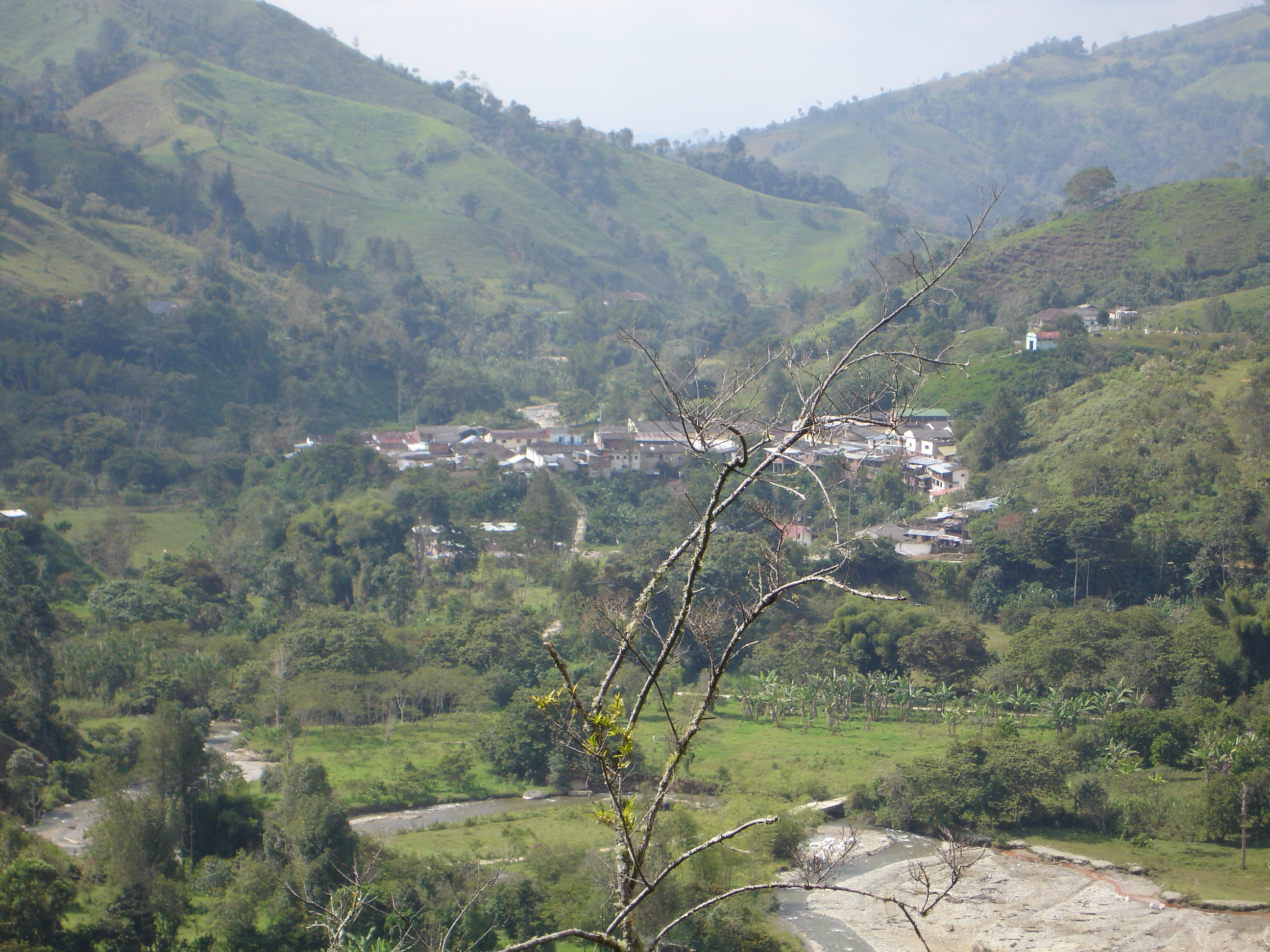
Living the peasant way of life in Santa Cruz de la Colina

After a longer posting-pause in which I finalized my first research phase, identifying supporters of rural grassroots development initiatives in the Province of Soto, here a new update of my activities in Colombia:

Time is flying and I am finalizing my second research phase, asking grassroots development initiatives to evaluate the support they are receiving to build joint capacities. To be able to speak with rural development initiatives, I was invited to spend a week with a peasant family in the vereda St. Ana of Santa Cruz de la Colina.

Santa Cruz de la Colina, Matanza, Colombia

Continue reading