
In June I published a post about the upcoming conference ‘Agriculture in an Urbanizing Society: International Conference on Multifunctional Agriculture and Urban-Rural Relations’, which included a call for Working Group proposals. The deadline for submitting Working Group proposals was 1 September 2011. This post is to announce that the deadline for submitting Working Group proposals has been postponed to 15 september 2011. If you would like to convene a working group but don’t have time to write a proposal, you can also express your interest by sending me an e-mail (han.wiskerke@wur.nl). Have a look at the conference website for an overview of the working group themes that have been proposed by the scientific committee. The deadline for abstracts will also be postponed by 2 weeks to 15 December 2011.
Tag Archives: Food
Notes from the ESRS conference (5)
Back in Wageningen, I am still digesting all the inspiration, material and knowledge that was floating around freely last week at the ESRS conference in Chania, Greece. For example, related to the earlier blog on the conference (2) the Working Group “New forms of citizen-consumer engagement in food networks: diversity, mechanisms and perspectives” had much to offer in addition to our own working group. Indeed, of all the types of consumer driven initiatives, such as food coops, CSA, consumer purchase groups, adoption schemes and landshares, the grow-it-your-own was largely absent. We concluded that a fusion of self-provisioning strategies and consumer driven engagement initiatives are necessary to understand the full spectrum of engagement with food growing. Another conclusion of the Working Group was that the driving force behind an initiative does not need to correspond with the nature of the initiative. Examples from Czech Republic showed how citizens had set up a farmers market, which is usually seen as a producer initiative. Also here, new terms and definitions were considered such as “civic food networks” or “pro-sumers” to move away from the consumer – producer dichotomy, a distinction which obscures more than it reveals.
The enormous differentiation in initiatives was another key finding when one looks across the presentations in this Working Group. We concluded that it is difficult to discover ‘hidden realities’ and that we most likely underestimate the number of alternative food networks around. Initiatives have different names across countries or sometimes do not want to be known in statistics and databases as they deliberately try to operate outside ‘the system’. The last point includes a tension. We would like to show and make visible the size of the alternative food networks, also to show its significance. But it also reminded me of a paper which I use in a course on political sociology on “Governmentality and territoriality” by Jonathan Murdoch and Neil Ward (1997). Statistics are a useful instrument to govern at a distance and one of the technologies of government now widely used and abused, but which we take for granted now. The paper, however, showed how the collection of statistics of Britisch agriculture from the 19th century onwards failed “not least because of a relunctance on the part of many farmers and landowners to cooperate, based on their belief that the exercise was an interference in their private affairs” (1997: 314). All governments depend on modes of representation by which the domains to be governed become visible. Freedom, according to Foucault, is “the art of not being governed quite so much” (Oksala 2008). A careful approach to visibility sounds healthy to me.
Conference Call – Agriculture in an Urbanizing Society
 A major demographic milestone occurred in May 2007. For the first time in the history of mankind the earth’s population became more urban than rural. This process of urbanization will continue in an accelerated pace in the forthcoming decades: the growth of the world population from 6 billion people in 2000 to 9 billion people in 2050 will mainly occur in urban areas. By 2050 the urban population will approximately be twice the size of the rural population.
However, this does not mean that urban areas are or will become of greater importance than rural areas. On the contrary, the urban and the rural have always heavily relied on each other and will do so even more in an era characterized by rapid urban population growth. Cities will continue to need resources such as food, fibre, clean water, nature, biodiversity, and recreational space, as well as the people and communities that produce and provide these urban necessities and desires. Hence, key questions for the next decades are how, where and by whom these urban necessities and desires will be produced and provided and if and how this can be done in manner that is considered to be socially, economically and ecologically sustainable and ethically sound.
In recent years the concept of multifunctional agriculture has emerged as an important reference in debates on the future of agriculture and the countryside and its relations with the wider and predominantly urban society. This is an expression of the fact that agriculture is not only valued for its contribution to food and fibre production and the economic development of the agro-industry, but needs to be assessed according to a much wider range of social, environmental, economic and ethical concerns. At farm level multifunctional agriculture is characterized by a variety of entrepreneurial strategies and activities, such as processing and direct marketing of food products, energy production, care for elderly and disabled people, and tourism. But multifunctional agriculture is also expressed at higher scales, such as the regional level (e.g. collective nature and landscape management schemes and regional branding) and the national level (e.g. policymaking and implementation).
Due to the multiplicity of activities, the multi-scalar character of multifunctionality and the geographical contextuality of expressions of multifunctional agriculture, research on multifunctional agriculture and changing urban-rural relations is highly fragmented, disciplinarily as well as geographically. Hence, this conference aims to advance the scientific state of the art in research on multifunctional agriculture and urban-rural relations by bringing together scholars of different disciplines (sociology, economics, spatial planning, land use planning, regional planning, urban planning, crop sciences, animal sciences, soil sciences, architecture, etc…) from all parts of the world.
Working group themes
The conference facilities allow for a maximum of 21 parallel working group sessions. The scientific committee has proposed 21 working group themes (see http://www.agricultureinanurbanizingsociety.com/UK/Working+group+themes/) and is inviting prospective working group convenors to submit a short (max 500 words) call text for the theme they would like to convene. Proposals for a working group call text can be send to the chair of the scientific committee by email (han.wiskerke@wur.nl) before the 1st of September 2011. The deadline for submission of abstracts will be 1st of December 2011. Abstracts will have to be submitted to the convenors.
More information
Please check the conference website for more information.
Growing food in the neighbourhood
Tilburg’s City Garden- Lise Alix
This winter I did an internship in which I set up a city garden in Tilburg. I found ten enthusiastic, mostly female neighbours, ready to cooperate in creating their neighbourhood’s kitchen’s garden. We learned about designing and preparing a garden, working together, and about physical endurance while spreading manure, transporting unwanted sand, and carrying and breaking paving stones.
 I was assigned to manage this project by the Brabantse Milieufederatie (BMF), an organization that tries to protect the environment. One of their focus points is on food, because food is a daily need that links many environmental problems like food transport, food packaging and unsustainable agriculture with use of pesticides and fertilizers.
One way of solving these problems is by growing our local vegetables, for example in neighbourhoods kitchen’s gardens. The BMF has, in cooperation with other organizations, tried to raise consciousness and support by the municipality of Tilburg on city gardens. As an example of how well it functions, BMF wanted to have one tangible kitchen’s garden in Tilburg. That’s where I came in.
Working group at 24th ESRS congress in Chania, Greece 22-25 August 2011: Call for papers
Imre Kovách ( Institute for Political Science of the Hungarian Academy of Sciences, Budapest), Petra Derkzen and I are organising a working group on “the governance of semi-subsistent food and farming strategies in the countryside and city- a compartive perspective” at the 24th ESRS congress in Chania (Greece) from 22-25 of August 2011. We would like to invite all interested researchers to submit their papers dealing with empirical or theoretical reflections on the driving forces, structure and mechanisms of semisubsistence food and farming strategies in the countryside and-or cities, both within developed and developing countries. Abstracts may be submitted to Imre Kovach (ikovach@mtapti.hu) AND chania2011@agr.unipi.it until the 30th of April 2011. For a more detailed description of the workshop please read further…
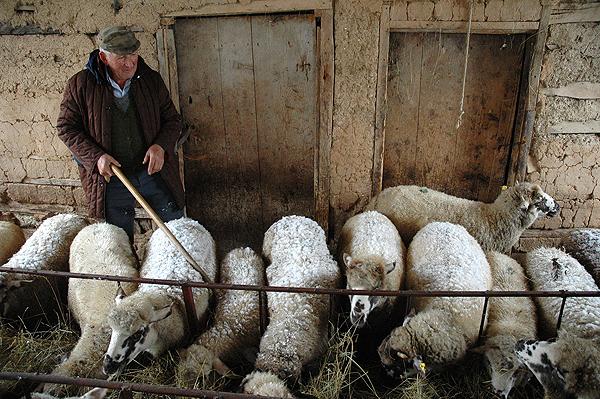
Courtesy of European Forum on Nature Conservation and Pastoralism

 Rural Sociology Wageningen University