Victory Gardens revisited – the Obama Foodscape

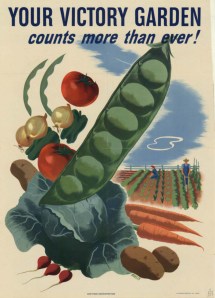
US World War II era poster promoting Victory Gardens (source: http://www.art.unt.edu/ntieva/pages/about/newsletters/vol_15/no_1/WarPosterImages.htm)

US World War II era poster promoting Victory Gardens

Victory Gardens, also known as ‘war gardens’ or ‘food gardens for defense’ were fruit, vegetable and herb gardens planted in backyards and on rooftops in the USA, the UK, Canada and Australia during World War II. They were considered to be an important means to reduce the costs for vegetables needed by the US War Department to feed the troops and to safeguard food security. One of the advocates of the Victory Garden was Eleanor Roosevelt, US first lady from 1933 to 1945, who also planted a Victory Garden at the White House. The Victory Gardens were a great success: the 20 million Victory Gardens in the US produced up to 40% of all vegetables that were consumed in the US.

After World War II the number of Victory Gardens rapidly decreased as most citizens believed that food shortages would be over soon. However, in recent years there is a campaign to re-establish Victory Gardens. Not to reduce the price of vegetables needed to feed US troops, but primarily from the perspective of food sovereignty; as a means to escape the growing dependence of consumers on the food stuffs provided by the food processing industries and retailers. At the same time gardening is also considered to be an important instrument in greening cities, in growing sustainable communities and in educating children about food and healthy eating (see e.g. our recent blogs about urban agriculture and nourishing the city).

For such a movement to become a success it is always helpful to have a leading figure as an icon. It seems that the USA’s new first family, in particular first lady Michelle Obama, is taking on this role. For the first time since the Roosevelt days, the White House once again as a garden. This beautiful short movie gives a good impression of the White House kitchen garden and the rationale behind it. 

However, there is more to food and the Obama’s than the White House kitchen garden only. Recently President Obama  announced that he wants to set up a White House farmers market to support local farmers and as an example of creating new connections between cities and its surrounding countryside. Interested to be informed about  the Obama Foodscape, have a look at the  Obama Foodorama weblog.

Sustainable food planning conference

AESOP logoOn 9 and 10 October 2009 the first Sustainable Food Planning Conference will be held. This conference is an initiative of the AESOP (Association of European Schools of Planning), the ISOMUL (International Studygroup On Multiple Use of Land) and the Rural Sociology Group of Wageningen University.

The sustainable food planning conference is organized to examine the role of food in urban and regional planning. Although political, societal and academic interests in food and the city are rapidly increasing, food largely remains a stranger to the field of urban and regional planning, spatial planning policies and planning studies. Recently the American Planning Association launched its Policy Guide on Community and Regional Food Planning. Inspired by this policy guide, this conference seeks to explore ways in which food can and should be incorporated in planning practices, policies and research and develop strategies for enhancing sustainable food planning in Europe. The character of the conference is primarily agenda-setting by establishing a network of planning practitioners, policymakers and agrifood and planning scholars in Europe and beyond.

.

Restaurant and meeting centre De Kemphaan (source: http://www.restaurantdekemphaan.nl/content/ons_bedrijf)

Restaurant and meeting centre De Kemphaan (source: http://www.restaurantdekemphaan.nl/content/ons_bedrijf)

The conference will take place at De Kemphaan in the city of Almere in the Netherlands. If you are interested to participate in this conference, please apply by e-mail to corine.diepeveen@wur.nl. Costs for participation are € 100,- (incl. drinks, lunches and diner). The number of participants is limited to 50 persons. For more information have a look at the conference programme below:


Day 1 – Generating ideas, exchanging experiences and comparing perspectives

09.00 – 09.30

Welcome and coffee/tea

09.30 – 09.45 Food and planning: an introduction to the conference Prof. Kevin Morgan (Professor of Governance & Development, Cardiff University, UK)
09.45 – 10.00 Including food and agriculture in urban planning: the Almere approach Mr. Henk Mulder (Almere municipality – director urban development and planning) 
10.00 – 10.30 An integrated and territorial perspective on food studies, policy and planning Prof. Han Wiskerke (Chair of Rural Sociology – Wageningen University, NL)
10.30 – 11.00

Coffee/tea break

11.00 – 12.00

Session 1: Agri-food policy issues

11.00 – 11.30 Food and agriculture in Europe’s peri-urban regions Mrs. Dwarshuis (President of Peri-Urban Regions Platform Europe – PURPLE)
11.30 – 12.00 Feeding the city: practices, challenges and lessons from developing countries Mr. Henk de Zeeuw (director RUAF foundation)
12.00 – 13.00

Session 2: Urban food planning practices

12.00 – 12.20 The practice of food planning in New York City Dr. Nevin Cohen (Associate Professor in Urban Studies at the New School for Liberal Arts, New York
12.20 – 12.40 The practice of food planning in New York State Mr. Bob Lewis (Senior Planner New York State)
12.40 – 13.00 Amsterdam’s food strategy (“Proeftuin Amsterdam) Mr. Bart Pijnenburg(Programme manager Proeftuin Amsterdam)
13.00 – 14.00

Lunch break

14.00 – 15.30

Session 3: Theoretical perspectives and academic issues

14.00 – 14.30 Reconnecting consumers and producers:  dynamics, diversity and potentials of alternative food networks Prof. Gianluca Brunori (Professor of Agriculture Economics – Pisa University, Italy)
14.30 – 15.00 Urban Food and Public Spaces: Planning for Security and Sustainability Dr. Roberta Sonnino (Lecturer in Environmental Planning – Cardiff University, UK)
15.00 – 15.30 Food and the city: the links between food, public health and sustainable urban development Dr. Martin Caraher (Reader in Food & Health Policies, City University London, UK)
15.30 – 16.00

Coffee/tea break

16.00 – 18.00 Excursion to City Farm Almere Tineke van den Berg (urban farmer)
19.30 – 22.30

Drinks & Diner

Day 2 – Towards an agenda for sustainable food planning

09.00 – 09.30

Welcome and coffee/tea

09.30 – 10.00 Including food in planning studies and planning practices: experiences from the USA Prof. Jerry Kaufman (Professor Emeritus of Urban and Regional Planning – University of Wisconsin-Madison, USA)
10.00 – 10.45 Issues, topics, themes for a sustainable food planning agenda (plenary inventory) Moderated by Prof. Arnold van der Valk (Professor of Land Use Planning – Wageningen University, The Netherlands)
10.45 – 11.15

Coffee/tea break

11.15 – 12.45 Developing the building blocks for a sustainable food planning agenda (parallel working sessions)
12.45 – 14.00

Lunch break

14.00 – 14.45 Plenary presentation of and discussion about results of parallel working sessions Moderated by Prof. Terry Marsden (Professor of Environmental Policy – Cardiff University, UK)
14.45 – 15.00 Sustainable food planning in Europe: concluding reflection and look ahead Prof. Kevin Morgan (Professor of Governance & Development, Cardiff University, UK)
15.00

Coffee & tea / end of conference

Voedsel lijmt versnipperd beleid

De komende maanden gaat Simone Planting (5e jaars studente Internationale Ontwikkelingsstudies) in het kader van haar doctoraalscriptie bij Rurale Sociologie onderzoek doen naar de mogelijkheden voor een integraal voedselbeleid in de Provincie Noord-Brabant. Eerder liep Simone stage bij Stichting Vrienden van het Platteland (nu: Nederland bloeit). Hierover schreef ze ook deze bijdrage aan deze weblog.

Simone voert haar doctoraal onderzoek uit in opdracht van de Brabantse Milieufederatie (BMF) en in samenwerking met de Provincie Noord-Brabant. Naar aanleiding van de aanvang van haar onderzoek liet de BMF gisteren een persbericht uitgaan:

Voedsel biedt een interessante ingang voor beleidsintegratie. Niet alleen raakt onze moderne voedselvoorziening aan verschillende beleidsterreinen, waaronder landbouw, transport en infrastructuur, natuur, milieu en gezondheid. Maatschappelijke problemen met voedsel gaan vaak ook verder dan een enkel beleidsterrein. Overgewicht is bijvoorbeeld gerelateerd aan gezondheid, maar raakt bovendien aan educatie en de beschikbaarheid en samenstelling van ons voedsel. De huidige sectorale insteek van overheidsinstanties biedt weliswaar altijd duidelijkheid over waar en bij wie de verantwoordelijkheid ligt, maar dreigt als geheel toch vaak onsamenhangend te blijven en suboptimaal. Voor duurzame ontwikkeling is echter juist een integrale aanpak geboden bij de grote maatschappelijke uitdagingen van deze tijd. Voedsel kan daarbij een verbindende rol spelen. Ondanks de complexiteit van het moderne voedselsysteem en het gebrek aan betrokkenheid van velen daarbij is er immers een grote gemene deler die ons allemaal verbindt: iedereen eet, liefst elke dag weer opnieuw.

Door een literatuuronderzoek te doen en door het voeren van interviews met diverse partijen hoopt Simone een voorstel te ontwikkelen waarmee een stad als Tilburg aan de slag kan om een voedselbeleid op te zetten dat bijdraagt aan duurzame ontwikkeling. Het onderzoek wordt in december afgesloten met een publieke presentatie in Tilburg.

Als belangrijk voorbeeld maakt Simone gebruik van het in de VS en Canada beproefde concept ‘Food Policy Council’ (FPC). Binnen Europa zet Londen de toon sinds enkele jaren met een eigen voedselstrategie. Het is een aanpak die ook bij enkele Nederlandse steden voorzichtig navolging vindt. Een FPC is een breed maatschappelijk netwerk of platform waarin verschillende prominente personen plaatsnemen die belang hebben bij een goed ontwikkeld regionaal voedselsysteem. Dit zijn bijvoorbeeld mensen uit de gezondheidsector, landbouw, natuur- en milieuorganisaties, bestuurders, ambtenaren, voedselverwerkende bedrijven, transportsector, horeca en consumenten. Het samenbrengen van verschillende meningen en ideeën over voedsel in een transparante omgeving leidt tot duurzame en maatschappelijk gedragen oplossingen voor een breed scala van vraagstukken die gerelateerd zijn aan onze stedelijke voedselvoorziening. Een FPC kan daarmee als brug fungeren tussen verschillende partijen en maatschappelijke initiatieven en de overwegend sectoraal ingestelde overheid. Een succesvol voorbeeld is de in 1991 opgerichte Toronto Food Policy Council in Canada.

De Brabantse Milieufederatie wil op het terrein van dit soort innovatieve benaderingen een initiator zijn en een stimulerende rol vervullen. Voor de Provincie Noord-Brabant geldt dat dit onderzoek aansluit bij een veranderende kijk op maatschappelijke sturing en beleidvorming. Tijdens dit onderzoek wordt Simone begeleidt vanuit de leerstoelgroep Rurale Sociologie van Wageningen Universiteit, de BMF en de Provincie Noord-Brabant. 

Over de uitkomsten en eventueel interessante tussenresultaten zal Simone en/of haar begeleider Petra Derkzen de komende maanden via deze weblog verslag doen.

Feeding the city or nourishing the city?

More than half of the world’s population is living in cities. It are especially the larger cities that are increasing in size and many of these ever expanding cities are located in regions that are most suitable for food production. The tension between a growing urban population and a decline in agricultural land is increasingly acknowledged. Also the former Dutch Minister of Agriculture, Cees Veerman, states that the growing urban demand for food requires a fundamental shift in food production systems: fresh food should be produced closer to cities. He holds a strong plea for setting up a large Metropolitan Agriculture pilot project (see also this video interview). At first sight, the idea of producing food close to where people live sounds appealing as it will reduce food miles significantly.

But at second sight, his plea for metropolitan agriculture is to a large extent nothing but a plea for an ongoing industrialization of food production as this metropolitan agriculture video shows. Veerman also states that small-scale initiatives like urban agriculture cannot fulfil the growing urban food demand. Although this may be true, I do believe that innovative forms of urban agriculture such as SPIN farming, small-scale hydroponics and rooftop gardening can provide a significant part of the food needed for the urban population.

Most important, however, is that urban agriculture is about nourishing the city, while Veerman’s metropolitan agriculture is limited to feeding the city or actually, to phrase Michael Pollan, to produce foodstuffs (i.e. the highly processed, modified, fructosed, hormoned, and antibioticized products that we eat) for the urban population. With nourishing the city, I refer to the fact that food is more than a vehicle for nutrients, vitamins, calories, proteins, etc…; it is also a means to contribute to the development of  sustainable and healthy cities: 

Urban agriculture has the potential to make a significant contribution to the solution of many current urban problems that fall within the rubric of healthy communities and sustainable development. These include:

  • environmental degradation and ecological restoration
  • resource consumption
  • health and nutrition issues
  • food security and access for lower income citizens
  • ecological education
  • local economic development and diversification
  • community building

All these can be influenced in a profound way by the activity of food production in urban spaces.  Add to that the increased freshness of locally produced food, lower transportation costs, dietary diversification, and responsiveness to local needs and the advantages of producing at least some of our food in cities becomes obvious. This is what makes the prospect of a city full of food gardens and overflowing with the bounty from urban greenhouses so exciting” (http://www.omegagarden.com/index.php?content_id=1509).

One aspect that is missing in the quote above is that urban agriculture is, unlike the form of agriculture now proposed under the label of metropolitan agriculture, a form of food production that centres around notions of food democracy and food sovereignty (see also Petra’s recent blog).

Although Cees Veerman may be right by concluding that urban agriculture is not capable of feeding the urban population, I do think that urban agriculture has the potential of producing a significant part of the food needed by urban dwellers, and, more important, urban agriculture does much more than just producing food (see e.g. urban farmer Will Allen). So if we take the different contemporary problems of many metropoles into account, I would argue that we are much better of with metropolitan food systems that do not simply feed the city but that actually nourish the city.

Job opening – Assistant/Associate Professor in Food Sociology

Job description

As assistant/associate professor you will teach and coordinate Bachelor and Master courses for the Bachelor and Master programme International Development Studies (specialization Sociology of Development) and for the Master programme Food Technology (specialization Gastronomy), and supervise Bachelor and Master thesis research for these programmes. You will undertake independent research and coordinate international research projects, specifically focusing on food production and provision in metropolitan regions and its importance for sustainable regional development as well as its significance for issues of public health, rural and regional employment, environmental quality and urban-rural relationships. If you qualify for an associate professorship you are expected to coordinate the Rural Sociology Group’s research theme “Dynamics and sustainability of regional food networks”. Other aspects of the job include project acquisition, training and supervision of PhD students and participation in various research and/or education committees. Continue reading