Afstudeerscriptie Alternative Food Geography Amersfoort

Waar komt ons voedsel eigenlijk vandaan? Steeds meer consumenten stellen die vraag en gaan op zoek naar alternatieven wanneer zij niet tevreden zijn met de gangbare antwoorden. Steeds meer steden zijn ook bezig met dit vraagstuk. Het besef dringt door dat veel autokilometers te maken hebben met supermarkt bezoek, dat ons eetpatroon te maken heeft met hoe we ons verhouden tot voedsel, dat eten en koken het wijkwerk ondersteunt, dat stadslandbouw meer dan één publieke functie kan vervullen. Vaak ontbreekt veel kennis over hoe de stad zich tot haar dagelijkse maaltijd verhoudt. Zo ook in Amersfoort. Een succesvolle brainstormbijeenkomst op 17 juni jl (zie eerder blog) door enkele initiatiefnemers (o.a. Transition Town Amersfoort) heeft het stadsbestuur geinteresseerd. Wellicht is de eerste stap gezet naar een Amersfoortse voedselstrategie. Een voedselstrategie

“richt zich op het totale complexe voedselsysteem dat dagelijks voorziet in de behoeften van een regio. Dit voedselsysteem omvat primaire productie, transport, verwerking, opslag en distributie, verkoop en marketing, restverwerking en dienstverlening en maakt deel uit van wereldwijde netwerken.” Cleo van Rijk, Startdocument CoP voedselstrategie voor gemeenten 2010.

DE VRAAG:

De initiatiefnemers in Amersfoort zijn in het kader van de ontwikkeling van een Amersfoortse Voedselstrategie op zoek naar afstudeerstudenten die alle uitingen van alternatieve vormen binnen alle facetten van dit complexe voedselsysteem in kaart willen brengen. Dus ontwikkelt zich in Amersfoort een alternatief voedsel netwerk? En zo ja, wie zijn de spelers, wat zijn de hoeveelheden, waar vindt het plaats en wat zijn de kenmerken?

Historisch Amersfoort

Ben je geinteresseerd? Neem dan contact op met Edgar van Groningen voor meer informatie. Email: edgarvangroningen@gmail.com
 

Integrated-regional food paradigm

In the current second year Bsc course ‘Agrarische en rurale ontwikkeling; sociologische perspectieven’, students have to make assignments in groups connected to documentaries which subsequently provide input for discussion tutorials. During the first week we worked with the concept of ‘paradigm’ and compared current competing agro-food paradigms. The agro-industrial paradigm (see e.g. Ploeg 2010) and the integrated-regional paradigm (see e.g. Wiskerke 2010).

It led to interesting discussions on feeding the world and the future of our resources. Very remarkable was that the integrated-regional paradigm changed names in the student reports to the ‘traditional’, or ‘local & artisanal’ paradigm. When asked, this turned out to be no conscious choice. It revealed implicit images of the integrated-regional paradigm which influences judgements about the feasibility of this alternative. It also revealed that the practice and future potential of this paradigm is still partly unimaginable.

Earlier this year, other Msc students went to see the integrated-regional paradigm in practice in Hemmen, just at the other side of the river Rhine. Here, several entrepreneurs in organic agriculture and retail are integrating their businesses while keeping their independence and are regionalising their practices step by step. This may still sound abstract. A true explanation needs more than one blog. Here, for now an example of what ‘integrated’ could mean.

Organic arable farm Lingehof (aprox. 80 hec. and 14 mainly contract crops) includes in its rotation scheme space for the gardeners of the Stroom, who run an organic vegetable box scheme for approx. 200 households. Together they also make it possible for people to adopt a (high-stem) apple tree. The dairy farm Opneij and the Lingehof together function as a mixed farm, exchanging manure and straw, rotating grassland and fodder crops. Organic shop the Smidse sells vegetables from the Stroom, meat from Opneij and bread from wheat of the Lingehof. Last year they also started collaboration on another level through the ngo Stichting Hemmens Land (and see earlier blog). One of the activities of this ngo is to set up thematic excursion arrangements to offer groups (such as the Wageningen students) the possibility to visit all involved entrepreneurs around a coherent (educational) program such as closing the nutrient cycle. This can be seen as an integrated (farm)diversification strategy and will create a source of extra income.

Wichterwest: A network meeting with gains for everybody

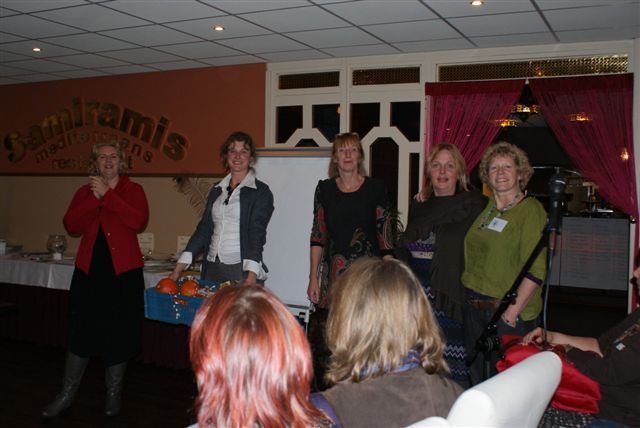
Yesterday, I – together with 66 rural business women- attended a meeting of the rural women’s business network ‘Wichterwest’ at Restaurant Samiramis in Grootegast.

 The establishment of women business networks was initiated by Groningen Province in an attempt to stimulate networking amongst rural business women in the province. Today, each region within Groningen province has a rural women’s network. In the Western region of Groningen province (a.k.a. Westerkwartier) the network is called ‘Wichterwest’ and is organised by the project leader ‘Vereiniging Groningen Dorpen.

 ‘Wichterwest’ acts as a platform for business women to network, to exchange ideas and to receive information about business. The organisers also arrange offers for business courses and trainings. For example, the organisers are arranging a new training programme which will focus on three different business aspects: a) business start-ups, b) business management and c) market/ marketing strategies. To respond to the great interest of business women in the network and to accommodate its growing number of participants, the organisers are now considering options to set up a foundation with the aim to increase income and offers.

 Yesterday’s meeting started with a speed dating session in which everybody got to know the fellow participants and their businesses. I was impressed by the variety of activities carried out by the women of the Westerkwartier. For example, I met a photographer, a Bed & Breakfast owner, an administrator, a clothes designer, several advisors, an interior designer and the owner of an online farm shop for regional products. The evening proceeded with an exercise to practice efficient networking skills and a delicious three course menu made of organic products produced in the Westerkwartier. Filled with food, excitement rose as the winners of a lottery game were announced. Each business woman was asked to bring a gift made by her company. By winning vouchers for advice, massage and acupuncture sessions, bags of sheep wool and cushions for man and beast, everybody was able to get an impression of the variety of products offered by business women in the Westerkwartier. The evening was completed with three different workshops concerning a) optimal business plans, b) press releases and c) the importance of the entrepreneur for making business.

Even though I am not a business women myself, I returned home filled with positive impressions regarding the innovative spirit and versatility of business women in the Westerkwartier- and a business arrangement made during the networking game- let me recall, I said I was not a business women?

The Food and Farming Transition: Toward a Post Carbon Food System

More and more scientists are pointing to the fact that the end of the cheap oil era will require us to fundamentally change the prevailing current food and agricultural system; a system that has become addicted to and dependent on fossil fuels. This week I came across a report entitled “The Food and Farming Transition: Toward a Post Carbon Food System” published by the Post Carbon Institute earlier this year.  Although the report focuses on the United States, its contents applies to many other parts of the world as well. In this well accessible and readable report the authors not only point to the key vulnerabilities of a food system resting on an unstable foundation of massive fossil fuel inputs but also to the seeds of transition toward a post carbon food system:

The seeds of the new food system have already been planted. America’s farmers have been reducing their energy use for decades. They are using less fertilizer and pesticide. The number of organic farms, farmers’ markets, and CSA operations is growing rapidly. More people are thinking about where their food comes from.

These are important building blocks, but much remains to be done. Our new food system will require more farmers, smaller and more diversified farms, less processed and packaged food, and less long-distance hauling of food. Governments, communities, businesses, and families each have important parts to play in reinventing a food system that functions with limited renewable energy resources to feed our population for the long term.

Stage opdrachten bij LandMarkt

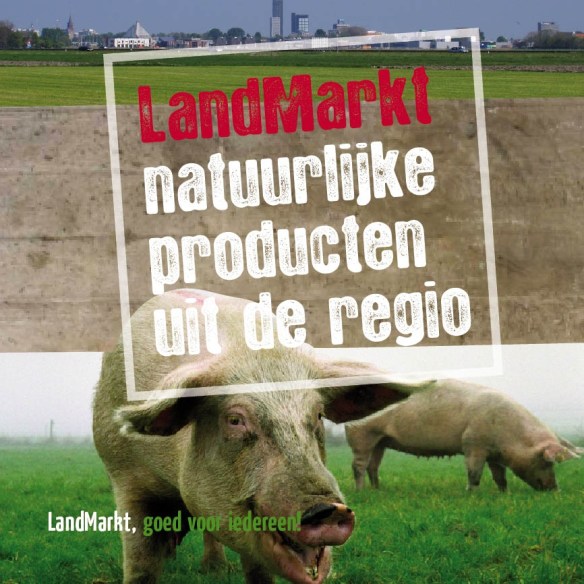
LandMarkt is een moderne open marktplaats met horeca die de stad en het platteland met elkaar wil verbinden door middel van lekker, lokaal en natuurlijk geproduceerd eten. Consumenten worden in contact gebracht met producenten, producten leveren rechtstreeks aan consumenten – local for local.

Een groep van onderzoekers, kennisinstellingen, financiers en ondernemers zijn actief in het project LandMarkt. Er wordt onder meer onderzoek gedaan naar consumentenwensen, samenwerking in de keten, het duurzaamheidsprofiel van diverse versketens en de planning van het voedselsysteem.

Tevens wordt aan beleidsmakers gevraagd hoe zij rekening houden met de stedelijke voedselvoorziening binnen de ruimtelijke planning. Medio 2010 staat de opening van de eerste LandMarkt gepland.

LandMarkt is op zoek naar studenten die een stage willen lopen bij dit zeer jonge bedrijf. Vragen van LandMarkt die in aanmerking komen zijn onder andere:

1. Het vaststellen van de door LandMarkt te gebruiken products assessment methode : hoe wegen we onze inkoopcriteria en communiceren we deze aan de consument.

 2. Het bepalen van de warenwettelijke- en kwaliteitseisen waarmee we rekening dienen te houden, zowel op product- als winkelvloerniveau

Meer informatie:  Jan Willem van der Schans. 

Email: Jan-Willem.vanderschans@wur.nl