Can farmers inform policy about multifunctional agriculture?

By Leonardo van den Berg (MSc. student International Development Studies, Wageningen University) & Klarien Klingen (graduate International Land and Water Management, Wageningen University).

On the 8th of October we participated in the mini-conference about multifunctional agriculture organized by the Rural Sociology Group. We would like to share some thoughts about the conference and relate them to our thesis research experiences in Brazil.

Gianluca Brunori spoke of the benefits of multifunctionality in Tuscany. Here, farms are not merely production spaces rather:

  • Educational sites where children learn about biodiversity and breeds of animals.
  • Sites where farmers are community leaders and negotiate with public institutions.
  • Sites where food quality is negotiated with consumers and subsequently created. This not only entails consumers’ feedback on wine but also farmers educating consumers on what other parts of a cow are edible.

These thoughts turn past and present public concerns of educating farmers upside down and coincide with our thesis experiences in Brazil, where we studied a movement of innovative peasants. Here, farmers refused to be assigned a role as a poor class and instead re-established their role as experts over production, consumption and the environment. Their knowledge, farming systems, and achievements surprised social and natural scientists.

Roberta Sonnino and Katrina Rønningen focused on state policies. Sonnino criticised the little support UK policy grants to multifunctional agriculture. She argues that the UK equates best value with low costs. The few developments in multifunctional agriculture have occurred despite rather than thanks of state action. An exception is the Scottish case where an increase in organic and locally produced school meals gained €150.000 of regional revenues. Rønningen showed us another picture: in Norway multifunctionality has been embedded in society for a long time. She says it started with market demand and that it is now supported by policy: the government aims at having 20% of the food locally produced by the year 2020. Farming as a profession is highly appreciated by the public: farmers are seen as managers of cultural heritage and as producers of healthy food.

Two things struck us about these two cases. First, the UK case shows how difficult it is to penetrate the neo-liberal armour that defines not only political but also much of our own rationality. Policies are often perceived as an obstacle rather than as enabling factors. It was this hostile context in which Brazilian peasants operated. Through diversification, agroecology, and community forms of exchange these peasants have increased their autonomy enabling them to pursue their own values. Second, the case of Norway gives us a taste of the role public policies could play in the valorisation of farmers as (re)producers of healthy food, nature, landscape, biodiversity, and public health. That most governments are lacking this is no secret, even according to a market oriented, middle size farmer in our research area:

I could fence a water source, buy some wire and provide some poles. If it were more, how do you say; all this imprisonment of all that is commerce, if it were more humane, looked more at the human side, I think there would be more left and all of society would gain from this (interview November 2009).

In short: we would argue that that the lessons from the third world should not be underestimated. Our experience learns that some of these cases may be running well ahead of theory and policy practice.

New ideas, but where are the new policies?

On behalf of Merel Heijke: second year student Master of International Development Studies at Wageningen University.

Thursday the eight of October I took part in the mini-conference: ‘Dynamics and Robustness of Multifunctional Agriculture: Lessons from abroad’ organized by Wageningen University’s Rural Sociology Group. I participated in the conference because since I came to Wageningen to study International Development Studies (I did my bachelor in interdisciplinary social science at the University of Utrecht), I really got interested in the way life is approached by people in the countryside. The topic multifunctional agriculture however, was quite new to me. Some considerations:

This conference opened my eyes about the difficulties people can face with certain top-down rural policies. The Norwegian guest Katrina Rønningen argued that too much attention and pressure is directed towards rural actors active in multifunctional agriculture. People that do not have sufficient knowhow and capacities to adjust their business to this way of life, fail and get into a lot of stress. This might be a consequence of a second point of view that struck me that afternoon, namely: policies implemented by the (national and/or local) government may not be relevant or can even hinder the development of new ideas. From a sustainable point of view: if we, as the global society, want to sustain the luxurious life we have, we need to adapt. Export versus quality, economical versus sustainable, short-term incomes against long-term investments – the choices are hard to make when governmental policies do not really support new initiatives (even the cheap ones) or the advertisement to the big public. An interesting topic to study…

I am very curious what the future will bring us… How will our food be produced in twenty years? What does our relationship with the countryside look like? How is our land going to be used? Let’s have an other conference about this subject in five years! This international exchange of information was really interesting and asking for new thoughts to develop. I am hungry for more!

Merel Heijke

Food and urban planning

MorgenTomorrowLast week the municipality of Amsterdam, together with the Netherlands Institute for Planning & Housing and the Ministry of  Housing, Spatial Planning & the Environment, organized and hosted the International Urban Planning Conference entitled MorgenTomorrow. The two-day conference was a combination of plenary sessions in the morning and parallel workshops in the afternoon. I had the honour and pleasure of convening a workshop entitled ‘Food and the City’. Although the food system is, as Pothukuchi and Kaufman (2000) rightfully state in their article in the Journal of the American Planning Association, a stranger to the field of urban planning it was good to see that the conference organizers had put food very prominently on the conference agenda. Not only by means of the workshop I convened but also by means of keynote lectures in the plenary sessions by LaDonna Redmond and Tim Lang. Both are extremely critical about the prevailing food system.

LaDonna is a community activist as well as founder and CEO the Institute for Community Resource Development (ICRD) in Chicago (Illinois). The ICRD’s mission is to rebuild the local food system by building grocery stores that bring access to sustainable products to urban communities of color, organizing farmers markets, converting vacant lots to urban farm sites and distributing local grown produce to restaurants. I was unable to attend LaDonna Redmond’s keynote, but she participated in my workshop and reflected on the different presentations.

Tim is Professor of Food Policy at the Centre for Food Policy of City University London. He has authored and co-authored many articles and books about food policy, especially focussing on the relation between food, health, social justice and the environment. His current work is about ‘omni-standards for sustainable diets’. I attended his keynote lecture and what I very much appreciated about his vision is that, despite the food system being a major contributor to climate change, devising sustainable food systems is not simply a matter of creating ‘climate neutral’ food systems. It will only be truely sustainable if it is able to meet a whole range of sustainability standards (a set of omni-standards as he calls them) in which social and health aspects are as important as economic and environmental ones. What struck me most in his presentation, and which will undoubtedly become the new issue in food debates, is the water footprint of the conventional food system.

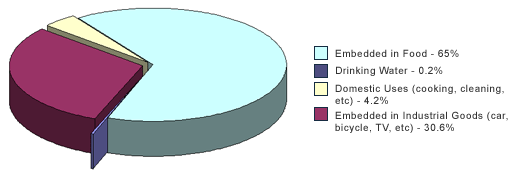
Around 65% of all fresh water is used for food production and with growing water scarcity and an increase in water-stressed countries, water use is likely to become the main threat for food production. The table below, of which Tim displayed a part in his presentation, is rather shocking. It shows how much water is needed to produce one portion of a whole range of mainly food products and drinks. It surely makes one (at least is does make me) aware of the urgent need for change.

Portion Litres Portion Litres Portion Litres
Pint of beer, 568ml 170 Cup of coffee, 125ml 140 Glass of orange juice, 200ml 170
Glass of milk, 200ml 200 Cup of instant coffee, 125ml 80 Glass of apple juice, 200ml 190
Cup of tea, 250ml 35 Glass of wine, 125ml 120 Orange, 100g 50
Slice of bread, 30g 135 Bread with cheese, 30g + 10g 90 Bag of potato crisps, 200g 185
Egg, 40g 135 Tomato, 70g 13 Hamburger, 150g 2400
Potato, 100g 25 Apple, 100g 70 Bovine leather shoes 8000
Sheet of A4, 80 g/m² 10 Cotton tee-shirt, medium 500g 4100 Microchip, 2g 32
Source: http://www.igd.com/index.asp?id=1&fid=1&sid=5&tid=48&cid=326

Mariann Fischer Boel’s blog – How the EU supports the dairy sector

In her blog Mariann Fischers Boel list what the EU is already doing to support the dairy sector and what next, steady but firm steps as she argues, will be taken.

Sustainable food planning conference – reminder & update

As mentioned in my blog of 28 August 2009 the Association of European Schools of Planning (AESOP), the International Studygroup on Multiple Use of Land (ISOMUL) and the Rural Sociology Group are hosting the first European Sustainable Food Planning conference. The conference will take place at De Kemphaan in the city of Almere in the Netherlands on 9 and 10 October 2009. It is still possible to register for this conference. If you are interested to participate in this conference, please apply by e-mail to corine.diepeveen@wur.nl. Costs for participation are € 100,- (incl. drinks, lunches and diner).

City estate De Kemphaan

Since the first announcement a couple of weeks ago, the conference programme has changed slightly. Below you can find the most recent version of the programme:

Day 1 – Generating ideas, exchanging experiences and comparing perspectives

09.00 – 09.30

Welcome and coffee/tea

09.30 – 09.45 Food and planning: an introduction to the conference Prof. Kevin Morgan (Professor of Governance & Development, Cardiff University, UK)
09.45 – 10.00 Including food and agriculture in urban planning: the Almere approach Mr. Henk Mulder (director urban planning Almere)
10.00 – 11.00

Session 1: Setting the scene

10.00 – 10.30 An integrated and territorial perspective on food studies, policy and planning Prof. Han Wiskerke (Chair of Rural Sociology – Wageningen University, Netherlands)
10.30 – 11.00 Feeding the city: practices, challenges and lessons from developing countries Mr. Henk de Zeeuw (director of the RUAF Foundation)
11.00 – 11.30

Coffee/tea break

11.30 – 13.00

Session 2: Theoretical perspectives and academic issues

11.30 – 12.00 Reconnecting consumers and producers:  dynamics, diversity and potentials of alternative food networks Prof. Gianluca Brunori (Professor of Agriculture Economics – Pisa University, Italy)
12.00 – 12.30 Urban food and public spaces: planning for security and sustainability Dr. Roberta Sonnino (Lecturer in Environmental Planning – Cardiff University, UK)
12.30 – 13.00 Food and the city: the links between food, public health and sustainable urban development Dr. Martin Caraher (Reader in Food & Health Policies – City University London, UK)
13.00 – 14.00

Lunch break

14.00 – 15.30

Session 3: Food planning practices and policies

14.00 – 14.30 Food and agriculture in Europe’s peri-urban regions Mrs. Dwarshuis (President of Peri-Urban Regions Platform Europe – PURPLE)  
14.30 – 14.50 The practice of food planning in New York city Dr. Nevin Cohen (Associate Professor in Urban Studies – New School for Liberal Arts, New York)
14.50 – 15.10 The practice of food planning in New York state Mr. Bob Lewis (senior planner New York State)
15.10 – 15.30 Amsterdam’s food strategy (“Proeftuin Amsterdam”) Mr. Bart Pijnenburg MSc (Programme manager Proeftuin Amsterdam)
15.30 – 16.00

Coffee/tea break

16.00 – 18.00 Excursion to City Farm Almere Tineke van den Berg (urban farmer)
19.30 – 22.30

Diner (Restaurant De Kemphaan – Almere)

Day 2 – Towards an agenda for sustainable food planning

09.00 – 09.30

Welcome and coffee/tea

09.30 – 10.00 Including food in planning studies and planning practices: experiences from the USA Prof. Jerry Kaufman (Professor Emeritus of Urban and Regional Planning – University of Wisconsin-Madison, USA)
10.00 – 10.45 Issues, topics, themes for a sustainable food planning agenda (plenary inventory) Moderated by Prof. Arnold van der Valk (Chair of Land Use Planning – Wageningen University, NL)
10.45 – 11.15

Coffee/tea break

11.15 – 12.45 Developing the building blocks for a sustainable food planning agenda (parallel working sessions)
12.45 – 14.00

Lunch break

14.00 – 14.45 Plenary presentation of and discussion about results of parallel working sessions Moderated by Prof. Terry Marsden (Professor of Environmental Planning – Cardiff University, UK)
14.45 – 15.00 Sustainable food planning in Europe: concluding reflection and look ahead Prof. Kevin Morgan (Professor of Governance & Development, Cardiff University, UK)
15.00

Coffee & tea / end of conference