Internship in the ‘Friesische Schafskäserei’ (Friesian sheep dairy), part 1

By Corinne Feldmann – MSc student

After finishing my master thesis with the RSO department and FiBL in Switzerland, I decided to do some more ‘practical work’ during the internship for my MSc Organic Agriculture.

So, here I am…on an organic sheep dairy farm in Northern Germany. The tourists are not yet here, since it is icy and cold – not very attractive for holidays right now. But in a few weeks they are supposed to come in order to visit the farm, look at the sheep, and try the cheese.

Right now the lambs are getting born. They are cute but freezing outside in the stable – just like me. There are quite a lot of lambs already, so that we will start to milk the sheep soon and than we can also start to produce cheese…for all the expected tourists.

Romashki or a Life Less Ordinary, part 1

Thomas Macintyre is a MSc student enrolled in the Master International Development Studies. For his MSc thesis research he spent 3 months in an ecovillage in the Ukraine, to study everyday village life. Thomas’ post is the first of a series in which he shares his experiences of the “life less ordinary” he has lived for 3 months.

Imagine if you can a little village surrounded by forests beside a little lake. Squirrels play in trees amongst the woodpeckers, frogs play hide and seek with the cranes in the lake, and when the sun has set, the wild pigs come out to sniff and dig around the fields and gardens in the village, curious as ever as to see what is new.  Continue reading

Wichterwest: A network meeting with gains for everybody

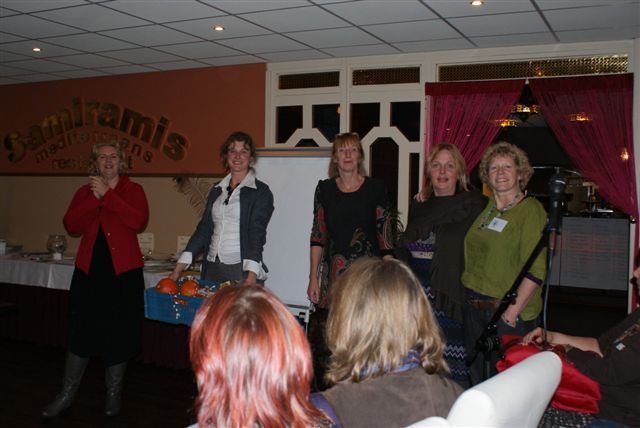
Yesterday, I – together with 66 rural business women- attended a meeting of the rural women’s business network ‘Wichterwest’ at Restaurant Samiramis in Grootegast.

 The establishment of women business networks was initiated by Groningen Province in an attempt to stimulate networking amongst rural business women in the province. Today, each region within Groningen province has a rural women’s network. In the Western region of Groningen province (a.k.a. Westerkwartier) the network is called ‘Wichterwest’ and is organised by the project leader ‘Vereiniging Groningen Dorpen.

 ‘Wichterwest’ acts as a platform for business women to network, to exchange ideas and to receive information about business. The organisers also arrange offers for business courses and trainings. For example, the organisers are arranging a new training programme which will focus on three different business aspects: a) business start-ups, b) business management and c) market/ marketing strategies. To respond to the great interest of business women in the network and to accommodate its growing number of participants, the organisers are now considering options to set up a foundation with the aim to increase income and offers.

 Yesterday’s meeting started with a speed dating session in which everybody got to know the fellow participants and their businesses. I was impressed by the variety of activities carried out by the women of the Westerkwartier. For example, I met a photographer, a Bed & Breakfast owner, an administrator, a clothes designer, several advisors, an interior designer and the owner of an online farm shop for regional products. The evening proceeded with an exercise to practice efficient networking skills and a delicious three course menu made of organic products produced in the Westerkwartier. Filled with food, excitement rose as the winners of a lottery game were announced. Each business woman was asked to bring a gift made by her company. By winning vouchers for advice, massage and acupuncture sessions, bags of sheep wool and cushions for man and beast, everybody was able to get an impression of the variety of products offered by business women in the Westerkwartier. The evening was completed with three different workshops concerning a) optimal business plans, b) press releases and c) the importance of the entrepreneur for making business.

Even though I am not a business women myself, I returned home filled with positive impressions regarding the innovative spirit and versatility of business women in the Westerkwartier- and a business arrangement made during the networking game- let me recall, I said I was not a business women?

Food, agriculture and cities

Recently the Food and Agricultural Organisation (FAO) has published a brochure and briefing note about food and agriculture in and around cities. Like many international public bodies, national governments and NGOs the FAO is concerned about the social, economic, ecological and health consequences of the concentration of the world’s population in and around large cities. In the brochure the FAO states that there is an urgent need to invest in urban food programmes: 

The 4th World Urban Forum cited the need for policies and interventions to ensure that the increasing number of urban poor do not get left behind. The food dimension of poverty in urban areas still has not been translated into sufficient policy action in many countries. Rural-urban linkages will become increasingly important. Urban policies also need to acknowledge the role of urban and peri-urban agriculture in urban development, ensure urban food supply and strengthen livelihoods of poor urban producers. This includes removing barriers and providing incentives for urban and peri-urban agriculture (UPA) as well as improving natural resource management in urban and peri-urban areas. … A paradigm shift in both urban and agriculture development, planning and policy formulation is required in order to ensure access to urban food security, improved environmental management and enhanced rural-urban linkages.

In order to broaden the approaches and to gather new insights for cities both of developing, intermediate or developed countries,  the FAO’s Global Forum on Food Security and Nutrition (FSN Forum) has opened a debate which is, in terms of contributing to the debate, only open for FSN forum members. However, everyone can read contributions to the debate. Furthermore, for those interested in this topic, I can highly recommend the website of the FAO’s Food for the Cities Initiative. It contains a lot of interesting fact sheets and publications about the multiple aspects related to food, agriculture and cities.

Sustainable food planning conference – reminder & update

As mentioned in my blog of 28 August 2009 the Association of European Schools of Planning (AESOP), the International Studygroup on Multiple Use of Land (ISOMUL) and the Rural Sociology Group are hosting the first European Sustainable Food Planning conference. The conference will take place at De Kemphaan in the city of Almere in the Netherlands on 9 and 10 October 2009. It is still possible to register for this conference. If you are interested to participate in this conference, please apply by e-mail to corine.diepeveen@wur.nl. Costs for participation are € 100,- (incl. drinks, lunches and diner).

City estate De Kemphaan

Since the first announcement a couple of weeks ago, the conference programme has changed slightly. Below you can find the most recent version of the programme:

Day 1 – Generating ideas, exchanging experiences and comparing perspectives

09.00 – 09.30

Welcome and coffee/tea

09.30 – 09.45 Food and planning: an introduction to the conference Prof. Kevin Morgan (Professor of Governance & Development, Cardiff University, UK)
09.45 – 10.00 Including food and agriculture in urban planning: the Almere approach Mr. Henk Mulder (director urban planning Almere)
10.00 – 11.00

Session 1: Setting the scene

10.00 – 10.30 An integrated and territorial perspective on food studies, policy and planning Prof. Han Wiskerke (Chair of Rural Sociology – Wageningen University, Netherlands)
10.30 – 11.00 Feeding the city: practices, challenges and lessons from developing countries Mr. Henk de Zeeuw (director of the RUAF Foundation)
11.00 – 11.30

Coffee/tea break

11.30 – 13.00

Session 2: Theoretical perspectives and academic issues

11.30 – 12.00 Reconnecting consumers and producers:  dynamics, diversity and potentials of alternative food networks Prof. Gianluca Brunori (Professor of Agriculture Economics – Pisa University, Italy)
12.00 – 12.30 Urban food and public spaces: planning for security and sustainability Dr. Roberta Sonnino (Lecturer in Environmental Planning – Cardiff University, UK)
12.30 – 13.00 Food and the city: the links between food, public health and sustainable urban development Dr. Martin Caraher (Reader in Food & Health Policies – City University London, UK)
13.00 – 14.00

Lunch break

14.00 – 15.30

Session 3: Food planning practices and policies

14.00 – 14.30 Food and agriculture in Europe’s peri-urban regions Mrs. Dwarshuis (President of Peri-Urban Regions Platform Europe – PURPLE)  
14.30 – 14.50 The practice of food planning in New York city Dr. Nevin Cohen (Associate Professor in Urban Studies – New School for Liberal Arts, New York)
14.50 – 15.10 The practice of food planning in New York state Mr. Bob Lewis (senior planner New York State)
15.10 – 15.30 Amsterdam’s food strategy (“Proeftuin Amsterdam”) Mr. Bart Pijnenburg MSc (Programme manager Proeftuin Amsterdam)
15.30 – 16.00

Coffee/tea break

16.00 – 18.00 Excursion to City Farm Almere Tineke van den Berg (urban farmer)
19.30 – 22.30

Diner (Restaurant De Kemphaan – Almere)

Day 2 – Towards an agenda for sustainable food planning

09.00 – 09.30

Welcome and coffee/tea

09.30 – 10.00 Including food in planning studies and planning practices: experiences from the USA Prof. Jerry Kaufman (Professor Emeritus of Urban and Regional Planning – University of Wisconsin-Madison, USA)
10.00 – 10.45 Issues, topics, themes for a sustainable food planning agenda (plenary inventory) Moderated by Prof. Arnold van der Valk (Chair of Land Use Planning – Wageningen University, NL)
10.45 – 11.15

Coffee/tea break

11.15 – 12.45 Developing the building blocks for a sustainable food planning agenda (parallel working sessions)
12.45 – 14.00

Lunch break

14.00 – 14.45 Plenary presentation of and discussion about results of parallel working sessions Moderated by Prof. Terry Marsden (Professor of Environmental Planning – Cardiff University, UK)
14.45 – 15.00 Sustainable food planning in Europe: concluding reflection and look ahead Prof. Kevin Morgan (Professor of Governance & Development, Cardiff University, UK)
15.00

Coffee & tea / end of conference