Food, agriculture and cities

Recently the Food and Agricultural Organisation (FAO) has published a brochure and briefing note about food and agriculture in and around cities. Like many international public bodies, national governments and NGOs the FAO is concerned about the social, economic, ecological and health consequences of the concentration of the world’s population in and around large cities. In the brochure the FAO states that there is an urgent need to invest in urban food programmes: 

The 4th World Urban Forum cited the need for policies and interventions to ensure that the increasing number of urban poor do not get left behind. The food dimension of poverty in urban areas still has not been translated into sufficient policy action in many countries. Rural-urban linkages will become increasingly important. Urban policies also need to acknowledge the role of urban and peri-urban agriculture in urban development, ensure urban food supply and strengthen livelihoods of poor urban producers. This includes removing barriers and providing incentives for urban and peri-urban agriculture (UPA) as well as improving natural resource management in urban and peri-urban areas. … A paradigm shift in both urban and agriculture development, planning and policy formulation is required in order to ensure access to urban food security, improved environmental management and enhanced rural-urban linkages.

In order to broaden the approaches and to gather new insights for cities both of developing, intermediate or developed countries,  the FAO’s Global Forum on Food Security and Nutrition (FSN Forum) has opened a debate which is, in terms of contributing to the debate, only open for FSN forum members. However, everyone can read contributions to the debate. Furthermore, for those interested in this topic, I can highly recommend the website of the FAO’s Food for the Cities Initiative. It contains a lot of interesting fact sheets and publications about the multiple aspects related to food, agriculture and cities.

Can farmers inform policy about multifunctional agriculture?

By Leonardo van den Berg (MSc. student International Development Studies, Wageningen University) & Klarien Klingen (graduate International Land and Water Management, Wageningen University).

On the 8th of October we participated in the mini-conference about multifunctional agriculture organized by the Rural Sociology Group. We would like to share some thoughts about the conference and relate them to our thesis research experiences in Brazil.

Gianluca Brunori spoke of the benefits of multifunctionality in Tuscany. Here, farms are not merely production spaces rather:

  • Educational sites where children learn about biodiversity and breeds of animals.
  • Sites where farmers are community leaders and negotiate with public institutions.
  • Sites where food quality is negotiated with consumers and subsequently created. This not only entails consumers’ feedback on wine but also farmers educating consumers on what other parts of a cow are edible.

These thoughts turn past and present public concerns of educating farmers upside down and coincide with our thesis experiences in Brazil, where we studied a movement of innovative peasants. Here, farmers refused to be assigned a role as a poor class and instead re-established their role as experts over production, consumption and the environment. Their knowledge, farming systems, and achievements surprised social and natural scientists.

Roberta Sonnino and Katrina Rønningen focused on state policies. Sonnino criticised the little support UK policy grants to multifunctional agriculture. She argues that the UK equates best value with low costs. The few developments in multifunctional agriculture have occurred despite rather than thanks of state action. An exception is the Scottish case where an increase in organic and locally produced school meals gained €150.000 of regional revenues. Rønningen showed us another picture: in Norway multifunctionality has been embedded in society for a long time. She says it started with market demand and that it is now supported by policy: the government aims at having 20% of the food locally produced by the year 2020. Farming as a profession is highly appreciated by the public: farmers are seen as managers of cultural heritage and as producers of healthy food.

Two things struck us about these two cases. First, the UK case shows how difficult it is to penetrate the neo-liberal armour that defines not only political but also much of our own rationality. Policies are often perceived as an obstacle rather than as enabling factors. It was this hostile context in which Brazilian peasants operated. Through diversification, agroecology, and community forms of exchange these peasants have increased their autonomy enabling them to pursue their own values. Second, the case of Norway gives us a taste of the role public policies could play in the valorisation of farmers as (re)producers of healthy food, nature, landscape, biodiversity, and public health. That most governments are lacking this is no secret, even according to a market oriented, middle size farmer in our research area:

I could fence a water source, buy some wire and provide some poles. If it were more, how do you say; all this imprisonment of all that is commerce, if it were more humane, looked more at the human side, I think there would be more left and all of society would gain from this (interview November 2009).

In short: we would argue that that the lessons from the third world should not be underestimated. Our experience learns that some of these cases may be running well ahead of theory and policy practice.

Resistance and Autonomy in Western Mexico – local actors creating a place of their own

 By Peter R.W. Gerritsen, Department of Ecology and Natural Resources, South Coast University Centre, University of Guadalajara, Av. Independencia Nacional 151, 48900, Autlán, Jal., Mexico. Email: petergerritsen@cucsur.udg.mx

 The local effects of global processes in the Mexican countryside are well documented; describing problems related to the quality of rural producers’ life, identity and traditional practices, as well as their resource management practices. Alike initiatives all over the world,  also in western Mexico local actors joined forces to counter these problems and created ‘a place of their own’ in a globalised world, a place for their own wellbeing.
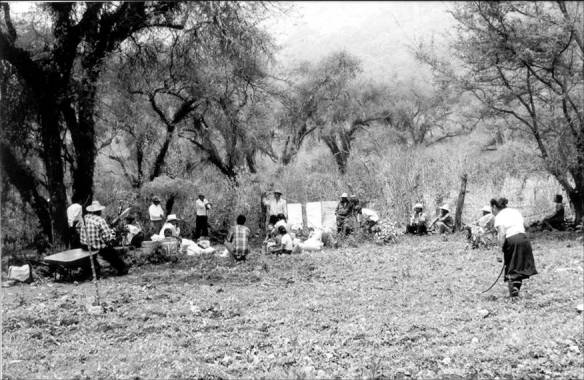
RASA - Peter Gerritsen

In the state of Jalisco, located in western Mexico, 20 groups of peasants and indigenous farmers, supported by professionals from non-governmental organizations and local universities, joined forces in 1999 and created the Red de Alternativas Sustentables Agropecuarias (RASA: the Network for Sustainable Agricultural Alternatives). As such, the RASA can be considered an umbrella organization for many local organized producer groups.

The RASA is also a social organization with characteristics of the so-called new social movements. New social movements have emerged since the late 1970s in the Mexican countryside, due to the problems created by global processes. The struggles that have led to their emergence originate from the demand to defend local structures and to remain control over the different domains of daily life. As such, these movements stress the need for endogenous development approaches. Closely related to the issue of specific life styles is the defense of the territory, being the place of local identity formation. It is also here, where innovative forms of resource management have emerged.
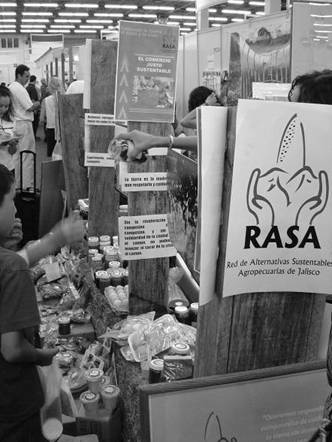
RASA 2 PGThe RASA´s main objective is strengthening a development model that aims to mitigate the local impacts of global processes and that permits the transition towards sustainable local development. In practice, the RASA organizes workshops on organic agriculture and fair trade, and organizes farmer-to-farmer meetings for sharing experiences (including political discussions on the countryside). These activities take place in the rural and peri-urban areas of Jalisco. The RASA also designs and implements new fair trade-channels, mainly in the metropolitan area of the Jalisco state capital Guadalajara. As such, the RASA´s actions are also directed at urban consumers. Finally, articulation with other social movements is actively sought for. Thus, the RASA seeks to create new room for maneuver by establishing strategic alliances with different societal actors.

The creation of local transition paths towards sustainable development, such as promoted by the RASA, is related to the issues of agency and power. These, in turn, are (often) related to resistance and autonomy. Both elements are also recognizable in the RASA experience.

To start with, the RASA has created its own socio-political space in the Jalisco countryside, which has permitted to resist to and counter the dominant rural development model in Mexico and in Jalisco that follows global tendencies. However, the RASA´s efforts must be understood as heterogeneous in nature; not all groups are involved in fair trade, but only those with a production surplus. Moreover, some groups focus more on basic grain production, while others cultivate horticultural crops. Furthermore, the RASA emerged outside the realm of governmental intervention in rural areas. In fact, it has been systematically neglected by formal institutions, as the RASA has been considered a threat to the established formal – historically-determined – political spaces in the rural arenas. Moreover, within the rural communities the RASA-members are perceived as outsiders. In this sense, the RASA conceptual approach has permitted strengthening their self-consciousness and self-organization, as well as improving their position in their communities. It has also led to the dimension of autonomy in the sustainable development model, as designed and implemented by the RASA.

New ideas, but where are the new policies?

On behalf of Merel Heijke: second year student Master of International Development Studies at Wageningen University.

Thursday the eight of October I took part in the mini-conference: ‘Dynamics and Robustness of Multifunctional Agriculture: Lessons from abroad’ organized by Wageningen University’s Rural Sociology Group. I participated in the conference because since I came to Wageningen to study International Development Studies (I did my bachelor in interdisciplinary social science at the University of Utrecht), I really got interested in the way life is approached by people in the countryside. The topic multifunctional agriculture however, was quite new to me. Some considerations:

This conference opened my eyes about the difficulties people can face with certain top-down rural policies. The Norwegian guest Katrina Rønningen argued that too much attention and pressure is directed towards rural actors active in multifunctional agriculture. People that do not have sufficient knowhow and capacities to adjust their business to this way of life, fail and get into a lot of stress. This might be a consequence of a second point of view that struck me that afternoon, namely: policies implemented by the (national and/or local) government may not be relevant or can even hinder the development of new ideas. From a sustainable point of view: if we, as the global society, want to sustain the luxurious life we have, we need to adapt. Export versus quality, economical versus sustainable, short-term incomes against long-term investments – the choices are hard to make when governmental policies do not really support new initiatives (even the cheap ones) or the advertisement to the big public. An interesting topic to study…

I am very curious what the future will bring us… How will our food be produced in twenty years? What does our relationship with the countryside look like? How is our land going to be used? Let’s have an other conference about this subject in five years! This international exchange of information was really interesting and asking for new thoughts to develop. I am hungry for more!

Merel Heijke

Good welfare of farmers as a precondition to provide welfare to pigs on farms

Last week, I was invited to the Animal Science Days in Padua to present my Master thesis results concerning the effect of farm modernization on the welfare of pigs in Croatia. I was given the opportunity to present my results twice; first, I presented my main results as an invited speaker and later I presented some aspects of my thesis in the form of a poster.

The main point of my study was that the modernization of Croatian housing systems, particularly small ones, does not necessarily ensure a better standard of pig welfare. This is because it often entails the removal of bedding and intensification of production, amongst others to reduce labour time and costs. Bedding such as straw is, however, important because it reduces injuries resulting from behavioural abnormalities directed towards pen mates (i.e. belly nosing, ear and tail chewing) and floor qualities. Also, across Europe intensification has risen much concern regarding the welfare of intensively housed animals. One can therefore suggest that Croatia needs to find a way to modernise its production units while retaining its beneficial aspects such as small scale and straw bedding.

In the course of my study, however, I found out that small pig farmers-which make up the majority of Croatian pig farmers- often lacked knowledge about the concept of pig welfare and the EU pig welfare directives. In fact, they seemed to be uninformed about the exact changes which will occur in the course of implementing the EU rules and regulations. This resulted on the one hand in frustration regarding their own lack of future perspective and on the other hand in a lack of interest regarding their motivation to ensure or improve the welfare of their pigs. The results thus suggest that motivations to ensure pig welfare are also dependent on the welfare of the pig farmers.

My main conclusion was therefore that in order to ensure animal welfare, it is necessary to ensure welfare of farmers as well. In order to ensure and improve pig welfare in the future, this topic needs to be approached from both social sciences and animal sciences in order to understand the close link between human and animal welfare. My presentation received great interest from the audience and I hope that this topic will be further elaborated in order to support small Croatian farmers and their pigs in the future.