Victory Gardens revisited – the Obama Foodscape

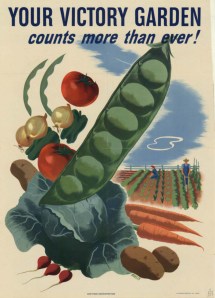
US World War II era poster promoting Victory Gardens (source: http://www.art.unt.edu/ntieva/pages/about/newsletters/vol_15/no_1/WarPosterImages.htm)

US World War II era poster promoting Victory Gardens

Victory Gardens, also known as ‘war gardens’ or ‘food gardens for defense’ were fruit, vegetable and herb gardens planted in backyards and on rooftops in the USA, the UK, Canada and Australia during World War II. They were considered to be an important means to reduce the costs for vegetables needed by the US War Department to feed the troops and to safeguard food security. One of the advocates of the Victory Garden was Eleanor Roosevelt, US first lady from 1933 to 1945, who also planted a Victory Garden at the White House. The Victory Gardens were a great success: the 20 million Victory Gardens in the US produced up to 40% of all vegetables that were consumed in the US.

After World War II the number of Victory Gardens rapidly decreased as most citizens believed that food shortages would be over soon. However, in recent years there is a campaign to re-establish Victory Gardens. Not to reduce the price of vegetables needed to feed US troops, but primarily from the perspective of food sovereignty; as a means to escape the growing dependence of consumers on the food stuffs provided by the food processing industries and retailers. At the same time gardening is also considered to be an important instrument in greening cities, in growing sustainable communities and in educating children about food and healthy eating (see e.g. our recent blogs about urban agriculture and nourishing the city).

For such a movement to become a success it is always helpful to have a leading figure as an icon. It seems that the USA’s new first family, in particular first lady Michelle Obama, is taking on this role. For the first time since the Roosevelt days, the White House once again as a garden. This beautiful short movie gives a good impression of the White House kitchen garden and the rationale behind it. 

However, there is more to food and the Obama’s than the White House kitchen garden only. Recently President Obama  announced that he wants to set up a White House farmers market to support local farmers and as an example of creating new connections between cities and its surrounding countryside. Interested to be informed about  the Obama Foodscape, have a look at the  Obama Foodorama weblog.

Urban Agriculture / Stadslandbouw

Growing food in urban gardens and allotments has a long history. In the Netherlands, allotment gardens are a marginal but natural part of the city’s infrastructure. Other European countries have their own history in urban gardening too, such as many Eastern European countries. Also in the US, urban gardening is a long standing practice.

However, in the Netherlands as well as in the US, urban gardening is moving from the fringe into the heart of a debate about health and sustainability. The manifestations look similar. For example, the Alemany Farm in San Francisco which started on a vacant lot (see story) or the Red Hook urban farm (see earlier blog). Also in Rotterdam, Proefpark de Punt started on a vacant lot and also this initiative met skeptics of urban planners and city leaders until it had proven itself.

Reading the articles and websites of initiatives related to Urban Agriculture in the US and its counterpart ‘Stadslandbouw’ in the Netherlands, there seems a striking difference too. In the US, the food production aspect of the gardening is taken far more serious as an option for providing people a significant portion of their daily food. Growing food in urban gardens is about access to fresh food. Not in the last place for those who do not have easy and affordable access.

In the Netherlands, this notion is not absent of course. But the language around the initiatives starts from a broader notion of the need for ‘green space’ for the health of the urban citizen. A green environment, education about nature and food, recreation possibilities in accessible green spaces, the improvement of mental health and social cohesion by means of gardening. These notions can also be found in the initial objective for setting up Proefpark de Punt:

‘Landleven in de Stad’, een natuurlijke speel- en recreatiemogelijkheid voor de buurt te creëren.

A trend watcher on the website of Proefpark de Punt talked about ‘squatting green space’ which is what many initiatives in the US and the Netherlands essentially do. However, the local context differs considerably which means that the connections to health and sustainability are interpreted quite differently. A call for comparative studies I guess.

Proefpark de Punt

Proefpark de Punt

Sustainable food planning conference

AESOP logoOn 9 and 10 October 2009 the first Sustainable Food Planning Conference will be held. This conference is an initiative of the AESOP (Association of European Schools of Planning), the ISOMUL (International Studygroup On Multiple Use of Land) and the Rural Sociology Group of Wageningen University.

The sustainable food planning conference is organized to examine the role of food in urban and regional planning. Although political, societal and academic interests in food and the city are rapidly increasing, food largely remains a stranger to the field of urban and regional planning, spatial planning policies and planning studies. Recently the American Planning Association launched its Policy Guide on Community and Regional Food Planning. Inspired by this policy guide, this conference seeks to explore ways in which food can and should be incorporated in planning practices, policies and research and develop strategies for enhancing sustainable food planning in Europe. The character of the conference is primarily agenda-setting by establishing a network of planning practitioners, policymakers and agrifood and planning scholars in Europe and beyond.

.

Restaurant and meeting centre De Kemphaan (source: http://www.restaurantdekemphaan.nl/content/ons_bedrijf)

Restaurant and meeting centre De Kemphaan (source: http://www.restaurantdekemphaan.nl/content/ons_bedrijf)

The conference will take place at De Kemphaan in the city of Almere in the Netherlands. If you are interested to participate in this conference, please apply by e-mail to corine.diepeveen@wur.nl. Costs for participation are € 100,- (incl. drinks, lunches and diner). The number of participants is limited to 50 persons. For more information have a look at the conference programme below:


Day 1 – Generating ideas, exchanging experiences and comparing perspectives

09.00 – 09.30

Welcome and coffee/tea

09.30 – 09.45 Food and planning: an introduction to the conference Prof. Kevin Morgan (Professor of Governance & Development, Cardiff University, UK)
09.45 – 10.00 Including food and agriculture in urban planning: the Almere approach Mr. Henk Mulder (Almere municipality – director urban development and planning) 
10.00 – 10.30 An integrated and territorial perspective on food studies, policy and planning Prof. Han Wiskerke (Chair of Rural Sociology – Wageningen University, NL)
10.30 – 11.00

Coffee/tea break

11.00 – 12.00

Session 1: Agri-food policy issues

11.00 – 11.30 Food and agriculture in Europe’s peri-urban regions Mrs. Dwarshuis (President of Peri-Urban Regions Platform Europe – PURPLE)
11.30 – 12.00 Feeding the city: practices, challenges and lessons from developing countries Mr. Henk de Zeeuw (director RUAF foundation)
12.00 – 13.00

Session 2: Urban food planning practices

12.00 – 12.20 The practice of food planning in New York City Dr. Nevin Cohen (Associate Professor in Urban Studies at the New School for Liberal Arts, New York
12.20 – 12.40 The practice of food planning in New York State Mr. Bob Lewis (Senior Planner New York State)
12.40 – 13.00 Amsterdam’s food strategy (“Proeftuin Amsterdam) Mr. Bart Pijnenburg(Programme manager Proeftuin Amsterdam)
13.00 – 14.00

Lunch break

14.00 – 15.30

Session 3: Theoretical perspectives and academic issues

14.00 – 14.30 Reconnecting consumers and producers:  dynamics, diversity and potentials of alternative food networks Prof. Gianluca Brunori (Professor of Agriculture Economics – Pisa University, Italy)
14.30 – 15.00 Urban Food and Public Spaces: Planning for Security and Sustainability Dr. Roberta Sonnino (Lecturer in Environmental Planning – Cardiff University, UK)
15.00 – 15.30 Food and the city: the links between food, public health and sustainable urban development Dr. Martin Caraher (Reader in Food & Health Policies, City University London, UK)
15.30 – 16.00

Coffee/tea break

16.00 – 18.00 Excursion to City Farm Almere Tineke van den Berg (urban farmer)
19.30 – 22.30

Drinks & Diner

Day 2 – Towards an agenda for sustainable food planning

09.00 – 09.30

Welcome and coffee/tea

09.30 – 10.00 Including food in planning studies and planning practices: experiences from the USA Prof. Jerry Kaufman (Professor Emeritus of Urban and Regional Planning – University of Wisconsin-Madison, USA)
10.00 – 10.45 Issues, topics, themes for a sustainable food planning agenda (plenary inventory) Moderated by Prof. Arnold van der Valk (Professor of Land Use Planning – Wageningen University, The Netherlands)
10.45 – 11.15

Coffee/tea break

11.15 – 12.45 Developing the building blocks for a sustainable food planning agenda (parallel working sessions)
12.45 – 14.00

Lunch break

14.00 – 14.45 Plenary presentation of and discussion about results of parallel working sessions Moderated by Prof. Terry Marsden (Professor of Environmental Policy – Cardiff University, UK)
14.45 – 15.00 Sustainable food planning in Europe: concluding reflection and look ahead Prof. Kevin Morgan (Professor of Governance & Development, Cardiff University, UK)
15.00

Coffee & tea / end of conference

Urban agriculture in Red Hook, Brooklyn NY

STA72194I took opportunity to visit New York City while on my way to my friend Jessica in Ithaca. Fortunately, I had the opportunity to ‘go local’ because Mikey, a friend of her agreed to show me around. We went on bikes exploring Brooklyn, a great experience. I soon learned that you only have to remember one thing; you are on your own, there are no rules in urban jungle traffic.

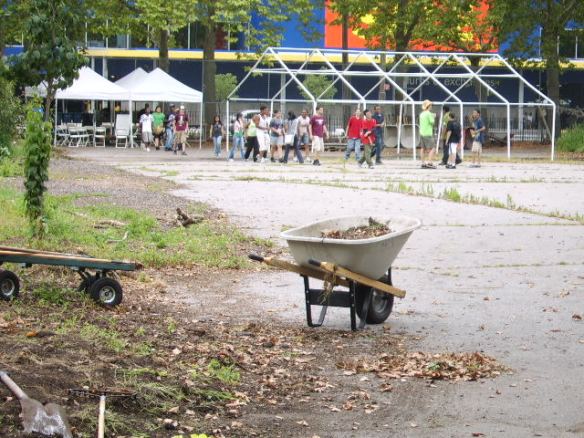
We visited an urban farm in Southern Brooklyn, in the Red Hook neighborhood, a predominantly black and low income community. The Added Value farm is experiencing its third growing season. The farm is located on a run down playground, still visible as a grey spot on Google earth, but now a green oasis, with a small hoop house nursery and a composting section.

STA72196The playground is still there but most of it is covered, underneath 18 inches of rich compost soil. All vegetables you can imagine are growing here, except carrots which go too deep. The produce is sold at the weekly farmers market at the spot and serves a twenty member CSA. The farm now neighbors a gigantic new and heavily opposed IKEA outlet. The outlet symbolizes the start of gentrification of the neighborhood, of which we saw an example at the waterfront, where abandoned industry buildings have been converted into lofty apartments. As more white people move in, rents and living costs increase, which forces the current inhabitants to move to other, cheaper parts of the city.

 The controversy around the outlet is one of the factors influencing the struggle of the farm to reach out to its immediate neighborhood community Donna explained. She is one of the farm workers and kindly showed us around. Showing and explaining the farm to whoever passes by is an important aspect of the openness of the place; the gate is always open while work is going on. Without a programmatic structure such as the youth education program, it has been hard to reach the neighborhood. For many the farm is still a bridge too far in the daily struggle to make a living while on a totally different diet due to the lack of affordable fresh produce and lost cooking skills.  

STA72195Donna is one of 4 farm interns. We met the manager briefly on his way to a meeting. There are also 4 youth workers employed on the farm. One of them was working with a new group of teenagers from the Bronx, who were introducing themselves to each other at the start of their Summer Youth Intensives. Weeding, harvesting, learning about vegetables and composting. But it all starts at a very basic level. Because more than anything else, the farm program is trying to teach these kids a different set of values. Learning the benefit of working as a team. Learning that it is not about the show, wearing appropriate working clothes. Turning compost; doing the dirty jobs. Respect for each other and for every living creature. The value of sharing. The taste of fresh basil.

 The skeptics (see blog Han) or the question alone really, about whether or not urban agriculture can actually provide enough produce to feed an entire city is the narrow economist argument of linear industrial thinking. The remnant of a past modernist era which by default end up in cost efficiency, scale enlargement and mass production solutions. At the cost of soil fertility and hard working people, Marx already taught us in the 19th century. Urban agriculture is about so much more than “only” providing “a bit” of fresh and healthy food.

Feeding the city or nourishing the city?

More than half of the world’s population is living in cities. It are especially the larger cities that are increasing in size and many of these ever expanding cities are located in regions that are most suitable for food production. The tension between a growing urban population and a decline in agricultural land is increasingly acknowledged. Also the former Dutch Minister of Agriculture, Cees Veerman, states that the growing urban demand for food requires a fundamental shift in food production systems: fresh food should be produced closer to cities. He holds a strong plea for setting up a large Metropolitan Agriculture pilot project (see also this video interview). At first sight, the idea of producing food close to where people live sounds appealing as it will reduce food miles significantly.

But at second sight, his plea for metropolitan agriculture is to a large extent nothing but a plea for an ongoing industrialization of food production as this metropolitan agriculture video shows. Veerman also states that small-scale initiatives like urban agriculture cannot fulfil the growing urban food demand. Although this may be true, I do believe that innovative forms of urban agriculture such as SPIN farming, small-scale hydroponics and rooftop gardening can provide a significant part of the food needed for the urban population.

Most important, however, is that urban agriculture is about nourishing the city, while Veerman’s metropolitan agriculture is limited to feeding the city or actually, to phrase Michael Pollan, to produce foodstuffs (i.e. the highly processed, modified, fructosed, hormoned, and antibioticized products that we eat) for the urban population. With nourishing the city, I refer to the fact that food is more than a vehicle for nutrients, vitamins, calories, proteins, etc…; it is also a means to contribute to the development of  sustainable and healthy cities: 

Urban agriculture has the potential to make a significant contribution to the solution of many current urban problems that fall within the rubric of healthy communities and sustainable development. These include:

  • environmental degradation and ecological restoration
  • resource consumption
  • health and nutrition issues
  • food security and access for lower income citizens
  • ecological education
  • local economic development and diversification
  • community building

All these can be influenced in a profound way by the activity of food production in urban spaces.  Add to that the increased freshness of locally produced food, lower transportation costs, dietary diversification, and responsiveness to local needs and the advantages of producing at least some of our food in cities becomes obvious. This is what makes the prospect of a city full of food gardens and overflowing with the bounty from urban greenhouses so exciting” (http://www.omegagarden.com/index.php?content_id=1509).

One aspect that is missing in the quote above is that urban agriculture is, unlike the form of agriculture now proposed under the label of metropolitan agriculture, a form of food production that centres around notions of food democracy and food sovereignty (see also Petra’s recent blog).

Although Cees Veerman may be right by concluding that urban agriculture is not capable of feeding the urban population, I do think that urban agriculture has the potential of producing a significant part of the food needed by urban dwellers, and, more important, urban agriculture does much more than just producing food (see e.g. urban farmer Will Allen). So if we take the different contemporary problems of many metropoles into account, I would argue that we are much better of with metropolitan food systems that do not simply feed the city but that actually nourish the city.