Video explaining design of Garden city Vreewijk (in Dutch)

Het Portaal, a socially engaged communication advice bureau in Rotterdam, just released a video explaining the making of the garden city Vreewijk in Rotterdam.

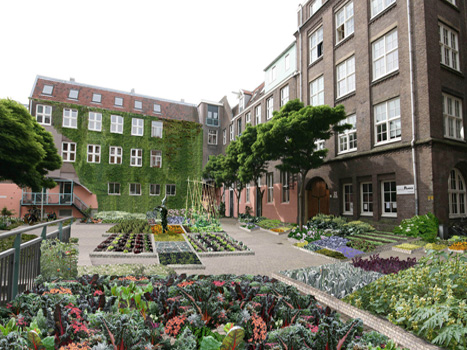
Architecture historian Marinke Steenhuis explains the background of the garden city concept and comments on the design of Tuindorp Vreewijk, the first realisation of this concept in The Netherlands. Garden cities were an enlightened response to the deplorable living conditions of factory workers during the early stages of industrialisation. Workers were supposed to live in well designed but efficiently built houses, in blocks with thoughtfully located backyard gardens and communal green spaces. They were supposed to grow their own vegetables and children could play in public green areas, where once there were meadows and cows on the Isle of Ijsselmonde, at the left bank of the river Maas.   

Prive (moes)tuinen en gemeenschappelijk groen

Het Portaal developed a project, sponsored by building society Com.Wonen, to produce a whole series of videos about the transformation of Vreewijk, a much debated subject as there are widely differing views on how this prachtwijk (beautiful district) of Rotterdam needs to be retrofitted to face the challenges of the 21 first century.

Urban farm providing care for the homeless in Rotterdam

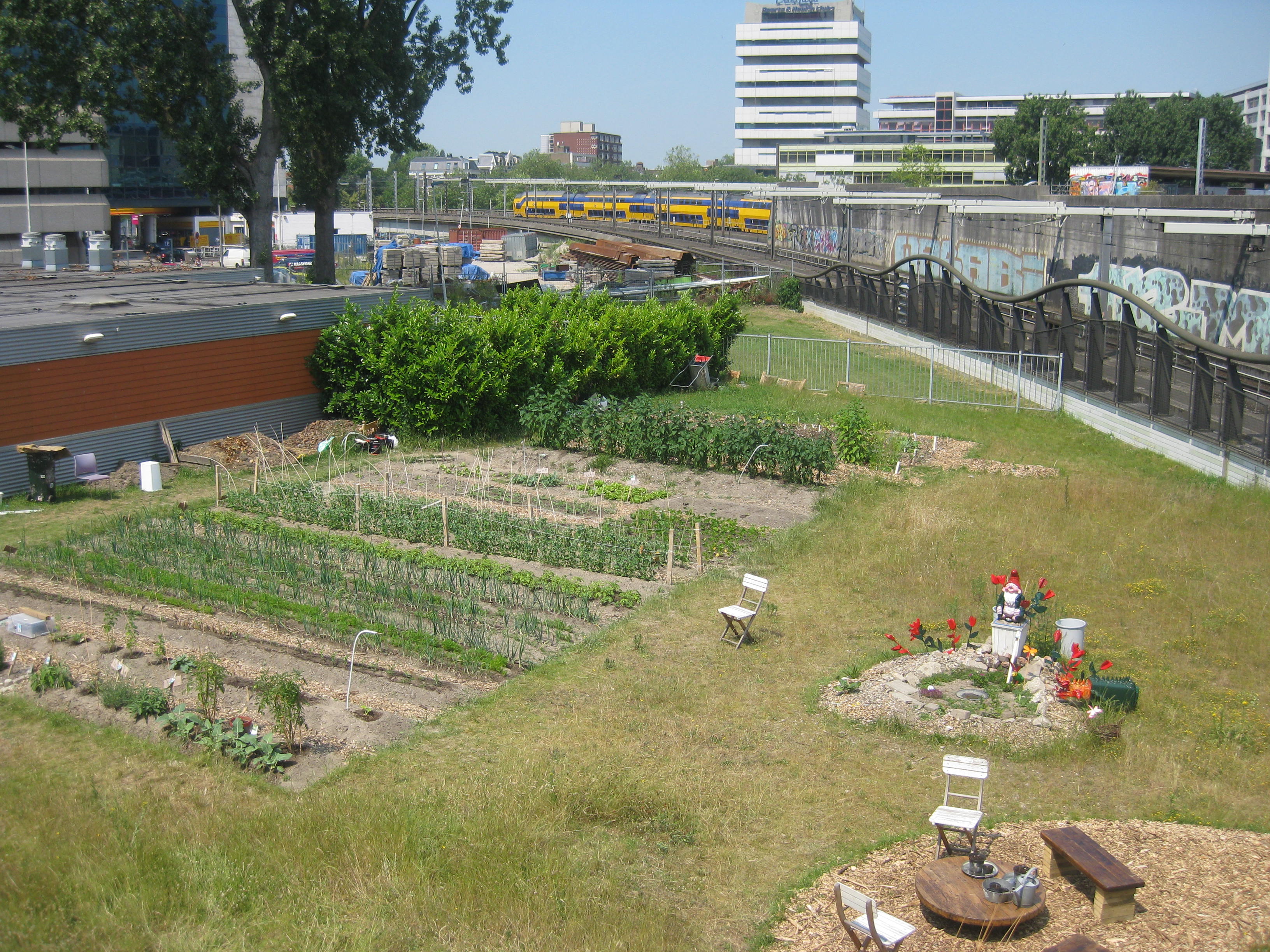
Last week I visited a vegetable and flower garden right in de centre of Rotterdam, on a triangular piece of land squeezed in between the former Shell Head Quarters, the railway going into the tunnel heading South, and the Pompenburg road, flying over the mouth of the railway tunnel towards Hofplein. This garden suddenly appeared on the scene last summer, it is visible from the Pompenburg road and many people passing by wondered what was going on down there.


We had no clue who was running the place, except that Transition Town Rotterdam is apparently involved in its design and operation, and that there is a link with the Nico Adriaans Foundation. But last week I set out to visit this remarkable garden.

It was a freezing cold winter day with snow, but I was assured that there was still some kale and Jerusalem artichoke in the garden. Soon when I got inside the provisional barracks located next to the garden I felt welcome. There was a relaxed atmosphere among the people that were staying there, most of them homeless, some of them with drug problems, I was explained by Jan Blankers, the garden coordinator. Jan works for the Nico Adriaans Foundation, an organisation in Rotterdam providing care and coaching for the homeless. The Foundation is an initiative of the Paulus Church, a church community in down town Rotterdam very dedicated to provide support to homeless people. When the original Paulus Church was removed (in order to make space for new residential development), it was decided to separate the church from the day care of homeless people both organisationally (the Nico Adriaans Foundation was established) as well as geographically (the Paulus church is located at the Mauritskade, the barracks and garden are close to the Hofplein).

Continue reading

PUREFOOD – 12 vacancies for ESRs are open

As mentioned in an earlier post on this weblog, the Rural Sociology Group has been granted the the coordination of a Marie Curie Initial Training Network  entitled ‘Urban, peri-urban and regional food dynamics: toward an integrated and territorial approach to food (PUREFOOD)’ funded by the European Commission’s Seventh Framework PEOPLE program. The objective of PUREFOOD is to train a pool of 12 early-stage researchers (ESRs) in the socio-economic and socio-spatial dynamics of the (peri-)urban and regional foodscape. The PUREFOOD network is centred around food as an integrated and territorial mode of governance and studies the emergence of the (peri-)urban foodscape as an alternative (as opposed to a globalised) geography of food, including the ways in which, and the extent to which, sustainability aspects generally considered to be intrinsic to the alternative food geography are incorporated by the more conventional food companies.

As of now all 12 PUREFOOD research vacancies have been published (or soon will be) by the host universities. For information about the ESR vacancies and application guidelines, you can download the PUREFOOD vacancies leaflet. For more information about the objectives, training and research approach and training program of PUREFOOD you can download the PUREFOOD information pack for prospective ESRs. The deadline for application is 3 January 2011.

Eligibility criteria

The enhancement of transnational mobility to improve career perspectives of early stage researchers is the main goal of the Marie Curie Initial Training funding. To achieve this objective the following eligibility criteria for prospective ESRs have been formulated:

  • You are eligible as an ESR if you are, at the time of recruitment (i) in possession of a university degree, and (ii) have a maximum of four years of full-time research experience, including any period of research training. This is measured from the date when you obtained the degree which formally entitles you to embark on a doctorate, either in the country in which the degree was obtained or in the country in which the research training is provided. Please not that ESRs cannot be PhD holders.
  • You are eligible to the position if, at the time of the selection by the host university, you did not reside or carry out your main activity (work, studies, etc) in the country of the host university for more than 12 months in the 3 years immediately prior to your recruitment.

If you have any questions about a vacancy please contact the contact person mentioned in the vacancy announcement. For general question about PUREFOOD please contact me (han.wiskerke@wur.nl).

Urban Agriculture: Havana as inspiration for the Hague

Yesterday the movie ‘Borders in Our Mind’ about urban agriculture in Havana and the Hague had its premiere at Stroom in the Hague. The documentary was made by artists Annechien Meier and Gaston Wallé. Central theme of Annechien’s work is the communication between people in urban and rural environments. With her installations she tries to rouse people’s curiosity about their interaction with the environment around them. Producing food in the city, is one way of doing this. She departs from the idea that allotment gardens reflect values of a culture in a specific time and place and give possibilities for people to come in touch with each other and the (natural) world around them.

Annechien also started the project ‘Panderplein’ in the Brouwersgracht in the Hague. Here, she built a vegetable garden in cooperation with the inhabitants. Since this summer, the first vegetables have been harvested! It is amazing and wonderful to discover such a green spot in the center of the city, and moreover the project contributes to social cohesion in the neighborhood.

For the film ‘Borders in Our Mind’, Annechien went to Cuba, Havana, to learn more about the possibilities for urban agriculture. Havana has a history of urban agriculture since the 1990s  due to petrol shortages, food shortages and economic crisis. Today more than 50% of Havana’s fresh produce is still grown within the city limits. No wonder Annechien choose this city to visit as inspiration for her work in the Netherlands. In the one-hour- movie many different forms, features and possibilities of urban agriculture pass in review. The result is indeed inspiring for anyone who is engaged in or concerned about food production in urban areas.

PhD position: Knowledge brokerage to promote sustainable food consumption and production

In January 2011 the project ‘FOODLINKS’ (Knowledge brokerage to promote sustainable food consumption and production: linking scientists, policymakers and civil society organizations) will start. This project is funded by the European Commission and will be carried out by a consortium of 14 partners (universities, regional and local governments and civil society organizations) from 9 European countries. The overall project aims at developing and experimenting with new ways of linking research to policy-making in the field of sustainable food consumption and production. FOODLINKS will be coordinated by Prof. Han Wiskerke and Dr. Bettina Bock of the Rural Sociology Group of Wageningen University.

Job description

Within the FOODLINKS project we are looking for a a PhD candidate who is interested in issues of science-society dialogue, science-policy collaboration and social learning in the field of sustainable production and consumption. The PhD candidate will combine the writing of a PhD thesis with hands-on participation in a EC-funded project and contribution to project deliverables. 

Within the overall FOODLINKS project,  the PhD project monitors and evaluates the processes of social learning taking place in three Communities of Practice that are established as part of the project. In these Communities of Practice researchers, policymakers and civil society organization exchange knowledge and experiences and commonly define new research questions in the field of short food supply chains, sustainable public food procurement and urban food strategies. The PhD project will evaluate the knowledge brokerage activities and processes of social learning that are taking place in the Communities of Practice as well as in the project as a whole. 

Requirements

  • A Master degree in sociology, communication science or innovation studies.
  • Knowledge of relevant theoretical concepts in science and technology studies, science-society dialogue and science-policy collaboration, such as boundary work, knowledge brokerage, multi-stakeholder participation and social learning.
  • Knowledge of and experience with monitoring and evaluating processes of (social) learning.
  • Some knowledge of or interest in agro-food research and issues of sustainable food production and consumption. 
  • Good analytical and writing skills.
  • Fluent in English
  • Willing to travel as the project will include frequent meetings within Europe.

 Appointment conditions

A PhD position for a period of 18 months, extended with another 30 months upon favourable evaluation. Gross salary will increase from € 2042 per month in the first year up to € 2612 per month in the last year based on a full-time appointment (38 hours per week). In addition, we offer a holiday bonus of 8% and an end-of-the-year bonus of 8.3% of your annual salary. 

 Additional information

Additional information about the vacancy can be obtained from:

  • Prof. dr. ir J.S.C. Wiskerke, Chair of Rural Sociology, Telephone number: +31 317 482679/4507 and
  • Dr. Ir B.B. Bock, Associate Professor Rural Sociology, Telephone number: +31 317 483275/4507 

Additional information about the FOODLINKS project can obtained through this link. The PhD position is mainly related to Work Packages (WPs) 2, 6 and 7 of FOODLINKS.

Additional information about the organisation can be obtained through one of the following:

Interested? Apply now via www.jobsat.wur.nl before November 8th 2010 (Vacancy number: SSG-RSO-0005).