Thesis Opportunity: Generating Buzz, Making Futures: Enthusiasm and Investment at Food Events

Food events such as Food Tank and Seeds and Chips are becoming important venues for steering the food innovation and food policy agenda. We are interested in gaining a better understanding of the types of innovations, policy agendas, and politics that are articulated and silenced in these spaces.  We seek one or two Msc students who will conduct a stakeholder mapping, event ethnography, and media analysis of these organizations and their events. This research will shed light on the uneasy relationship between finance, innovation, and politics in the food sector, and the role of enthusiasm and celebrity as modes of communication and policy making for more or less just and sustainable food futures.

green pineapple fruit with brown framed sunglasses beside yellow surface

Photo by Lisa Fotios on Pexels.com

Qualifications:           

  • You have some training in qualitative methods and critical social theory
  • You are an interested in celebrity and food politics
  • You are willing to develop new methodologies to analyse digital media and events
  • You are registered for one of the following MSc programmes: MID, MCS, MLP, MFT, or MOA
  • You have completed at least 2 RSO courses (or relevant social science courses)

Questions? Please get in touch!

Supervisors: Oona Morrow (RSO) oona.morrow@wur.nl & Prof. Mike Goodman, University of Reading

Thesis Opportunity: The TEDification of Food Activism

Increasingly TED talks are becoming trusted sources for food politics and policy making, and an important medium for food activists to communicate through. Yet, there are also limits to what can be communicated in a TED talk and how. These limitations affect the types of knowledge and activist performances that are deemed suitable. We would like to understand what TED talks are doing to and for food politics, by conducting a comprehensive analysis of recent TED talks on the theme of FOOD. We are interested in the celebrity, bodily, and visual performances that compose these talks. The effects of these talks on public opinion and policy. And the limitations and possibilities of TED talks as a mode of food activism.

Ted-Talk

Qualifications:           

  • You have some training in qualitative methods and critical social theory
  • You are an interested in digital media and food activism
  • You are willing to develop new methodologies and tools for analysing digital media
  • You are registered for one of the following MSc programmes: MID, MCS, MLP, MFT, or MOA
  • You have completed at least 2 RSO courses (or relevant social science courses)

Questions? Please get in touch!

Supervisors: Oona Morrow (RSO) oona.morrow@wur.nl & Prof. Mike Goodman, University of Reading

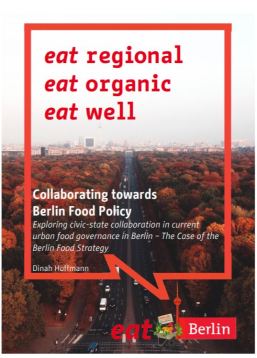
Collaborating towards Berlin Food Policy: Exploring civic-state collaboration in current urban food governance in Berlin – The Case of the Berlin Food Strategy

dinah thesis coverDinah Hoffman, MSc student Communication, Health and Life Sciences
Specialization: Health and Society, Wageningen University

Below please find the abstract of the MSc thesis Collaborating towards Berlin Food Policy: Exploring civic-state collaboration in current urban food governance in Berlin – The Case of the Berlin Food Strategy

The full thesis can be downloaded from the WUR-Library by clicking on the hyperlink


Urban food policy is an area that joins actors from civil society, academia, the local state and the market. To accomplish sustainable changes of local food systems these actors work together in governance arrangements. Two prominent instruments that are used in urban food governance where these actors collaborate are the food policy council and the urban food strategy. Both can be initiated through top-down or bottom-up processes or a combination of both with the relationship of local government and civil society having an impact on the success of the initiatives. One of the cities where civil society and local government engage in collaborative food governance is the city-state of Berlin, the biggest city in Germany, surrounded by the agricultural region of Brandenburg. Drawing on data from 11 interviews and 40 documents, this thesis describes and examines the nature of the relationship and governance arrangement of the two main actors in current Berlin food governance. The collaborative governance framework, a categorization of civic-state relationships found in urban food governance and the concepts of integrated food policy and institutionalization were used to guide the analysis. The objective of this thesis is to understand how civic-state collaboration in urban food governance looks like in Berlin, what impact the local context has on the development of the governance arrangement and what strengths and challenges involved stakeholders perceive. The two main stakeholders were found to be the civic food policy council Ernährungsrat Berlin and the Berlin Senate Administration for Consumer Protection. It was found that the Ernährungsrat Berlin’s food policy activity brought forward a relationship where they are striving for independence but are linked to the government through a secondary agency, being the aforementioned administrative department. Although not embedded in municipal institutions, which has been identified as crucial for a food policy councils’ success, the Ernährungsrat Berlin proved to be an agile and resilient structure able to successfully be an independent advocate for civil society and a valued advisor to the government. Their collaboration resulted in the development of a Berlin Food Strategy. In this thesis I investigate the process of developing this strategy as a form of collaborative governance. Regarding their governance arrangement around the Berlin Food Strategy, the involvement of the Green Party in the current coalition was found to have had a big impact on the position the Ernährungsrat Berlin but also food policy was able to occupy on the urban agenda. This research identified a number of strengths and challenges of the governance arrangement including a strong interdependence, a strong and long history of civic action, the presence of political food champions in the coalition and the administration, the limiting structure and functioning of the Senate administrations and the limited inclusiveness and representatives of the Ernährungsrat Berlin.

Key words: urban food governance, urban food policy, food policy council, urban food strategy, collaborative governance, Berlin food strategy, Ernährungsrat Berlin, Senate of Berlin

Internship Opportunity at Greendish

This is an internship for Dutch speaking students who can make a five month commitment.

Over Greendish

Greendish heeft sinds haar oprichting in 2011 professionals uit de food service industrie geholpen in hun transitie naar gezonde en duurzame menu’s en werkwijzen die goed zijn voor de mens, het bedrijf en onze aarde.


In de food service industrie zien we veel onwetendheid en misverstanden over duurzaamheid en gezond eten; het zou bijvoorbeeld duur, moeilijk en niet lekker zijn. Door de dreiging van klimaatverandering en de stijgende behoefte aan voedsel, kunnen we deze misverstanden niet langer negeren. Als verantwoordelijke professionals, moeten we het heft in eigen handen nemen om de transitie te starten die nodig is voor de toekomst van de sector en van onze planeet. Wij geloven dat juist deze sector-pioniers uiteindelijk boven de rest uit zullen stijgen en over de hele linie het meest succesvol zullen zijn.


Met ons ambitieuze team van voedingsdeskundigen, chefs en gedragswetenschappers werken wij er hard aan te zorgen dat gezond- en duurzaam eten makkelijk, lekker en overal toegankelijk is voor iedereen.


Het project ‘Restaurants van Morgen’

“Gezond voor de consument, duurzaam voor de samenleving en kostenbesparend voor de horecaondernemer! Dat is wat Greendish en Natuur & Milieu met Restaurants van Morgen willen bereiken.”


Over het project

Restaurants van Morgen (afgekort RvM) is een project waarin Greendish samenwerkt met de organisatie Natuur & Milieu. Binnen het project begeleiden we 23 restaurants in de Regio Foodvalley (gemeenten Ede, Nijkerk, Rhenen, Veenendaal en Wageningen) naar een duurzamere toekomst. Het project bestaat uit drie fases: de nulmeting (T0), de begeleiding, en de T1 meting. De nulmeting is afgelopen jaar uitgevoerd. Hierin gingen we bij alle restaurants langs en hielden we een interview met de chefs/eigenaren. Verder onderzochten we onderwerpen zoals de samenstelling van de menukaart, waste en inkoop. Ook de top-5 populairste hoofdgerechten werd volledig doorgemeten. De restaurants zijn inmiddels op de hoogte gebracht van de resultaten. Momenteel zijn wij bezig met de tweede fase van het onderzoek, de begeleiding. Voor deze begeleiding zijn er twee trajecten opgezet, light begeleiding (LB) en intensieve begeleiding (IB). De intensieve begeleiding wordt gegeven aan acht daarvoor uitgekozen restaurants. Voor hen wordt samen met ons een plan op maat gemaakt. De rest van de restaurants krijg light begeleiding, waarmee we op een wat algemener niveau informatie met de restaurants zullen delen over verschillende onderwerpen rondom duurzaamheid. Na afronding van de begeleidingsfase zal er een tweede meting worden uitgevoerd, de T1 meting. Dit is waar jij potentieel je steentje zult gaan bijdragen!


Wat zul je zoal gaan doen?

De meetmethoden voor de T1 metingen hebben we inmiddels ontwikkeld. Jouw bijdrage aan de T1 meting zal onder andere bestaan uit:

  • Het inplannen van afspraken
  • Langsgaan op locaties met Greendish medewerkers
  • Interviews houden of aantekeningen nemen (kwalitatief onderzoek)
  • Wegingen doen van gerechten in de restaurants, vergelijkbaar aan de T0 meting (kwantitatief onderzoek)
  • Het effect laten zien van de interventie op hoeveelheden, bereiding, inkoopbeleid en meer
  • Analyse van de resultaten en het verschil tussen T0 en T1
  • De resultaten visualiseren aan de hand van een presentatie
  • Adviezen samenstellen voor restaurants


Overige werkzaamheden

Werken bij Greendish is erg divers, en in overleg kunnen er dus zomaar andere leuke taken bijkomen waarmee jij een inkijk krijgt in de dagelijkse werkzaamheden van onze stichting!


Wat verwachten wij van jou?

Greendish bestaat uit een klein team, waar we onderling leuk met elkaar omgaan. Zo lunchen we gezamenlijk en organiseren we maandelijks een borrel of andere activiteit. We zijn open en informeel en bieden veel ruimte voor eigen inbreng. Zowel het werken in teamverband als zelfstandig kunnen werken is belangrijk. Een stage bij Greendish is uitdagend maar leerzaam en op het grensgebied tussen Wetenschap en praktijk.


Wil je impact maken en bijdrage aan verandering in de samenleving waarbij miljoenen eetmomenten van consumenten onderweg op stations, luchthavens, in restaurants en tijdens de lunch op kantoor gezonder en duurzamer worden, dan bij je bij ons aan het juiste adres!
Meld je aan via https://greendish.org/nl/internship-position-nl/


Contactpersoon: rose.korte@greendish.org


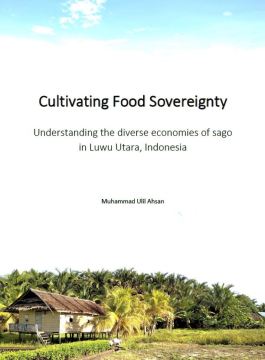
Cultivating Food Sovereignty: Understanding the diverse economies of sago in Luwu Utara, Indonesia

title pg ulilMuhammad Ulil Ahsan, MSc Student Development and Rural Innovation, Wageningen University


Below the abstract of the MSc-thesis “Cultivating Food Sovereignty: Understanding the diverse economies of sago in Luwu Utara, Indonesia“.


The full thesis can be downloaded from the WUR-Library by clicking on the hyperlink


Indonesia has taken up food sovereignty in the constitutional document Food Act number 18/2018 that animates the food policy and program implementation in Indonesia. However, it remains largely rhetorical since the food program implementation has undermined the local food system in many places. This study explores the implementation of food sovereignty in Luwu Utara that is predicated with productionist paradigm, where self-sufficiency is the main goal and transnational corporation are involved in the process of enactment. The implementation put pressure on the local food system in Luwu Utara, particularly in relation to sago. The sago food system encompasses complex issues ranging from the relationship between people in the system to their relation with sago. The diverse economy framework is applied to unravel the diverse forms of economies that lie within the sago food system, and to legitimate the value of food sovereignty existing in Luwu Utara. Diverse economies of sago in Luwu Utara are dominated by non-capitalist practices that can challenge the dominant discourse of capitalist economy as food sovereignty against for. The different forms of food sovereignty at different scales necessitates reflection on food sovereignty implementation. Cultivating food sovereignty requires reflexivity, creating the basis of food sovereignty and building recognition are the strategies to develop a multi-scalar sovereignty. Administering multi-scalar sovereignty is a challenge that must be overcome in the development of a democratic food system in Indonesia.

Keywords: Food sovereignty, diverse economies, sago, Luwu Utara