Herinnering Discussiebijeenkomst Buitenlandse Ervaringen Multifunctionele Landbouw

Op donderdag 8 oktober 2009 organiseert de vakgroep Rurale Sociologie van Wageningen Universiteit een interessante discussiebijeenkomst over buitenlandse ervaringen van multifunctionele landbouw. Wat gebeurt er in het buitenland en wat kunnen we ervan leren?

Op de bijeenkomst geven een aantal toonaangevende internationale onderzoekers u een indruk van de ontwikkeling rond multifunctionele landbouw in Italië, het Verenigd Koninkrijk en Noorwegen. In de aansluitende forumdiscussie gaan we hierover met elkaar in debat. We verwachten ongeveer 80 tot 100 mensen uit o.a. praktijk, wetenschap, overheid en belangenbehartiging.

De bijeenkomst is interessant voor iedereen actief op het gebied van multifunctionele landbouw en meer wil weten over de betekenis van buitenlandse ervaringen voor Nederland. Als u graag over (uw) grenzen heen kijkt, dan mag u deze bijeenkomst niet missen!


Datum: Donderdag 8 oktober 2009
Tijd: 13.00 – 17.00 uur
Locatie: Landgoed Heerlijkheid Mariënwaerdt, De Hooge Schuur, ‘t Klooster 5 in Beesd


Aan deelname van deze bijeenkomst zijn geen kosten verbonden, de voertaal is Engels.


Programma

12.30 Ontvangst (koffie/thee)

13.00 Opening door dagvoorzitter

Krijn Poppe – Chief Science Officer Agroketens en Visserij, ministerie van LNV

13.05 Welkomstwoord

Frans van Verschuer – eigenaar Landgoed Heerlijkheid Mariënwaerdt, Beesd

13.15 Dynamiek en robuustheid multifunctionele landbouw – introductie onderzoeksproject en presentatie eerste resultaten

Han Wiskerke – projectcoördinator en hoogleraar Rurale Sociologie, Wageningen Universiteit

13.30 Multifunctionele landbouw in Italië – de ‘rural disctrict approach’ in Toscane

Gianluca Brunori – hoogleraar Agrarische Economie, Universiteit van Pisa, Italië

14.00 Multifunctionele landbouw in het Verenigd Koninkrijk – de rol van de staat en de publieke sector

Roberta Sonnino – universitair docent Milieubeleid, Universiteit van Cardiff, Verenigd Koninkrijk

14.30 Multifunctionele landbouw in Noorwegen – een presentatie door:

Katrina Rønningen – senior onderzoeker, Centrum voor Plattelandsonderzoek, Universiteit van Trondheim, Noorwegen (uitgenodigd)

15.00 Pauze

15.30 Dynamiek van plattelandsontwikkeling en landbouw wereldwijd – een vergelijking tussen Europa, China en Brazilië

Jan Douwe van der Ploeg – hoogleraar Transitiestudies, Wageningen Universiteit

16.00 Forumdiscussie – inspirerende lessen voor multifunctionele landbouw in Nederland

16.55 Afsluiting door dagvoorzitter

17.00 Borrel


Aanmelden

Meld u aan met het aanmeldformulier. Wij willen u er op wijzen dat er een beperkt aantal deelnameplaatsen beschikbaar zijn. Voor aanvullende informatie neem contact op met Corine Diepeveen via corine.diepeveen@wur.nl of 0317 – 484507.

De discussiemiddag wordt georganiseerd in het kader van het onlangs gestarte onderzoeksproject ‘Dynamiek en Robuustheid van Multifunctionele Landbouw’. Het onderzoek is ondersteunend aan de Taskforce Multifunctionele Landbouw en wordt gefinancierd door het ministerie van LNV.

Jan Schakel in China – part two

The IMRD-students, who are visiting China to do their case study, just finished their fieldwork in the Bamudi-village in the Yanqing County, North of Beijing. After three weeks of lectures, fieldtrips and surveys, they now will write the final report in the last week of their stay in China. The report will cover the findings from interviews, visits and meeting with farmers, village leaders, shop keepers and other households in the Bamudi-village (Beijing) and Quaoli village (Nanjing).

Part of the methodology of the PRA (Participatory Rapid Appraisal) is to provide a ‘Community Development Program’ and to present and discuss this plan with local inhabitants in the Village Hall to have feedback from the farmers and others involved. It will be a thrilling event, because the situation is rather complex; also in this area, not too far from Beijing.

Industrialization in China started before urbanization (heavy industry in the sixties in the middle and Northeast of China), but in recent decades urbanization is really skyrocketing: from 10% in 1949 and still only 18% in 1979 to almost up to 50% in 2007! Actually, just some month ago, there were –for the first time in their long history- more people living in the cities then in the rural areas! Although the number of ‘the poor’ (which was for a long time synonymous with ‘the rural’) decreased from 250 million in 1978 to less then 15 million in 2007, the rural area still faces tremendous problems. The unique rural-urban migration in China (young labour left to the cities) resulted in disorganization of rural communities and the erosion or even loss of cultural identity, values and the ability of collective action, as well as issues of elites that are leaving, while vulnerable groups are ‘left-behind’.

Box 1: ‘Poor, so rural….’

One of the farmers we visited (see picture) lives in a remote area, just outside Bamudi-village. The farmer is suffering high blood pressure for many years, and his wife (both in their sixties) is illiterate. They own their house (built in 1962) and rent 3,5 mu of land (0,2 ha.), growing mostly corn, fruit and some vegetables. Last year they earned 2000 Yan (200 Euro) by selling apricot to the market, but this year there is hardly any harvest at all, due to the chilly spring. Opposite to other rural families, they don’t have remittances from family members who work in the city (migrant workers), so the family income is only 5000-6000 Yan (or RMB) a year (around 550 Euro), which is really low, even to Chinese standards. As part of  the new pro-farming-policies, the household will have some extra income, like social security and minimum living standard subsidies, compensation for environmental protection schemes, alleviation of agri-tax and subsidies for certain products (mainly grain). The liveability of the community and the households will also be improved by measures of the New Countryside Construction Program; see box 2).

Village farmer

The situation in Bamudi-village is really complex, because a new phenomena – besides the traditional rural-urban-migration processes- is occurring in the region: the urban-rural-migration, which expresses the rediscovery of the rural area by the urban, and a new relation between the city and the countryside. During all the interviews in the village, it became clear that neither the central, nor the provincial government, and neither the county or the village leaders knew how to handle this new phenomena. There are no rules, nor policies and regulations, and the traditional land tenure system doesn’t fit to tackle this new migration process. One of the conclusions, drawn by the students after doing their surveys, is that there is hardly any future in this part of China, if they follow the traditional route or path of development. The growing conditions in this mountainous area very bad, and together with the lack of skilled labour and motivated young people, it rural life is very hard and it will imply the end of agriculture around the municipality of Beijing. Only mostly elderly people will stay in the village, while the rest of the family moves out to the cities. But due to polices (among others) from the NCCP (see box 2), like reafforistication and environmental protection, there might be new sources of income be created. That Bamudi village will be Beijing’s  ‘back garden’ in the near future, implies definitely the final end of a long agricultural tradition, but it will also give the area the opportunity to (re-)develop again in a more modern and more successful way.

We are looking forward to listen and learn what the local villagers will think about the analyses the students have made and the findings that will be presented and discussed tonight; we’re all looking forward to their comments and opinions. And hope that indeed it will be a thrilling night!

Box 2: New Countryside Construction Program (NCCP)

In 2006 the Chinese government launched a new plan to restore the balance and the inequity between the rural and the urban. Part of it will be the NCCP. Background of the NCCP is the rapid industrialization and urbanization, which widened the gap between urban and rural, and forced the state to support farmers and pay more attention to resource and environmental protection. Part of it will be an urbanization strategy: no allowing for most farmers to go to towns, but stay in the villages. To improve the living conditions in these villages, several measures were undertaken, like: promoting agriculture production, e.g. agricultural industrialization infrastructural development like roads, drinking water, street lights employing farmers tot protect non-governmental forests, waters, roads and environment providing public goods: medical, rural education, energy, communication and so on increasing farmers income by subsidies, human resource development, providing help to the poor (among others).

Jan Schakel, Bamudi-Village

Jan Schakel in China – part one

A group of IMRD-students from different European countries is visiting China this month, doing a case study for their International Master in Rural Development. The first part took place in Nanjing in the Jiangsu Province (200 miles west of Shanghai), where the Nanjing Agriculture University hosted the students for two weeks. Besides lectures by professors from the NAU (who actually knew Wageningen University very well, because most of them did their MSc and/or PhD at the WU!), fieldwork was done in two villages in the rural area south of Nanjing. Together with 25 Chinese undergraduate students from all over China (doing a summer school at the NAU), different households were visited and many farmers (mostly female: so called ‘left-behind-woman’, who’s husbands are migrant workers in the big cities) were interviewed. All information gathered by both European and Chinese students was presented at the university and put together in a final report (soon available on the IMRD-website).

Official group photo

More or less the same program is organized by the Chinese Agriculture University in Beijing (ranked nr. 1’s Agriculture University of China), who is responsible for the second half of the IMRD case study. The COHD (College of Humanities and Development) is hosting us, and also the COHD is a leading centre of excellence on rural development within and outside China. Among others, the COHD is monitoring, analysing and evaluating the new ‘Pro-Farmers-Policies’, as well as the New Countryside Construction Programme (2006). These new policies, programs and measures should tackle the ‘dualism’ between the rural and the urban; a very serious problem threatening China stability as a whole and the future of China’s rural areas more particularly. Part of the New Countryside Construction Program is the Village Development Program (VDP, also from 2006), which will also monitored, steered and evaluated by the COHD.

The IMRD students is given the opportunity to have a closer look at the VDP in an area 2 hours north of Beijing. Fieldwork will be done in 5 days through the use of the PRA-methodology (Participatory Rapid Appraisal) in the Bamudi village in the Yanqing county. With a group of 5 Chinese master students and their professors, farmers, village leaders and others in Bamudi-village will be interviewed and observed by means of several participatory methods.

So far this Case study is really impressive – in all kinds of ways. But: not only me, but also the IMRD-students are getting tired. It’s summertime in China, and in Nanjing (with over 8 million people) and Beijing (almost over 18 million inhabitants) it is 3xH: Hot (over 35 Degrees Celsius), Hazy and Humid, and it’s crowded everywhere. So tomorrow we will leave the city and go to the mountains, where it’s a little bit cooler (although you don’t feel the difference anymore between 38 and 34 degrees). The bad news however is that the mosquito’s are waiting for us, and that there is no internet, no air-conditioning, no shower, no shop, no restaurant nor anything in Bamudi; so it’s going to be a week really ‘doing fielwork’ , and the forthcoming days no more news on our weblog!

By the way: also in Beijing I noticed that Wageningen is rather well-known. Everybody still speaks about professor ‘Jan Douwe’ (they call me ‘prof. Jan’), who visited BAU over a month ago, and who must has done a really great and impressive job, because everyone asks me about him. However, not everyone is really pleased with him; I met a member of the COHD who is (among others) translating Jan Douwe van der Ploeg’s most recently book ‘The New Peasantries’ into Chinese, and it seems to be a ‘hell of a job’. But when it is finished -and that will be within a short period- this book will also be available to at least 1.300.000.000 Chinese people, so well done Jan Douwe!

Jan Schakel, Beijing 2009-08-01

Discussiebijeenkomst multifunctionele landbouw: ervaringen uit het buitenland

Op donderdag 8 oktober 2009 organiseert de vakgroep Rurale Sociologie van Wageningen Universiteit een interessante discussiebijeenkomst over buitenlandse ervaringen van multifunctionele landbouw. Wat gebeurt er in het buitenland en wat kunnen we ervan leren?


Op de bijeenkomst geven een aantal toonaangevende internationale onderzoekers u een indruk van de ontwikkeling rond multifunctionele landbouw in Italië, het Verenigd Koninkrijk en Noorwegen. In de aansluitende forumdiscussie gaan we hierover met elkaar in debat. We verwachten ongeveer 80 tot 100 mensen uit o.a. praktijk, wetenschap, overheid en belangenbehartiging.

De bijeenkomst is interessant voor iedereen actief op het gebied van multifunctionele landbouw en meer wil weten over de betekenis van buitenlandse ervaringen voor Nederland. Als u graag over (uw) grenzen heen kijkt, dan mag u deze bijeenkomst niet missen!


Datum: Donderdag 8 oktober 2009
Tijd: 13.00 – 17.00 uur
Locatie: Landgoed Heerlijkheid Mariënwaerdt, De Hooge Schuur, ‘t Klooster 5 in Beesd


Aan deelname van deze bijeenkomst zijn geen kosten verbonden, de voertaal is Engels.


Programma

12.30 Ontvangst (koffie/thee)

13.00 Opening door dagvoorzitter

Krijn Poppe – Chief Science Officer Agroketens en Visserij, ministerie van LNV

13.05 Welkomstwoord

Frans van Verschuer – eigenaar Landgoed Heerlijkheid Mariënwaerdt, Beesd

13.15 Dynamiek en robuustheid multifunctionele landbouw – introductie onderzoeksproject en presentatie eerste resultaten

Han Wiskerke – projectcoördinator en hoogleraar Rurale Sociologie, Wageningen Universiteit

13.30 Multifunctionele landbouw in Italië – de ‘rural disctrict approach’ in Toscane

Gianluca Brunori – hoogleraar Agrarische Economie, Universiteit van Pisa, Italië

14.00 Multifunctionele landbouw in het Verenigd Koninkrijk – de rol van de staat en de publieke sector

Roberta Sonnino – universitair docent Milieubeleid, Universiteit van Cardiff, Verenigd Koninkrijk

14.30 Multifunctionele landbouw in Noorwegen – een presentatie door:

Katrina Rønningen – senior onderzoeker, Centrum voor Plattelandsonderzoek, Universiteit van Trondheim, Noorwegen (uitgenodigd)

15.00 Pauze

15.30 Dynamiek van plattelandsontwikkeling en landbouw wereldwijd – een vergelijking tussen Europa, China en Brazilië

Jan Douwe van der Ploeg – hoogleraar Transitiestudies, Wageningen Universiteit

16.00 Forumdiscussie – inspirerende lessen voor multifunctionele landbouw in Nederland

16.55 Afsluiting door dagvoorzitter

17.00 Borrel


Aanmelden

Meld u aan met het aanmeldformulier. Wij willen u er op wijzen dat er een beperkt aantal deelnameplaatsen beschikbaar zijn. Voor aanvullende informatie neem contact op met Corine Diepeveen via corine.diepeveen@wur.nl of 0317 – 484507.

De discussiemiddag wordt georganiseerd in het kader van het onlangs gestarte onderzoeksproject ‘Dynamiek en Robuustheid van Multifunctionele Landbouw’. Het onderzoek is ondersteunend aan de Taskforce Multifunctionele Landbouw en wordt gefinancierd door het ministerie van LNV.
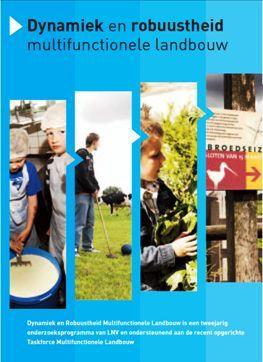
Folder Onderzoek Dynamiek en Robuustheid Multifunctionele Landbouw

Voorkant folderOnlangs hebben we een mooie informatiefolder gemaakt voor ons onderzoek ‘Dynamiek en Robuustheid van Multifunctionele Landbouw’. In deze folder is, naast een beknopt overzicht van de onderzoeksfasen, ook informatie te vinden over o.a. de achtergronden, doelstellingen, resultaten en partners van het project.

De folder is hier te downloaden.

Overige informatie is te vinden op ons ‘Multifunctionele Landbouw Weblog’. Op deze plek houden we u op de hoogte over de recentste ontwikkelingen en resultaten van het project.