Unknown's avatar

About Han Wiskerke

Chair and Professor of Rural Sociology at Wageningen University (The Netherlands) Research domains: rural development, multifunctional agriculture, city-region food systems

The Food and Farming Transition: Toward a Post Carbon Food System

More and more scientists are pointing to the fact that the end of the cheap oil era will require us to fundamentally change the prevailing current food and agricultural system; a system that has become addicted to and dependent on fossil fuels. This week I came across a report entitled “The Food and Farming Transition: Toward a Post Carbon Food System” published by the Post Carbon Institute earlier this year.  Although the report focuses on the United States, its contents applies to many other parts of the world as well. In this well accessible and readable report the authors not only point to the key vulnerabilities of a food system resting on an unstable foundation of massive fossil fuel inputs but also to the seeds of transition toward a post carbon food system:

The seeds of the new food system have already been planted. America’s farmers have been reducing their energy use for decades. They are using less fertilizer and pesticide. The number of organic farms, farmers’ markets, and CSA operations is growing rapidly. More people are thinking about where their food comes from.

These are important building blocks, but much remains to be done. Our new food system will require more farmers, smaller and more diversified farms, less processed and packaged food, and less long-distance hauling of food. Governments, communities, businesses, and families each have important parts to play in reinventing a food system that functions with limited renewable energy resources to feed our population for the long term.

Food, agriculture and cities

Recently the Food and Agricultural Organisation (FAO) has published a brochure and briefing note about food and agriculture in and around cities. Like many international public bodies, national governments and NGOs the FAO is concerned about the social, economic, ecological and health consequences of the concentration of the world’s population in and around large cities. In the brochure the FAO states that there is an urgent need to invest in urban food programmes: 

The 4th World Urban Forum cited the need for policies and interventions to ensure that the increasing number of urban poor do not get left behind. The food dimension of poverty in urban areas still has not been translated into sufficient policy action in many countries. Rural-urban linkages will become increasingly important. Urban policies also need to acknowledge the role of urban and peri-urban agriculture in urban development, ensure urban food supply and strengthen livelihoods of poor urban producers. This includes removing barriers and providing incentives for urban and peri-urban agriculture (UPA) as well as improving natural resource management in urban and peri-urban areas. … A paradigm shift in both urban and agriculture development, planning and policy formulation is required in order to ensure access to urban food security, improved environmental management and enhanced rural-urban linkages.

In order to broaden the approaches and to gather new insights for cities both of developing, intermediate or developed countries,  the FAO’s Global Forum on Food Security and Nutrition (FSN Forum) has opened a debate which is, in terms of contributing to the debate, only open for FSN forum members. However, everyone can read contributions to the debate. Furthermore, for those interested in this topic, I can highly recommend the website of the FAO’s Food for the Cities Initiative. It contains a lot of interesting fact sheets and publications about the multiple aspects related to food, agriculture and cities.

Stadslandbouw in perspectief – Tilburg als voorbeeld

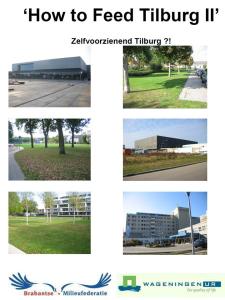
Cover Zelfvoorzienend TilburgEen groep studenten van Wageningen Universiteit heeft in opdracht van de Brabantse Milieufederatie een kort onderzoek uitgevoerd naar de mogelijkheden om het aantal voedselkilometers in de gemeente Tilburg te reduceren. Dit onderzoek is een vervolg op een eerdere verkenning van een andere groep Wageningse studenten naar voedselconsumptie in Tilburg, waarover ik op 24 april een blog schreef. De effecten van het toepassen van volkstuinen in de gemeente en de huidige voedselconsumptie van inwoners zijn hierin onderzocht. De afgelopen weken heb ik deze groep begeleid. Het rapport dat zij hebben gemaakt n.a.v. hun onderzoek is via deze link te downloaden. De belangrijkste uitkomsten van hun onderzoek zijn samengevat in de vorm van een persbericht:

Duizenden inwoners van de gemeente Tilburg kunnen worden voorzien in de jaarlijkse behoefte aan groenten en fruit door het aanleggen van volkstuinen in verschillende woonwijken. Door grasvelden rondom flatgebouwen en andere gebouwen te gebruiken als volkstuin zijn de bewoners in staat, dichtbij huis hun eigen (biologische) voedsel te verbouwen.

Voedselkilometers, het aantal kilometers afgelegd door voedsel, zijn in de gemeente Tilburg onnodig hoog. Aardappelen, appels, tomaten en melk worden buiten de grenzen van de gemeente gehaald. De CO2 uitstoot van het geconsumeerde voedsel is derhalve zeer groot. Door een tekort aan land- en tuinbouwgrond in de gemeente Tilburg is het echter niet mogelijk om in de toekomst in de gehele consumptie van de bewoners van de gemeente Tilburg te voorzien. Het vergroten van de mate van zelfvoorziening door een aanpassing van de benutting van de land- en tuinbouwgrond en het uitgeven van extra grond voor de verbouwing van aardappelen, groente en fruit, verkleint de CO2 uitstoot aanzienlijk.

 “Urban agriculture”, het verbouwen van aardappelen, groente en fruit binnen de grenzen van de stedelijke omgeving kan toegepast worden voor het verminderen van het tekort aan land- en tuinbouwgrond. De gemeente Tilburg beschikt binnen de stad over een groot aantal hectare grond geschikt voor de verbouwing van aardappelen, groente en fruit op volkstuinen.

Grasvelden en platte daken in woonwijken kunnen worden toegepast voor de verbouwing van aardappelen, groente en fruit. Buurtbewoners zijn hierdoor in staat om lokaal verbouwde producten te consumeren en de CO2 uitstoot aanzienlijk te verminderen. In totaal kunnen ruim 5100 bewoners jaarlijks worden voorzien in de voedselconsumptie van aardappelen, groente en fruit door het toepassen volkstuinen in woonwijken. Dit is meer dan zes keer de stadsschouwburg Tilburg vol.

Foodprint Sitopia

Foodprint logoOn Monday 3 November Stroom Den Haag (an independent centre focusing on the urban environment from the visual arts, architecture, urban planning and design) organized a small workshop as part of its program entitled ‘Foodprint – food for the city”. Foodprint takes place over the course of several years and focuses on the influence food can have on the culture, shape and functioning of the city, using The Hague as a case study. With a series of activities Stroom aims to increase people’s awareness of the value of food and to give new life to the way we view the relationship between food and the city.

The Hungry CityThe Foodprint program commenced on 25 March 2009 with a lecture by Carolyn Steel, author of the book “The Hungry City: How Food Shapes Our Lives“. In this book she gives a beautiful account of the role of food in shaping urban development. In a nutshell she shows that the size and shape of cities were directly related to the amount and kinds of food that the rural hinterland could provide. For a long time this implied that there was a food provision related barrier to urban growth. However, with the introduction of modern production, transportation, processing, preservation and storage technologies, global agriculture became the city’s hinterland and thus the ‘natural barrier’ to urban growth disappeared. According to Carolyn Steel on her blog:

“One important consequence of this was that urban authorities began to loosen their grip on the food supply, relying more and more on commercial companies to feed the urban population. That might have seemed a good idea at the time, but the result today is that we are totally reliant on trans-national corporations to feed us, who have no civic responsibility and no interests at heart other than making money. That puts them in an extremely powerful position – especially when you consider how difficult it is to feed cities as large as those we now live in.”

Carolyn Steel shows, like others have done as well from complementary and partly overlapping perspectives (e.g. Tim Lang, Michael Pollan, James Howard Kunstler), that most contemporary urban dwellers have become disconnected from and ignorant about food provision and are too a large extent, if not completely, dependent on a global industrialized food provisioning system that is intrinsically unsustainable.

The Hungry City ends with a chapter about the future, in which the author asks how we can use food as a tool for re-thinking cities and the way we live in them. For this, she introduces the term Sitopia (a word based on a combination of the Greek words Sitos, meaning food, and Topos, meaning place, hence food-place):

“The world is already shaped by food, so we may as well start using food to shape the world more positively.”

At the workshop we (i.e. Carolyn Steel, people working at Stroom Den Haag, scientists of different universities, architects, etc…) mainly discussed ideas and exchanged information about ongoing activities that are in one way or the other related to the notion of Sitopia. For me it was very interesting to exchange visions and experiences with disciplines (in particular visual arts and architecture) I normally do not interact with in education or research. And there was a shared desire to find ways to really collaborate, for instance by participating in each other’s projects. Although no concrete future plans were made, I do believe that workshops like this as well as the sustainable food planning conference I organized a month ago are the seeds of new interdisciplinary networks focusing on sustainable urban/regional foodscapes.

To learn more about Carolyn Steel’s vision on food and the city, I highly recommend her recent talk at the TED conference in Oxford.

Sustainable Food Planning Conference

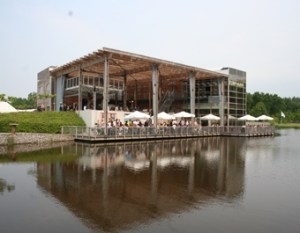
De KemphaanIn her recent blog, Petra already reflected on the Sustainable Food Planning Conference that was held in Almere (at De Kemphaan) on 9 and 10 October. My personal impression is that it was a very successful kick-off of the AESOP thematic group on sustainable food planning. In addition to lots of interesting presentations, there were interesting discussions and the strong will and desire among the participants to continue collaboration. One of the ways to continue collaboration is by means of an annual conference. Another is to create an electronic platform to facilitate exchange of experiences, examples, articles, reports, etc… Soon we will launch such a platform by means of a weblog similar to this one. For the time being, this post provides the links to the dowloads of the presentations and the discussion.

De Kemphaan, 9 and 10 October 2009, Almere, The Netherlands

The program
The participants
Presentation 1 Mr. Henk Mulder Including food and agriculture in urban planning: The Almere approach
Presentation 2 Prof. Han Wiskerke An integrated and territorial perspective on food studies, policy and planning
Presentation 3 Mr. Henk de Zeeuw Feeding the city: Practices, challenges and lessons from developing countries
Presentation 4 Prof. Gianluca Brunori Reconnecting consumers and producers: Dynamics, diversity and potentials of alternative food networks
Presentation 5 Dr Roberta Sonnino Urban food and public spaces: Planning for security and sustainability
Presentation 6 Dr Marin Caraher Food and the city: The links between food, public health and sustainable urban development
Presentation 7 Mrs. Lenie Dwarshuis Food and agriculture in Europe’s peri-urban regions
Presentation 8 Dr. Nevin Cohen The practice of food planning in New York City
Presentation 9 Mr. Bart Pijnenburg, MSc Amsterdam’s food strategy (“Proeftuin Amsterdam”)
Presentation 10 Prof. Jerry Kaufman Including food in planning studies and planning practices: Experiences from the USA
Report of the discussion