Dawn Cheong is PhD-candidate at the Rural Sociology Group (dawn.cheong@wur.nl) . Her first paper has just been published open access in ‘Agriculture and Human Values‘: Cheong, D.D., Bock, B. & Roep, D. (2023) Unpacking gender mainstreaming: a critical discourse analysis of agricultural and rural development policy in Myanmar and Nepal https://doi.org/10.1007/s10460-023-10502-x.
Abstract Conventional gender analysis of development policy does not adequately explain the slow progress towards gender equality. Our research analyses the gender discourses embedded in agricultural and rural development policies in Myanmar and Nepal. We find that both countries focus on increasing women’s participation in development activities as a core gender equality policy objective. This creates a binary categorisation of participating versus non-participating women and identifies women as responsible for improving their position. At the same time, gender (in)equality is defined exclusively as a women’s concern. Such discourses, as constitutive practices, produce specific knowledge about rural women and new subjectivities that prescribe and govern them solely as subjects of development. Our research suggests that such a limited discursive practice invisiblises gendered power relations and structural and institutional issues, ultimately slowing progress towards gender equality. We demonstrate the importance of studying policy as discourse, beyond the effectiveness of policies or mainstreaming tools, and call for empirical evidence on the impact of these discourses on women’s subjectivities and lived experiences.
The issue of gender and agriculture has been on the research agendas of civil society organisations, governments, and academia since the 1970s. Starting from the role of women in agriculture, research has mainly focused on the gendered division of work and the normative constitution of the farm as masculine. Although the gendered division of work has been questioned, the idea of binary gender has mostly been taken as a given. This explorative research shifts the attention from the production of (traditional) gender roles to the making and unmaking of binary gender. An ethnographic study of four farms in Switzerland is drawn on to explore queer farming practices and investigate how queer farmers navigate gender normativity and what this tells us about gender in agriculture more broadly. After considering the mechanisms through which queer farmers are discouraged from farming as a livelihood on the basis of their sex, gender or sexuality, this article argues that queer farmers de- and re-construct gender and farming identities differently, which has research and policy implications for a more diverse and resilient rurality.
Els Hegger is a farmer and researcher working with RSO on the SWIFT project. In this post, she reflects on the role of women in dominant agricultural debates and her own experiences at the SWIFT project kick-off meeting.
Els writes:
Because of the Brazilians (representing the MST movement), I realised what is going on and how -maybe- there is an alternative. When reading this project proposal I was both very interested and at the same time, I thought: “Didn’t we have this whole feminine thing, is this really necessary? Aren’t women in the Netherlands already empowered? Is this discussion about inclusion, LHBTIQ+ etc., really necessary?” I didn’t raise these questions out of resistance but because I didn’t see it. For me, women have the same opportunities as men. At least… I thought so.
However… women are absent in their fullness. We participate under certain set conditions, set by a white male capitalist-dominated history. It is so entrenched that I guess we don’t fully realize this.
Look at the main agricultural stage in the Netherlands. Yes, we now have Caroline v/d Plas, but is that a female representation? As a farmer, as a woman, as an Agroecological entrepreneur, I don’t feel represented. It’s not my arena. The method, the sound, the non-verbal language. We withdraw because we don’t feel at ease, we don’t feel home. Lethargy kicks in.
So, we need to create our home where we feel at home. Which language fits this? Which stories resonate? Is it singing, dancing, mystica, poems, histories…? Only if we re-create and co-create these, we can connect and only then we can enter the political arena. It’s rather obvious, but at the same time it is so interwoven with everything that we stop realising, it settles in the subconscious.
Within Toekomstboeren we’ve had quite some discussions about exactly this (although not specified through women) as I nearly withdrew from Toekomstboeren. I said I didn’t feel comfortable with the way we enter politics. For me, agroecology (AE) is so different from the dominant narrative that I cannot lobby in a traditional way, being drawn to the tables and tell what we need.
It is not my language and then we are tempted to withdraw. That’s why women are invisible. AE is a way of life, not a job you hold. It is running through my veins, it’s in every cell and bone. AE is not about ecologic farming, the word logic is not fitting. It’s beyond any rationale in a traditional sense; it is like the rhizomes of Deleuze and Guattari. Mapping these could be an interesting insight.
Then there are the Brazilians (and there are more examples), who have developed their own language in a broad sense. They are able to mobilise an energy that truly connects: it is not only hierarchical, vertical talkative way of getting what you want. It is more horizontally moving, feeling as part of something not being united because you’re against something. This Brazilian way of mobilizing creates a togetherness that gives power to act. On a physical level, I feel backed, not such a naked back.
Obviously, this is a language beyond words. It is an all-encompassing language. A body language as much as a nature-language. It knows no race, ethnic origin, colour, male-female, it just is. You could say it is a feminine energy that complements the very overly present male energy. But.. is that correct? Or do we need to redefine? Is it a scale that is round, the edges are stretched so much that the ends are the beginning again? One of the Brazilians said: “Dare to acknowledge the woman inside you.” That goes for everyone, not only women. Vertical and horizontal.
Could you say that we need to tilt this structure of power?
The extremes are voiced, but the big middle group is searching. Is it a Western thing, a capitalistic view on male/female? Power? I think of Indonesia where I saw much more softness with men and at the same time a pride and dignity with both men and women. Equal in a very different sense. How does this result in voicing?
To come back to the beginning: changing the narrative. Which stories do we want to tell, to share, to connect to and built upon? We need to reframe, reconstruct and reclaim the words farmer, farming and food production. Stop talking about nature, start being it. Stop trying to fit in. Empower ourselves through language (including non-verbal language). Which future do we want to live now?
—
Els Hegger runs a small CSA market garden in the east of the Netherlands. Besides running this small-scale farm, she is an active member of Toekomstboeren and has a seat in the Federation of Agroecological Farmers in the Netherlands. One day a week she is a researcher at the Rural Sociology Group for the SWIFT-project. Els is passionate about flipping around dominant stories of food production and consumption, in order to reclaim truths and recognise the rich diversity of which human beings are an inherent entwined part.
Merissa Gavin, Master’s Student, International Development Studies at Wageningen University
My daily ‘commute‘ Beyond the methods and ethics of data collection, something we were taught in fieldwork preparation is that the field is full of surprises. Often you arrive to a reality much different to what your a priori desk research may lead you to expect.
I came to Huelva expecting to observe and participate with Jornaleras de Huelva en Lucha (JHL), a self-organised feminist and anti-racist group of day labourers in the strawberry industry. My intention, in the best-case scenario, was to live and work alongside the fruit harvesters. Failing this, I was willing to accept visiting where the workers lived, hanging out with them after work and joining unionist action organised by JHL. However, due to the delicacy of immigrant workers’ statuses and the protectionist front of employers, this avenue proved unviable. Employers commonly provide accommodation on site and they are reluctant to facilitate external interactions. In place of JHL, the entry point for my research has been Asociación Nueva Ciudadanía por la Interculturalidad (ASNUCI). ASUNCI is an association that offers its members hostel beds, internet connection and hygiene services, all of which are in high demand amongst workers not housed by their employers, but instead living in roadside settlements without electricity or water.
Merissa Gavin, Master’s Student, International Development Studies at Wageningen University
Re-negotiating precarity: Migrant fruit pickers in southern Spain For my ongoing thesis research, I am interested in how migrant workers in Spain’s agri-food industry navigate politically induced precarity. Precarity, within the scope of this research, refers to the instability of immigrants’ status in society as they embody the paradox of being essential for the economy yet ostracised from socio-political life and unprotected by the state. To deepen my understanding of this phenomenon, I have come to Huelva, Andalusia, in the south of Spain to meet the people harvesting the fruit supply of Europe, from oranges and lemons, to strawberries and blueberries. An industry kept afloat by the work of undocumented migrants, the seasonal fruit harvest attracts thousands of migrant workers to rural Andalusia every year, with parts of the region largely populated by migrants of African descent living in makeshift roadside settlements, las chabolas. My research focuses on the lived experience of these workers as they struggle for the conditions of a dignified life.
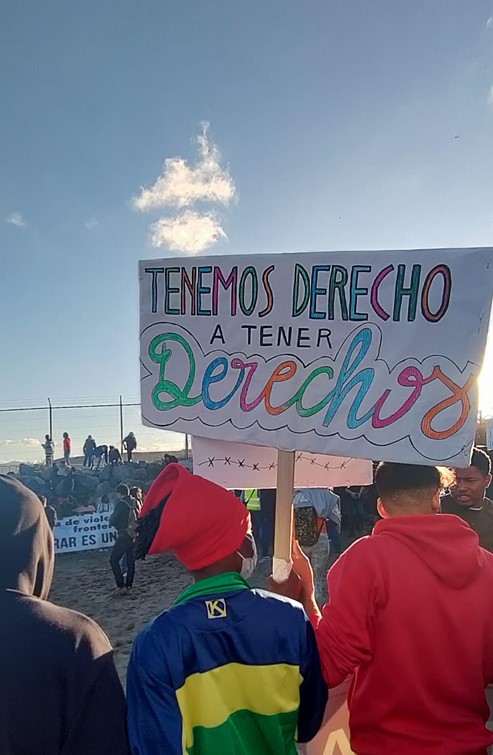
“Tenemos derecho a tener derechos” (We have the right to have rights). Photo taken by the author at the March for Dignity Continue reading →


 Rural Sociology Wageningen University