
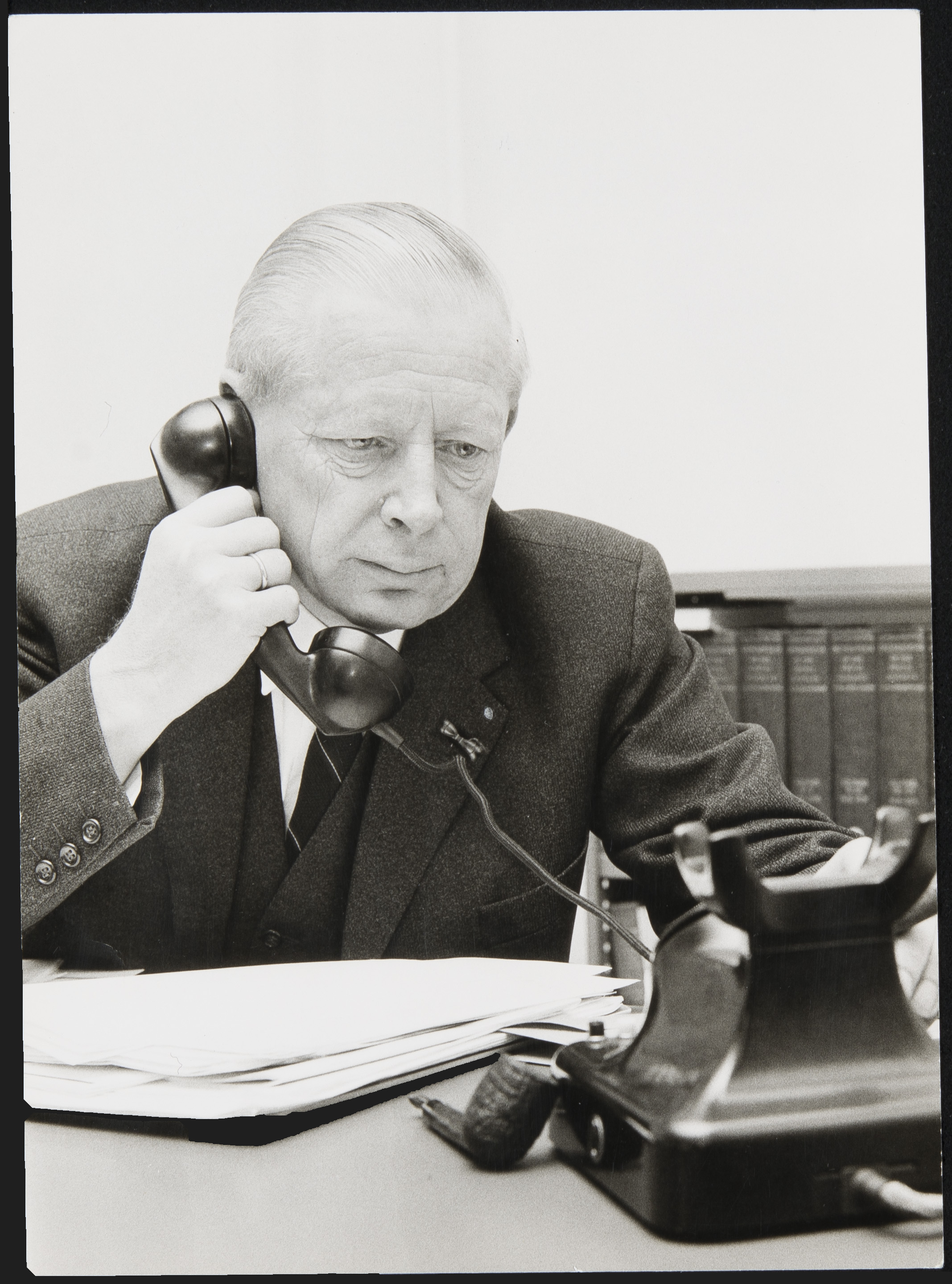
 This is a picture of Professor Hofstee. It is clearly an old picture: it is black and white (no filter!), and the clothing looks rather outdated and overly formal. But what also stands out is the phone. I wonder whether he was really making a phone call here, or whether this was staged for the picture. In any case, this bakelite phone (‘bakeliet’, have you ever used the word for something else than a phone?) made me wonder how technology has changed over the last 75 years. How differently we must be writing, teaching, researching, reading, searching for literature than the generations before us! Many of us will have cursed our computers or have been annoyed with having to use yet another digital tool, but for sure technology has made our lives easier in several ways. I can’t imagine having to do my work without email, or having had to type or even handwrite (!) my PhD thesis. Continue reading
Category Archives: Education
75th Anniversary: 1) an introduction to a year of celebration events and activities (updated)
 In September 1946 Evert Willem Hofstee, the founding father of Rural Sociology at Wageningen University, started as Professor and Chair of Social and Economic Geography and Social Statistics.
In the years that followed, the department was reorganized and renamed (e.g. Agrarian Sociology of Western Areas; Sociology) several times, with Rural Sociology being the official name since the late 1990s. Hofstee was also one of the founders and the first President of the European Society for Rural Sociology.
The Rural Sociology Group of Wageningen University will celebrate its 75th Anniversary on the 13th of May 2022. On that day we will organize an international conference at which we will present, discuss and reflect upon the past, present and future of rural sociology in an interactive setting. And we will, of course, also have a party in the evening of the 13th of May 2022 to celebrate 75 years of rural sociology at Wageningen University with current and former staff members, PhD students and graduates, former and current students and colleagues with whom we collaborated in national and international research projects. So SAVE THE DATE if you want participate in our conference and join our party. More details about the conference program will be published on this website soon!
The conference and party will not be the only activity that we will organize to celebrate our 75th anniversary. Starting today, we will arrange a variety of events, activities and outputs leading up to our main festivity on May 13, 2022.
- A weekly blog (on this website) about the past, present or future of Rural Sociology. This may be about a specific theory, a research project, an event, or something else;
- A seminar series (online or blended) with agrarian, rural and food sociologists from other universities;
- A series of rural field trips in the Netherlands, visiting, for example, rural sociology graduates that have become farmers;
- A PhD Day with and for PhD graduates and PhD candidates and a PhD Magazine with an overview of all PhD graduates, their PhD thesis and career after completion of their PhD thesis;
- An anniversary book about the past, present and future of Rural Sociology in Wageningen.
We are looking forward to a year of celebration activities and events and hope many of our (former) colleagues and students will do so too. And we hope to welcome you at our celebratory event on the 13th of May 2022. So stay tuned to this blog and get to know more about the past, present and future of Rural Sociology in Wageningen in the forthcoming 12 months.
Update (July 8, 2021): due to COVID-19, the celebratory event is postponed from October 24, 2021 to May 13, 2022
Register now for RSO55306 – A Global Sense of Place: Place-based approaches to development | Period 5

In the face of urgent environmental and societal challenges, how do we move towards inclusive futures? What is the role of people in places? And what can be our role as (social) scientists?
In this course, we explore inclusive place-based approaches to development. We analyse how change happens from below and how people take matters in their own hands, shaping the places they live in according to their own needs and values. A relational perspective allows us to see the interdependence between the local and the global, the urban and the rural and the individual and the collective.
Besides engaging with key theories and analysing topical cases, we reflect upon our own role as (social) scientists and explore the tools and methodologies we need in place-based research, specifically focusing on participatory and creative methods.
This advanced MSc course is relevant for all students (including PhD candidates) with an interest in inclusive development, that seek theoretical as well as methodological guidance. The course can help students prepare an MSc thesis proposal and is supported by lecturers from all chair groups involved in the Centre for Space, Place and Society (RSO, SDC, HSO and GEO)
For more information, contact anke.devrieze@wur.nl.
Thesis skills – an online RSO support system for thesis students
Ever wonder how to write the perfect research question?
Problems in building raport with your respondents in the field?
Never really quite sure what operationalisation of concepts means?
Is a thesis stressing you out?
RSO has just designed an online learning environment on Brightspace called Thesis Skills. Thesis Skills is an innovative platform that is 100% online and 100% based on your needs.
The aim of this digital thesis environment is to give you tools to assist you in the thesis writing process. We have divided this process into topics such as planning, proposal writing, literature review, in the field and after the field, writing, etc. For each of these we have created a module containing information, exercises and self-tests. You do not have to take all modules, but can select the ones most appropriate for you. Mini-tests help you select these. The digital thesis environment also contains peer support discussion fora to discuss difficulties with other students, and exchange tips and tricks.
All master thesis students (already busy with their thesis or planning to start) of RSO are invited to register for this online education platform. You can do this by sending an email to Jessica de Koning (jessica.dekoning@wur.nl)
De weg naar duurzame pachtafspraken tussen boer en gemeente: uitkomst ACT-opdracht
Image
 Door Amarins Bouman, Jurrian Veldhuizen, Henry Abbink, Robin Kampert, Ester Klein Hesselink en Floor Sluijter. Studenten van Wageningen Universiteit die als onderdeel van hun Master opleiding een Academic Consultancy Training (ACT) opdracht hebben uitgevoerd.
De afgelopen twee maanden hebben wij onderzoek gedaan in het kader van het Wetenschapswinkel project ‘Boeren zonder land: hoe is dat mogelijk?’ in opdracht van Vereniging Toekomstboeren. Met 6 studenten van verschillende achtergronden (consumentenwetenschappen, bos-en natuurbeheer, international development & biologische landbouw) zijn wij aan de slag gegaan met het onderzoeken van alternatieve pachtconstructies. Binnen dit onderzoek is er gekozen voor de gemeente als landeigenaar, waarna er 3 verschillende boeren & gemeenten zijn geïnterviewd. Het onderzoek richtte zich op de sterke en zwakke punten van de pacht- en huurovereenkomsten en hoe deze de (on)zekerheid van duurzame boeren beïnvloeden. Dit is visueel weergegeven in bovenstaande figuur.
Boeren worden in de overeenkomsten met de gemeente vaak geconfronteerd met onzekerheden die verband houden met de duur van hun overeenkomsten en de duurzaamheidsaspecten. Er is vaak geen visie en/of beleid vanuit de gemeente op het gebied van het faciliteren van (duurzame) landbouw. Dit leidt tot de onzekerheidsproblematiek zoals korte contracten en beperkte mogelijkheden tot investeringen voor de lange termijn, zoals die in een goede bodem. Echter blijken de gemeenten en duurzame boeren elkaar te vinden in de waarde die de onderlinge afspraken kunnen hebben voor de lokale gemeenschap. Naast de agrarische functie kan een boerderij in de stad ook van grote maatschappelijke waarde zijn.
Op basis van onze bevindingen moedigen we boeren en gemeenten aan om meer te weten te komen over elkaars behoeften en hoe de pachtovereenkomst in ieders voordeel kan werken. Zie de Infosheet hieronder. In ons rapport kunt u hier meer over lezen.
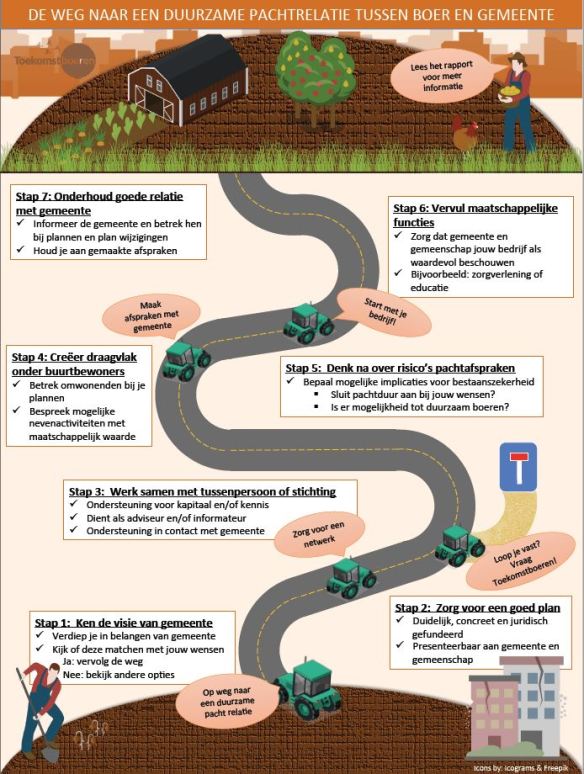
Infosheet: ‘De weg naar een duurzame pachtovereenkomst tussen boer en gemeente’.
 Rural Sociology Wageningen University